June 16, 2026
How to Choose a Chandelier for Your Dining Room: A Considered Guide

A dining room chandelier isn't a status symbol; it's a tool for defining how a room feels and functions. If you've ever sat under a light that felt like a looming cloud or a tiny, distant star, you know that scale matters. Knowing how to choose a chandelier for dining room setups requires more than just an eye for style. It's about building a space that works as hard as you do, whether you're hosting a late dinner or spreading out a project on the table at 6 AM.
It's easy to feel stuck between rigid hanging rules and the fear of buying a fixture that looks out of place. Most of us just want a room that feels intentional and works for the way we actually live. This guide provides a clear formula for sizing and installation, giving you the confidence to equip your space with a light that earns its place. We'll walk through the measurements and light quality standards you need to build a dining area you'll choose to come back to.
Key Takeaways
- Learn the simple math for sizing a fixture that fits your room and table without overwhelming the space.
- Discover how to choose a chandelier for dining room environments that must function as both a workspace and an eating area.
- Understand how to evaluate visual weight so your light feels intentional and earns its place in the room.
- Identify the technical additions, like dimmers and specific color temperatures, that make a single room work for different times of day.
- Get a clear formula for hanging height to ensure your lighting is effective for work and comfortable for dinner.
Measuring for Scale: The Math of Proportional Lighting
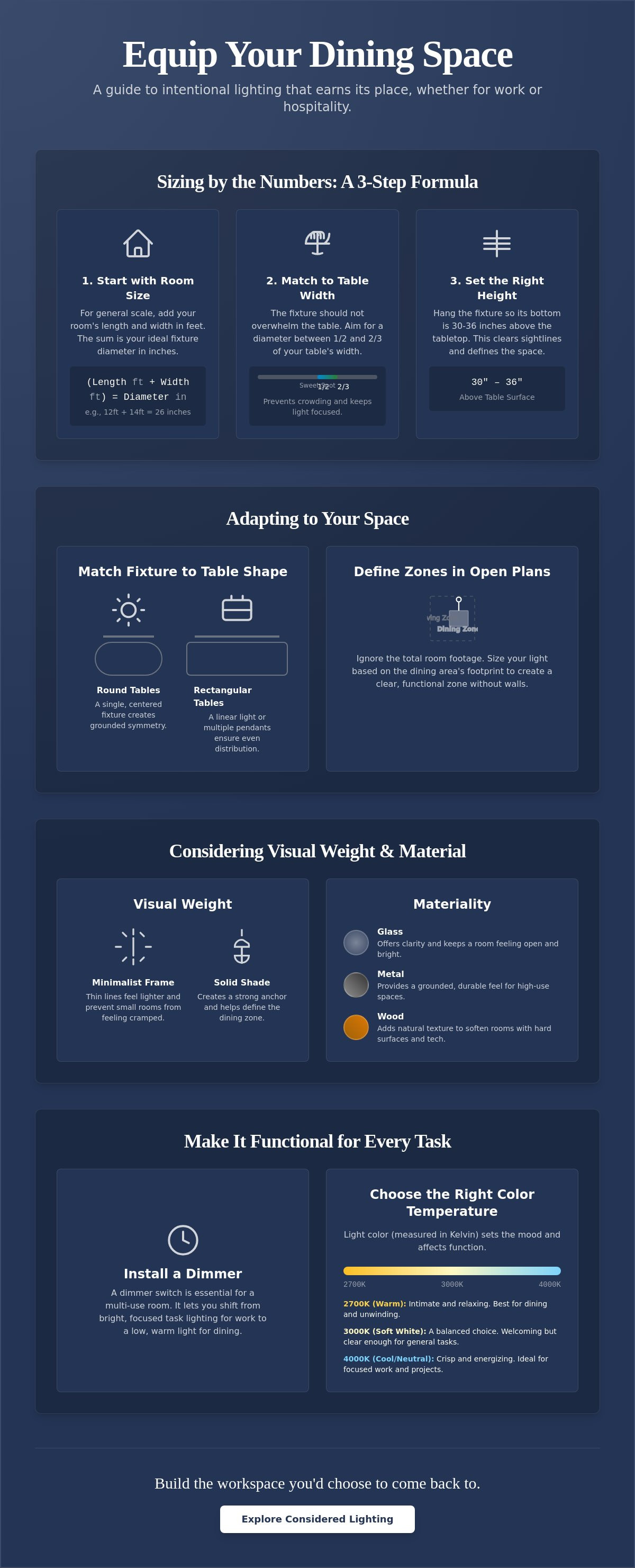
Proportions aren't just for decorators; they're for anyone building a room that feels right. If the scale is off, the room feels off. To understand what is a chandelier in a functional sense, you have to treat it as the anchor of the space. A simple way to find the right diameter is to add the length and width of your room in feet. If your room is 12 by 14 feet, the sum is 26. This means a 26 inch diameter fixture is your starting point.
The room size is only half the story. Because the light lives above the table, the furniture dictates the final choice. This is the most practical part of learning how to choose a chandelier for dining room setups. You want a fixture that measures between one-half and two-thirds the width of your dining surface. This keeps the light focused on the work or the meal without the edges of the fixture feeling like they're crowding the people sitting there.
Because the furniture is the foundation of the room, many homeowners find that visiting a modern furniture store San Diego helps them select tables and chairs that perfectly complement the scale and style of their chosen chandelier.
To better understand this concept, watch this helpful video:
Verticality is the next metric. For every foot of ceiling height, allow for 2.5 to 3 inches of fixture height. If you have an eight foot ceiling, a 20 to 24 inch tall light keeps the room balanced. Once you have the fixture, hang it so the bottom sits 30 to 36 inches above the tabletop. This height is high enough to keep sightlines clear for conversation but low enough to make the light feel intimate and intentional.
Sizing for Round vs. Rectangular Tables
Geometry dictates the flow. For round tables, stick to a centered circular fixture that mimics the table shape. It creates a sense of symmetry that feels grounded. For long rectangular tables, a single round light often looks like an afterthought. Consider a linear chandelier or a pair of smaller pendants to distribute light evenly across the entire surface. You can find options for both in our ceiling lights collection.
The Rule of Thirds for Open Floor Plans
Knowing how to choose a chandelier for dining room zones in an open floor plan is about creating boundaries without walls. If your dining area is part of a larger room, ignore the total square footage of the house. Size the light based on the specific dining zone you've created. Ensure the light doesn't compete with other lighting fixtures in the immediate vicinity. Each light should have its own job to do.
Selecting a Style That Earns Its Place
Style is often framed as a matter of taste; however, when you are building a room that functions as both a dining area and a secondary workspace, style is a matter of utility. A fixture shouldn't just look good. It has to earn its place by supporting the activities that happen beneath it. When considering how to choose a chandelier for dining room environments, start with the material. Glass offers clarity and keeps a room feeling open. Metal provides a grounded, permanent feel. Wood adds a natural texture that can soften a room filled with tech and screens.
Visual weight is equally important. A minimalist frame with thin lines feels lighter in a small room, preventing the space from feeling cramped. Conversely, a solid drum shade creates a strong focal point and can help define the "dining zone" in an open floor plan. If you are looking for more pro tips for choosing a chandelier, remember that the goal is balance. The light should complement your existing decor without dominating the entire visual field.
Modern Minimalism vs. Industrial Function
Clean lines and exposed bulbs are more than a trend; they are tools for keeping a space streamlined and organized. These designs work well if you prefer a clutter-free environment for deep work. Industrial styles, often featuring heavier metal accents, provide a sense of durability. They feel permanent and steady, which is ideal for high-use rooms where the table serves as a project hub.
Balancing Work and Hospitality
Many guides on how to choose a chandelier for dining room setups ignore the fact that the table often doubles as a desk. If you spend hours at the table with a laptop, choose a light that provides enough downward task lighting. Avoid overly ornate designs that cast heavy, distracting shadows across your workspace. The room should feel approachable and functional, not like a museum. If you need help finding a fixture that balances these needs, you can always reach out to our team for a second opinion on your layout.
Technical Details for a Functional Room
The technical side of lighting is where a room's utility is won or lost. Once you've handled the scale and style, the final step is ensuring the light actually performs. Knowing how to choose a chandelier for dining room setups involves looking beyond the aesthetic and checking the specs. This is about making the room work for your specific needs every day, from the first cup of coffee to the final email.
A dimmer switch is the most important tool for a multi-use room. It allows you to shift the atmosphere instantly. You need bright light for morning focus on a project, but you want a soft glow for evening meals. This transition helps the room feel like a workspace when you need it and a home when you don't. Without a dimmer, you're stuck with a single mood that rarely fits every hour of the day.
Color quality matters for both work and hospitality. Aim for a color temperature between 2700K and 3000K. This range provides an inviting glow that remains bright enough for focus. Additionally, check the Color Rendering Index (CRI). A CRI of 90 or higher ensures that the colors of your food and materials look accurate. Lower CRI bulbs can make a space feel muddy or artificial, which is frustrating in a room where you spend serious hours.
The Importance of Dimmable Lighting
Control over your environment is a requirement for productivity. High-output light helps you stay alert and focused during the day. When the work is done, dimming the chandelier signals a shift in mindset, helping you wind down. Always verify that your chosen fixture is compatible with standard dimming hardware to avoid technical frustrations like flickering or buzzing.
Bulb Choice and Energy Efficiency
- Use LED bulbs: They keep the room cool during long hours at the table and are the standard for efficiency as of 2026.
- Choose frosted bulbs: If your fixture has exposed light sources, frosted bulbs help reduce glare on screens and tabletops.
- Plan for maintenance: Ensure the fixture is easy to dust and that bulbs are accessible for replacement without a complex teardown.
Equip your space with workspace essentials that complement your lighting setup. A well-considered room is built from small objects that earn their place. By focusing on these technical details, you ensure your dining room remains a functional environment that you'll choose to come back to, day after day.
Build a Room for the Work and the Rest
Choosing the right light is about more than aesthetics; it's about intentionality. By following the math of proportional lighting and selecting materials that support your daily tasks, you ensure your fixture earns its place. Understanding how to choose a chandelier for dining room setups allows you to transform a simple table into a functional zone for deep focus or a quiet evening meal. When you prioritize technical details like a high CRI and dimmable controls, you build an environment that adapts to your needs rather than forcing you to adapt to it.
We provide a refined selection of lighting and decor designed for the people who do the work. Every piece in our collection is a considered design, made to be part of a room that actually gets used. We also offer free shipping on orders over a set threshold to help you get your space ready. Build a room you choose to come back to with Ergovanta lighting. It's time to equip your space deliberately and enjoy the results of a room built just for you.
Frequently Asked Questions
How big should a chandelier be for a 60-inch round table?
A 60-inch round table requires a chandelier with a diameter between 30 and 40 inches. Staying within this range ensures the fixture is proportional to the surface without feeling like it's crowding the people sitting there. If you choose a minimalist design, you can aim for the larger end of that spectrum. For a solid or heavy fixture, sticking closer to 30 inches keeps the space balanced and intentional.
How high should I hang a chandelier if I have 10-foot ceilings?
For 10-foot ceilings, hang the bottom of the chandelier 36 to 42 inches above the tabletop. The standard rule is to start at 30 to 36 inches for an eight-foot ceiling and add three inches of height for every additional foot of ceiling. This adjustment prevents the fixture from feeling too low in a room with more vertical space; it keeps the light effective for the work you do at the table while maintaining clear sightlines.
Can I use a chandelier in a room that I also use as a home office?
You can absolutely use a chandelier in a room that doubles as a home office, provided it offers enough downward task lighting. When learning how to choose a chandelier for dining room spaces that serve as workspaces, look for designs that avoid casting heavy, distracting shadows. Pairing the fixture with a dimmer switch is essential. This allows you to have bright, focused light during your workday and a softer atmosphere once the work's finished.
What is the best color temperature for a dining room light?
The ideal color temperature for a dining room light falls between 2700K and 3000K. This range provides a warm, inviting glow that mimics natural light without feeling overly yellow or clinical. It's bright enough to help you stay focused on projects during the morning but soft enough to create a relaxed environment for dinner. Choosing bulbs with a high Color Rendering Index (CRI) of 90 or above will also ensure colors look accurate in your space.
From the catalog