June 21, 2026
Minimalist Home Office Lighting Ideas: Building a Workspace for Focus

Most people treat lighting as an afterthought: they buy a desk and a chair, then wonder why they have a headache by 3:00 PM. The workspace shapes the work. If you spend serious hours at a desk, the room around it matters more than you think. Squinting at a screen through glare or struggling through late-night sessions in a dim corner isn't just annoying; it is physically draining. Your environment should support your output, not work against it.
Finding the right minimalist home office lighting ideas isn't about decorating a room. It is about building an environment that allows you to focus without distraction. You deserve a space that feels considered and made for the work you actually do. We will show you how to equip your workspace with intentional lighting that reduces eye strain and supports deep work. We will cover how to layer your light sources, why aiming for 300 to 500 lux is the standard for focus, and how to choose objects that earn their place on your desk without adding clutter. By the end, you'll have a clear plan to build a room you actually want to come back to every morning.
Key Takeaways
- Treat lighting as a tool rather than a decoration. Understand how purposeful function in your environment directly impacts your daily focus and energy.
- Implement minimalist home office lighting ideas by layering task, ambient, and accent lights to eliminate eye strain and distracting screen glare.
- Equip your desk deliberately with small objects that earn their place, ensuring your setup remains clean and highly functional for deep work.
- Evaluate fixtures based on the work you actually do, choosing considered materials and intentional designs that support long hours at the desk.
- Shift from temporary fixes to a setup of equipment you own, building a workspace you will choose to come back to every morning.
Light as a Tool: Why Your Workspace Lighting Matters
The workspace shapes the work. Equip it deliberately. If you spend serious hours at a desk, the room around it matters more than you think. Most desk setups fail because they treat lighting as an afterthought or a decorative flourish. True minimalist home office lighting ideas start with the understanding that light is a tool. It is a piece of equipment, no different than your monitor or your keyboard. When you can’t see clearly, you can’t think clearly.
At Ergovanta, we look at the etymology of our name to guide how we build. "Ergo" comes from the Ancient Greek for purposeful function in action. When your space is lit with intentionality, you remove the friction of starting a task. You stop fighting your environment and start doing the work. Better visibility isn't about sheer brightness; it is about clarity and focus. It is about creating a space that works for you.
To better understand how to layer your setup for maximum focus, watch this breakdown of a productive desk arrangement:
The Physical Impact of Poor Light
Poor lighting is a quiet drain on your energy. If you find yourself hitting a slump by mid-afternoon, the culprit might be eye fatigue caused by inadequate task lighting. When the light is wrong, you lean in. You hunch. You squint. This relationship between screen glare and posture is why many people struggle to stay in their seats for deep work. By using considered lighting equipment, you reduce the physical strain that leads to burnout. You build a space where you can actually sit and do the work comfortably.
Light That Earns Its Place
Minimalist lighting is often misunderstood as having fewer fixtures. In reality, it is about having better light that earns its place on your desk. It means moving beyond clinical, flickering overheads toward a setup that feels like it belongs in your space. This is where you find the "Vanta" advantage: the coined word for the edge you gain when your environment is optimized for your output. When your workspace is equipped with intentionality, it provides a cognitive edge. It allows you to stay in the zone longer because your eyes and mind aren't fighting the room. This is lighting for the people who do the work.
Three Minimalist Lighting Ideas to Equip Your Desk
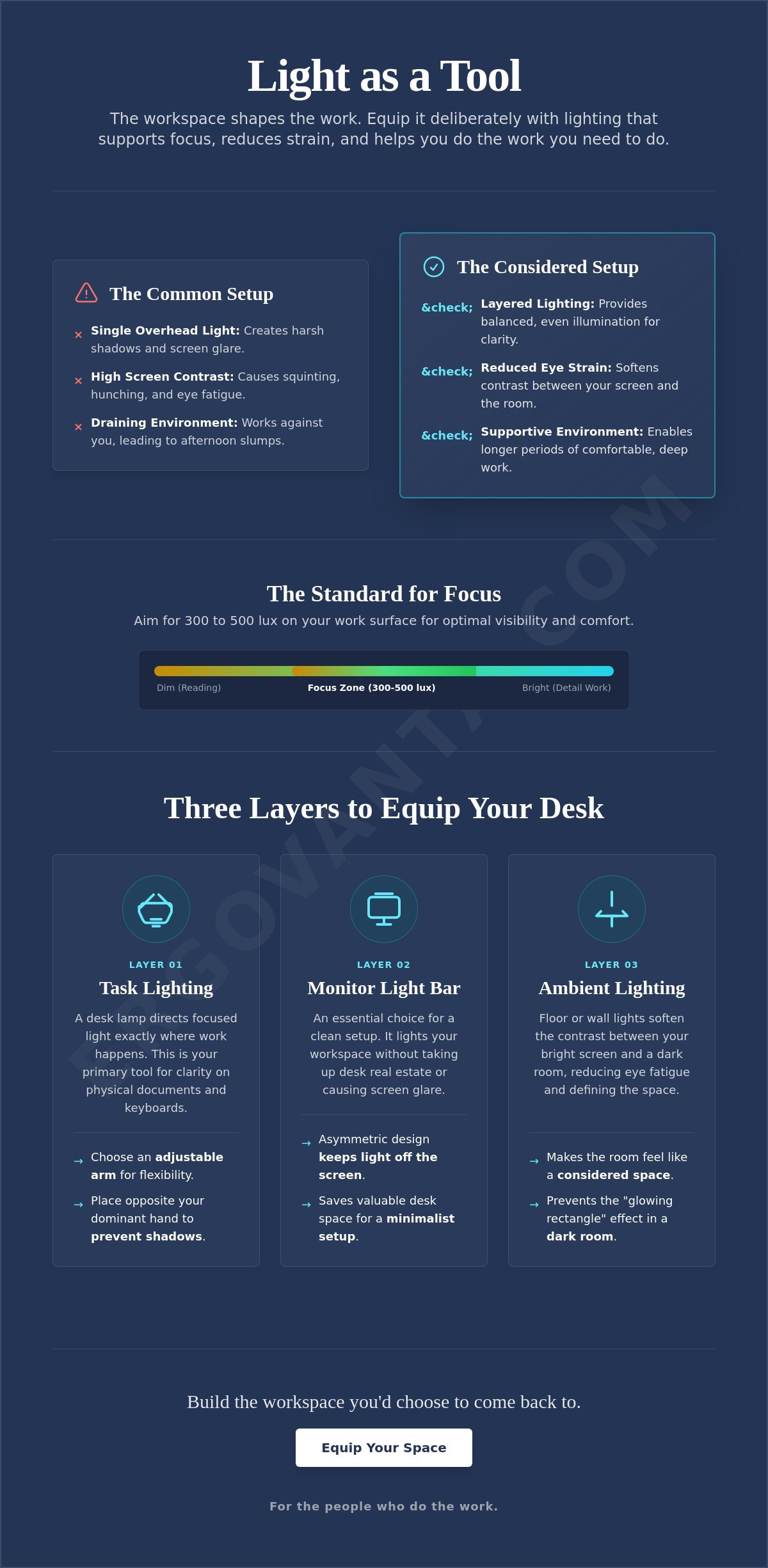
Equip your desk deliberately. A single bulb hanging from the ceiling isn't a setup; it's a compromise. To build a workspace that supports deep work, you must layer your light. Incorporating effective minimalist home office lighting ideas means giving every fixture a specific job. While natural light is a great starting point during the day, it fails anyone who works late or on overcast afternoons. You need a structured framework to maintain focus and visibility when the sun goes down.
Task Lighting for Focused Execution
The primary tool for any desk is desk lamps. These are designed to direct light exactly where the work happens. When selecting equipment, choose adjustable arms. Flexibility is a requirement, not a decorative choice. You need to be able to pivot the source to avoid glare on physical documents or your keyboard. To meet ergonomic lighting standards, place the lamp on the opposite side of your dominant hand. This simple move prevents your writing hand from casting shadows across your workspace.
Monitor Light Bars for Space-Saving Efficiency
If your desk is crowded, a monitor light bar is an essential choice. These equip your screen with visibility without taking up any desk real estate. They use the science of asymmetric optical design to project light downward onto your workspace while keeping it off the monitor surface. This reduces the reflection that causes eye strain for people who spend serious hours at a desk. It's a considered solution for those who want a clean aesthetic and high-performance equipment.
Ambient Lighting to Define the Room
Focus is hard to maintain in a dark room with a glowing screen. When exploring minimalist home office lighting ideas, consider using floor lighting to soften the contrast between your monitor and the surrounding walls. This ambient layer defines the room and makes it feel like a space you actually want to use. Wall lights are another considered way to reclaim space while maintaining a warm atmosphere. The goal is a balanced environment where every piece of equipment earns its place. If you need help selecting fixtures for your specific layout, you can reach out to our team for guidance.
Selecting Lighting That Earns Its Place
The workspace shapes the work. Equip it deliberately. When vetting minimalist home office lighting ideas, look for materials that last. Metal, glass, and high-quality polymers are the difference between temporary fixes and considered equipment. A light that looks good but flickers or casts harsh shadows is just another distraction. You need tools that earn their place by supporting your focus for years, not just weeks. Evaluate every fixture based on the work you actually do; if a light doesn't improve your visibility or your mood, it doesn't belong on your desk.
Color Temperature and Intentionality
Color temperature is a tool for intentionality. Use 4000K neutral white light during your peak execution hours. This cooler, blue-toned light signals to the brain that it is time for deep work and high energy. As the day ends, transition to 2700K warm light for the ritual of winding down. This shift helps your space evolve from a place of high output to a room where you can actually relax. Dimmable options are a non-negotiable requirement for any multi-use home office; they allow you to adjust the atmosphere to match the intensity of the task at hand.
Integrating Lighting into Your Workspace Essentials
Your lighting should work in harmony with your other tools. This means paying attention to cable management. A cluttered desk is a distracted mind; hide power cords behind monitor stands or under desk shelves to keep your minimalist aesthetic clean. Consider how a desk lamp interacts with your laptop stand or monitor arm to ensure no shadows are cast across your primary work zone. Before adding any new fixture, perform a final check: does this light help you do the work, or is it just taking up space? Only the objects that provide a clear advantage should remain.
Build the workspace you would choose to come back to every morning. When every object is intentional and every light source has a job, the room itself becomes a catalyst for your best output. Equip your space for the long haul. For the people who do the work, the room around the desk is just as important as the desk itself.
Build a Workspace for the Long Haul
The workspace shapes the work. Equip it deliberately. Lighting isn't just about avoiding a dark room; it's about building a space where you can actually think. We have covered how to layer task and ambient sources to reduce strain and why specific color temperatures signal your brain to either focus or rest. These minimalist home office lighting ideas are meant to help you move beyond temporary fixes and toward a setup of equipment that earns its place on your desk.
At Ergovanta, we believe in functional tools that earn their place. Our curated collection of minimalist essentials is designed for people who do the work. When your environment feels considered and intentional, the friction of starting your day disappears. You deserve a room that gets used because it was made for the work you actually do. There is no reason to settle for a setup that leaves you drained by mid-afternoon.
If you're ready to stop fighting your desk environment, we can help you find the right pieces for your specific layout. Equip your workspace with considered lighting and build a room you will choose to come back to every morning. Your best work is waiting for the right light.
Common Questions About Workspace Lighting
What is the best type of light for a home office with no windows?
The best approach for a windowless room is a layered setup that mimics the depth of natural daylight. You need high CRI (Color Rendering Index) bulbs, ideally 90 or above, to ensure colors look vibrant rather than flat or gray. Use floor lamps to bounce light off the ceiling and walls. This ambient layer prevents the room from feeling like a cave. When exploring minimalist home office lighting ideas for dark spaces, focus on creating depth through multiple sources rather than one harsh overhead light.
How do I stop my desk lamp from reflecting off my computer screen?
To stop reflections, move your lamp to the side of your monitor rather than placing it directly in front or behind your seating position. Use a lamp with an adjustable arm to direct the beam strictly onto your desk surface. If you see a bright spot on your screen, angle the head of the lamp downward. Keeping the light source below your eye level also helps prevent direct glare from hitting your pupils while you do the work.
Is a monitor light bar better than a traditional desk lamp?
A monitor light bar is superior for reclaiming desk real estate, but a traditional lamp offers more directional versatility. Light bars use an asymmetric optical design to illuminate your workspace while keeping light off the screen surface. This makes them an essential choice for small or crowded desks. However, if your work involves sketching or physical paperwork, a desk lamp with a flexible arm provides better control. Many people choose to equip their space with both to handle different tasks throughout the day.
What color light is best for working on a computer all day?
Neutral white light around 4000K is the standard choice for all-day focus. It provides enough clarity to keep you alert without the clinical harshness of higher-temperature daylight bulbs. If your work continues into the evening, use dimmable bulbs or tunable LEDs. Transitioning to warmer tones like 2700K as the sun sets helps signal to your brain that it's time to wind down. This intentional shift protects your sleep cycle after spending serious hours at a desk.
From the catalog