July 2, 2026
Office Wall Lighting Ideas: Build a Workspace That Works for You

Your desk isn't a storage unit for lamps. If you're fighting for every square inch of surface area, the problem isn't the size of your desk; it's where you've put your light. Most people settle for harsh overhead glare or a bulky lamp that eats up space and tangles cords. It's an easy trap to fall into, but it makes your workspace feel smaller and more chaotic than it needs to be.
The room around your desk matters more than you think. By exploring intentional office wall lighting ideas, you can reclaim your desk surface and build a workspace that actually supports the way you work. Intentional lighting helps you define your focus zone without a single cord getting in your way. We'll show you how to use wall-mounted solutions to eliminate eye strain, clear the clutter, and equip a space that stays out of your way so you can do the work. Discover how to choose fixtures that earn their place on your walls while keeping your desk clear for the tools that actually matter.
Key Takeaways
- Reclaim your desk surface by moving your light source to the wall, leaving more room for the objects that actually earn their place.
- Equip your space with swing-arm sconces to get adjustable task lighting that stays out of the way of your hands.
- Learn how specific office wall lighting ideas, such as picture lights, can turn your walls into functional reference zones for notes and calendars.
- Choose the right installation method for your current setup and use cord management to ensure your new light doesn't add visual clutter.
Why wall lighting earns its place in your workspace
The workspace shapes the work. If you spend serious hours at a desk, the environment around it dictates your output. Every object on your desk should earn its keep, yet most people settle for lighting that takes up more space than it provides value. A lamp is a necessity, but the physical footprint of a traditional base is often wasted territory. When you explore office wall lighting ideas, you're making a deliberate choice to clear the path for your actual work.
Reclaiming your desk surface
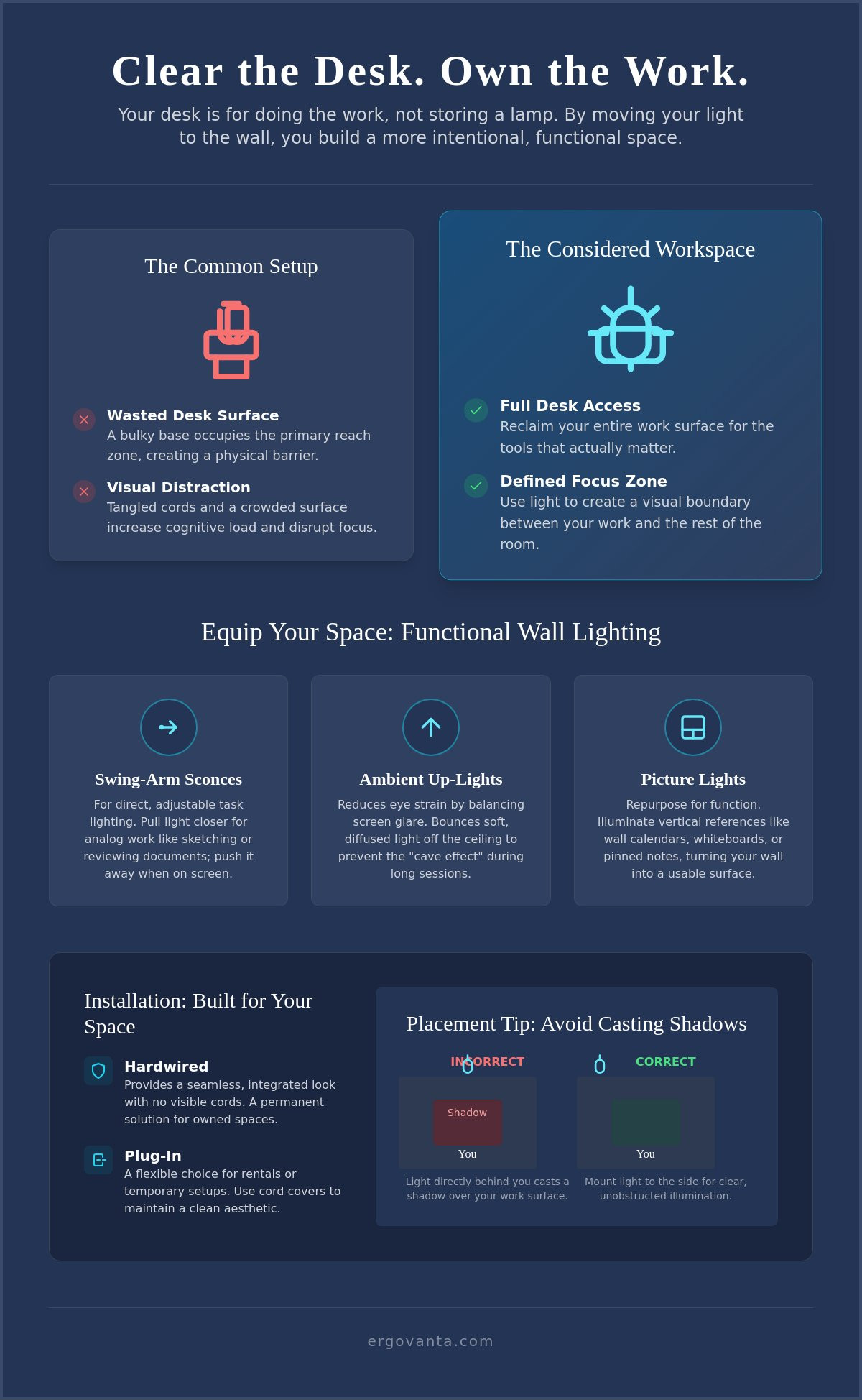
A standard desk lamp occupies a significant portion of your primary reach zone. It creates a physical barrier and adds to the visual clutter of tangled cords. By mounting your light to the wall, you eliminate that footprint entirely. This reduction in visual noise lowers your cognitive load, allowing you to focus on the task rather than the mess. It's a foundational step when you equip your workspace essentials. You aren't just decorating; you're optimizing the room for purposeful utility.
Defining the work zone
Many of us work in rooms that serve two or three purposes. Your office might be a guest room or a corner of the living room. Wall lighting acts as a visual anchor that defines the boundary where "home life" ends and "work life" begins. Using specific task lighting directed at your desk signals to your brain that it's time to shift into a different mode. It creates a dedicated zone for focus that exists even when the rest of the room is in shadow.
Choosing considered lighting is about building a space you actually choose to come back to. It's about more than just seeing your keyboard; it's about how the room feels when you sit down to start. These office wall lighting ideas help you build a workspace that feels separate and intentional. When the lighting is made for the work, the room works with you, rather than getting in your way.
Functional office wall lighting ideas to equip your space
Equipping your space requires tools that adapt to your workflow. Generic fixtures might brighten a room, but they rarely solve the problems of a working day. When considering office wall lighting ideas, look for functionality that matches your specific tasks. The goal is to build a setup that supports your focus without requiring constant adjustment.
Swing-arm sconces for task focus
The swing-arm sconce is the most versatile tool in the room. It allows you to physically move the light source based on what you're doing. Pull it closer for analog tasks like sketching or reviewing hard-copy documents; push it back against the wall when you're focused on your screen. This flexibility ensures you always have light where you need it without sacrificing desk space. You can find several functional options in our wall lights collection that are designed specifically for this kind of purposeful movement.
Ambient wall lighting for the long haul
Serious hours at a desk require more than just a single bright spot. Relying solely on a monitor or one task light creates a "cave effect" that leads to significant eye strain. Up-lighting sconces are an effective way to soften the room. By bouncing light off the wall and ceiling, you create a layer of diffused ambient light that balances the harsh glow of your screen. This layering is essential for maintaining comfort during long sessions.
Consider repurposing picture lights as well. While often used for art, they are excellent for illuminating vertical references like wall calendars or pinned notes. Proper placement is also critical. To avoid casting shadows over your keyboard or notepad, mount lights slightly to the side of your primary seating position rather than directly behind you. If you're unsure which configuration fits your specific layout, feel free to reach out to our team for guidance on building a setup that works for you.
How to install and layer wall lighting for the long haul
The workspace shapes the work. Equip it deliberately. Choosing between a hardwired fixture and a plug-in model depends entirely on your relationship with your space. If you own your room, hardwiring provides a seamless, integrated look that clears the wall of all distractions. However, many who do the work are in temporary or shared environments where drilling into the electrical system isn't an option. For these flexible spaces, plug-in office wall lighting ideas offer the same functional benefits without a permanent commitment.
Plug-in solutions for flexible spaces
A plug-in sconce is a practical tool for anyone building a workspace in a rental. The challenge is ensuring the cord doesn't become the very clutter you're trying to avoid. Use cord covers that match your wall color or route cables behind furniture to keep the look considered. When you manage the wires effectively, you maintain the organizational win of a clear desk surface without the mess of hanging cables. It's about making the light source look like it belongs there, rather than looking like an afterthought.
Equipping the room for the work
Your lighting must work in tandem with your other tools. When you combine wall-mounted fixtures with monitor stands, you build a complete ergonomic environment that respects your physical comfort. This setup prevents your screen from blocking your light source. It ensures your task area remains bright and usable throughout the day. Selecting materials like matte metals or durable finishes ensures your lighting can handle the intensity of daily use.
Ultimately, these office wall lighting ideas are about more than just aesthetics. They are about building a room that gets used and stays functional over the long haul. Choose fixtures that feel made for the work, not just for the look. When every object earns its place, you build a workspace you'd choose to come back to. This is for the people who do the work.
Equip your workspace for intentional focus
The workspace shapes the work. Equip it deliberately. By moving your light source to the wall, you've done more than just clear a desk; you've built a room that works with you. These office wall lighting ideas are about finding the right tools for your specific workflow. Whether you choose the flexibility of a swing-arm sconce or the permanent clarity of a hardwired installation, you are prioritizing the environment where you spend your most serious hours. Every object must earn its place, and your lighting is no exception.
At Ergovanta, we are driven by "Ergo," or purposeful function in action. We want to give you the "Vanta," your competitive advantage, through a workspace that feels like yours. Our tools are made for the people who do the work. When your lighting is considered and your desk is clear, you can focus on the tasks that actually matter. It's time to stop fighting your room and start building the one you choose to come back to.
Equip your space with intentional wall lighting and reclaim your focus today.
Common Questions About Office Wall Lighting
How high should I mount wall lights in my office?
Mount task-oriented wall lights so the bottom of the shade sits roughly at eye level while you're seated at your desk. For most setups, this means placing the fixture between 15 and 20 inches above the desk surface. If you're installing ambient up-lighting to soften the room, aim for a higher placement around 60 to 66 inches from the floor. This allows the light to diffuse naturally across the ceiling without creating distracting hotspots in your peripheral vision.
Do wall lights provide enough light for reading and writing?
Yes, wall lights are excellent for reading and writing as long as you choose a model with an adjustable arm. These office wall lighting ideas work best when you can pull the light source directly over your documents to eliminate shadows. Ensure your bulb provides between 450 and 800 lumens to maintain clarity during deep work. An adjustable sconce gives you the flexibility to move the light exactly where it's needed for analog tasks and push it away when you're back to digital work.
Can I use wall lights if I rent my office space?
You can absolutely use wall lights in a rental by opting for plug-in versions. These fixtures offer the same functional benefits as hardwired models but only require a few small screws for mounting. When it's time to move, you can easily patch the holes and take your lighting with you. Use intentional cord routing or paintable cord covers to keep the wires organized against the wall, ensuring your "off the desk" setup stays clean and considered.
How do I avoid glare on my computer screen with wall lighting?
Position your lights to the side of your monitor rather than directly behind your seating position to prevent screen glare. Placing your office wall lighting ideas to the left or right of your primary field of vision minimizes reflections that cause eye strain. You should also look for fixtures with opaque shades or use frosted bulbs to soften the output. This creates a balanced layer of light that illuminates your workspace without bouncing off your screen and disrupting your focus.
From the catalog