May 31, 2026
Restaurant Outdoor Lighting Guide: Boost Your Curb Appeal

A 2024 survey found that 54% of people are more likely to choose a restaurant with outdoor seating. It’s a significant draw, but only if the environment feels intentional. Most restaurant outdoor lighting falls into one of two traps: it is either too dim for your team to work safely or so bright that guests feel like they are sitting under a parking lot floodlight. You likely recognize the frustration of buying fixtures that break after one season or watching a patio feel flat the moment night falls.
The goal is to build an outdoor room that guests choose to come back to. This guide shows you how to equip your space with lighting that defines the area and supports the actual work being done. We will look at how to balance functional task lighting with the warm, considered atmosphere that keeps tables full. From navigating 2026 energy codes to selecting durable, IP65-rated equipment that earns its place, you’ll learn to create a layout that works as hard as you do.
Key Takeaways
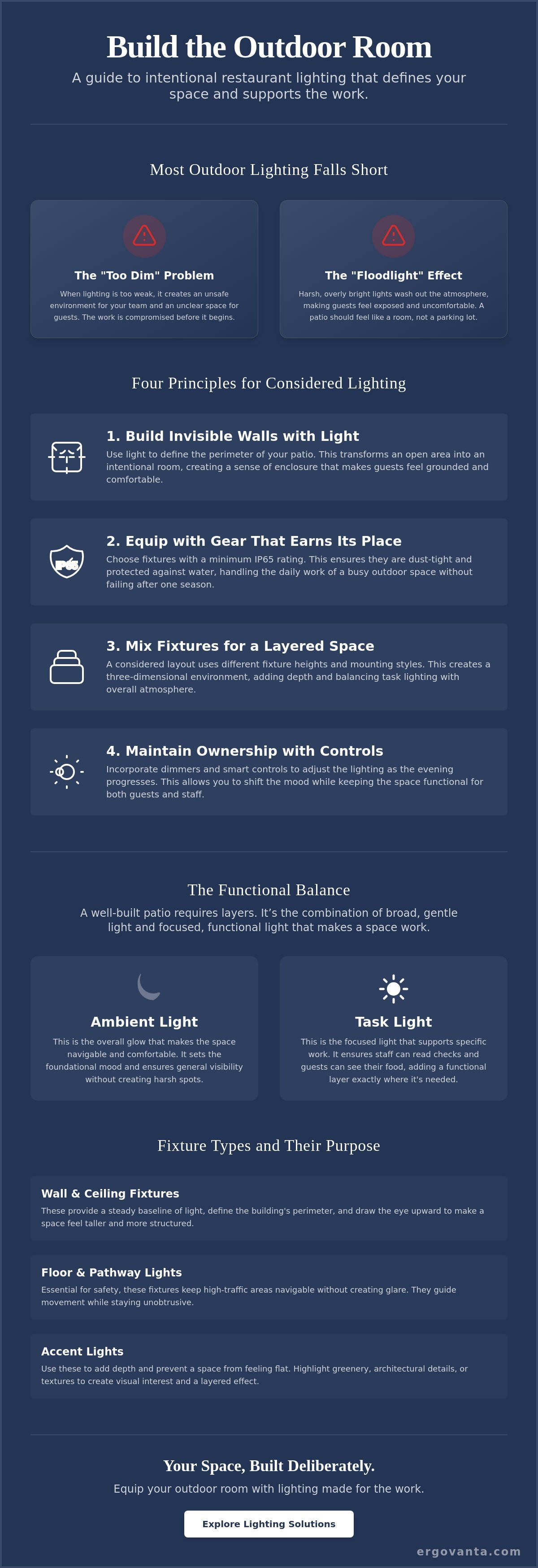
- Build invisible walls with light to define your patio as an intentional room. This transforms a basic outdoor area into a space guests actually choose to stay in.
- Equip your space with restaurant outdoor lighting that earns its place through high IP ratings and weather resistance. Only use equipment built to handle the daily work of a busy dining area.
- Mix fixture heights and mounting styles to create a three-dimensional environment. A considered layout balances the light your team needs to work with the atmosphere your guests expect.
- Maintain ownership of your environment by using dimmers and smart controls. These tools allow you to adjust the lighting as the night changes while keeping the space functional for everyone.
Defining the Outdoor Room: Why Intentional Lighting Matters
The workspace shapes the work. On a patio, that work includes everything from a server reading a ticket to a guest enjoying a meal. If you treat your exterior as a collection of tables under a floodlight, you aren't building a room; you're just lighting a parking lot. Proper restaurant outdoor lighting acts as the invisible walls of your patio. It defines where the space begins and ends, creating a sense of enclosure that makes guests feel grounded rather than exposed.
Intentionality is the difference between a space that feels like an afterthought and one that feels like a destination. When you equip your space with a considered layout, you prevent the light pollution that often bleeds into neighboring properties or washes out the night sky. Instead, the focus remains exactly where it should: on the table and the company. Modern Landscape lighting principles suggest that the best rooms aren't the brightest ones. They are the ones where light is placed with purpose.
To better understand how these elements come together, watch this helpful video:
Zoning Your Space with Light
Light is a structural tool. Use it to separate high-traffic pathways from quiet dining corners without needing physical dividers. Identify your focal points: the bar, the entrance, or a specific architectural feature. By highlighting these areas, you guide the guest's eye and movement naturally through the space. Don't be afraid of the dark. Shadows are necessary to create a sense of privacy and comfort. If everything is bright, nothing is special.
The Functional Balance of Task and Ambient Light
A well-built patio requires layers. Ambient light provides the overall glow that makes the space navigable. Task light ensures your staff can read checks and your guests can see their food. This balance is the core of effective restaurant outdoor lighting. Equip your area with layers so you can adjust intensity as the evening progresses. Using wall lights or lamps designed for the work allows you to shift the mood while maintaining the utility your team needs to function.
Equipping Your Space: Choosing Lights That Earn Their Place
Every object in your space should earn its place. In a high-traffic environment, durability is a requirement, not a bonus. You need restaurant outdoor lighting fixtures that handle the work daily without failing after one season. Focus on materials built for the elements: stainless steel, heavy-duty polycarbonate, and weather-sealed glass are the baseline. When you build a patio layout, remember that the environment around the table matters as much as the furniture itself. It is about creating a three-dimensional room where every light serves a specific function.
To ensure your equipment lasts, look for a minimum IP65 rating. This ensures your fixtures are dust-tight and protected against water from any direction. Choosing durable gear means you spend less time on maintenance and more time on the work that actually matters. It's about personal ownership of your space and ensuring every tool you install is intentional.
Wall and Ceiling Fixtures for Structural Support
Wall lights provide a steady baseline of light. They define the perimeter of your building and help guests understand the layout of the space. To add verticality, consider how ceiling lights or pendants draw the eye upward. This makes an outdoor area feel taller and more intentional. Choose designs that are considered and functional; they should look as good during the day as they do when the sun goes down. Following Energy-efficient outdoor lighting principles ensures your setup is effective without being wasteful.
The Role of Floor and Accent Lighting
Safety is non-negotiable. Floor lighting and pathway markers keep the space navigable without blinding your guests. While structural lights do the heavy lifting, accent pieces add the depth that makes a room feel finished. Use light to highlight greenery or the textures in your brickwork. This creates a layered effect that prevents the space from feeling flat. You can browse our full lighting collection to find pieces made for the work. If you have questions about specific layouts, feel free to reach out to our team for more information.
Implementation and Durability: Making the Work Last
The work doesn't stop when the sun goes down. If you want a patio that gets used year-round, durability must be your starting point. In the context of restaurant outdoor lighting, durability is a requirement, not a feature. You are looking for equipment that handles rain, wind, and the daily wear of a busy service. Equip your system with dimmers and smart controls to maintain personal ownership over the atmosphere. Intentionality means planning for the off-season. Choose fixtures that are easy to clean and maintain so the space remains functional regardless of the weather.
Building a patio guests want to return to requires a long-term view. Cheap fixtures that fail after one season are a distraction from the work. By selecting gear with high protection ratings, you ensure your environment remains consistent. It is about building a space that reflects the care you put into your business.
Understanding IP Ratings and Weatherproofing
The IP (Ingress Protection) rating tells you exactly what a fixture can handle. For areas exposed to direct rain, IP65 or higher is the standard you need. It ensures the housing is dust-tight and protected against water jets. If you are lighting a covered area, IP44 is often sufficient. Don't just install and forget. Check the seals and gaskets regularly to prevent moisture buildup. A considered maintenance routine ensures that the small objects you've chosen continue to earn their place.
Smart Controls for Daily Efficiency
Efficiency is about doing the work without wasting resources. Use timers or motion sensors to ensure your restaurant outdoor lighting is only active when needed. This saves energy and extends the life of your equipment. When selecting bulbs, consider the color temperature. A range between 2700K and 3000K provides a warm, inviting glow that feels natural rather than clinical. It mimics the golden hour, encouraging guests to relax. You can explore our workspace essentials to find objects that are made for the work. Build the workspace you would choose to come back to, even if that workspace is an outdoor patio.
Build the Room Your Guests Choose to Stay In
The patio is more than a spillover area. It is a workspace that requires deliberate planning. By using light to define invisible walls, you create an environment that feels finished. We have looked at why durable equipment with high IP ratings is a requirement for any space that handles daily service. Every object you choose must earn its place; failing fixtures are just clutter with a cord.
Effective restaurant outdoor lighting is about more than visibility. It is about taking personal ownership of the atmosphere your guests experience. From choosing the right color temperature to implementing smart controls, every detail should support the work being done. If you are ready to build a space that feels like yours, we provide considered designs that are built for daily use. We are here for the people who do the work.
Build your space with intentional lighting from Ergovanta. Your outdoor room should be an environment you would choose to come back to every night.
Frequently Asked Questions
What is the best color temperature for restaurant outdoor lighting?
2700K to 3000K is the ideal range for restaurant outdoor lighting. This temperature produces a warm, amber glow that mimics the golden hour and makes guests feel comfortable. Avoid anything above 4000K; cool white light feels clinical and uninviting in a dining environment. By sticking to warmer tones, you build a space that feels intentional and encourages guests to stay for another round.
How do I calculate how many lights I need for my patio?
Calculate your needs by zoning the space rather than using a generic formula. Start by equipping your focal points, such as the bar and the entrance, then add ambient layers for general visibility. A common target is 1 to 5 foot-candles for dining areas. It is always better to install more low-intensity fixtures with dimmers than a few high-output lights that create harsh glare and flat shadows.
Is solar lighting reliable enough for a commercial restaurant setting?
Hardwired systems remain the standard for commercial reliability. While solar technology has improved, it depends too heavily on daily sun exposure and battery health to provide consistent restaurant outdoor lighting for a full shift. Use solar only for low-priority accenting in areas where wiring is impossible. For the core areas that support the work and ensure safety, stick to a wired 12V or 120V system.
What does an IP rating mean for outdoor fixtures?
An IP (Ingress Protection) rating defines how well a fixture's housing protects against dust and water. The first number represents protection against solids and the second represents liquids. For any equipment exposed to direct rain, IP65 is the baseline requirement. It ensures the light is dust-tight and water-resistant. Choosing fixtures with high ratings ensures your equipment earns its place and functions correctly through every season.
From the catalog