September 6, 2026
10 Functional Dorm Room Lighting Ideas for Students
The institutional overhead light is a relic of efficiency, not focus. It's time to reclaim your space. Most dorm rooms aren't designed for deep work; they're designed for durability. This often leaves you staring at a flickering fluorescent tube while you're trying to finish a project at midnight. You need a setup that works as hard as you do. Finding the right dorm room lighting ideas is about more than just decor. It's about building an environment where you can actually think.
You already know the frustration of limited outlets and strict housing rules that prevent wall mounting. You deserve a workspace that feels intentional and calm, not one that contributes to eye fatigue and mental drain. We'll show you how to layer light and equip your desk to turn a sterile dorm into an intentional workspace. This guide explores ten functional solutions, such as monitor light bars that save space and floor lamps that soften the room. You'll learn how to navigate campus regulations while creating a desk that's built for the work.
Key Takeaways
- Stop relying on harsh institutional overheads that cause eye strain and build a layered lighting system designed for focus.
- Explore functional dorm room lighting ideas like monitor light bars to reclaim desk real estate while eliminating screen glare.
- Equip the corners of your space with floor lamps to provide the diffused, intentional light needed to wind down after a long day of classes.
- Use directional task lamps to keep light spill contained to your workspace, ensuring you stay productive without disturbing your roommate.
- Choose lighting made from intentional materials like metal and wood that will earn its place in your dorm and your first apartment.
Why standard dorm lighting fails and how to fix it
The workspace shapes the work. Equip it deliberately. Most dorm rooms are illuminated by a single, high-intensity fluorescent fixture that prioritizes maintenance over clarity. These lights are notorious for flickering and blue light spikes that disrupt your natural sleep cycle. Research has shown that standard fluorescent lighting, often found in institutional settings, can contribute to off-task behaviors like daydreaming and difficulty focusing. When your environment feels like a hospital hallway, your brain treats it as a place to endure, not a place to create. Finding effective dorm room lighting ideas involves breaking away from this single-source trap.
The overhead fluorescent problem
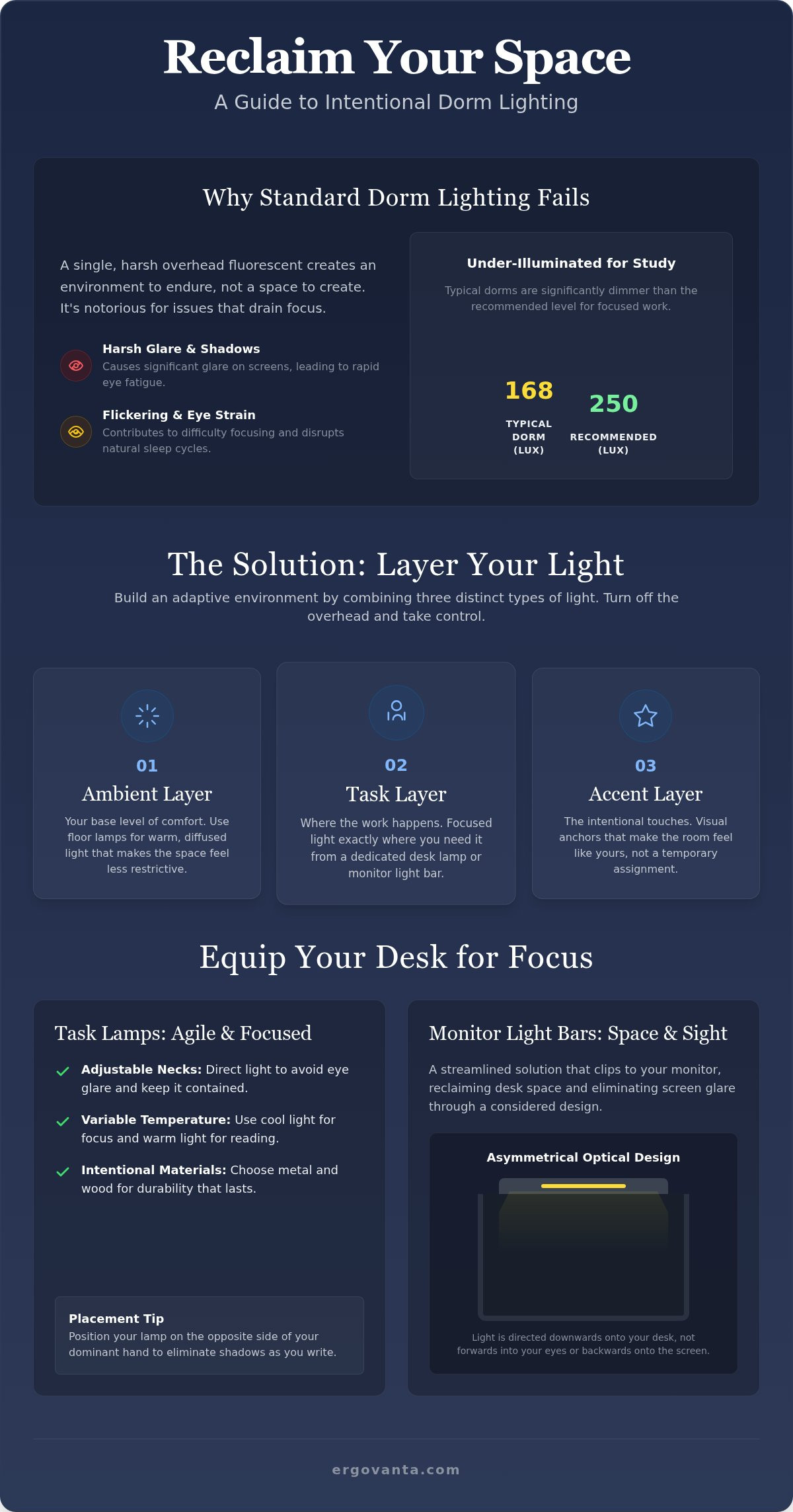
Top-down lighting is efficient for cleaning crews, but it's brutal for students. High-intensity overheads create harsh shadows and significant glare on laptop screens, leading to rapid eye fatigue. A study measuring light intensity in student dormitories found an average of 168 lux, which is significantly lower than the 250 lux recommended for a study area. This under-illumination forces your eyes to work harder just to parse text on a page. The first step in building a better workspace is the psychological shift of turning off the main switch. Instead of relying on that sterile glow, use floor lamps to bounce light off the ceiling. This creates a softer, indirect ambient glow that fills the room without the aggressive glare of a fluorescent tube.
Layering light for intentionality
A workspace that gets used is one that adapts to your needs. You shouldn't have just one light setting for reading, sleeping, and hosting friends. Effective dorm room lighting ideas rely on layering three distinct types of light to create a considered environment:
- Ambient layers: This is your base level of comfort. It replaces the "big light" with warm, diffused sources that make the 10x12 space feel less restrictive.
- Task layers: This is where the work happens. These are the small objects that earn their place by focusing light exactly where you need it, such as a dedicated desk lamp or a monitor light bar.
- Accent layers: These are the intentional touches that add personality. Think of these as the visual anchors that make the room feel like yours rather than a temporary assignment.
By separating these layers, you gain control over your daily rhythm. You can dim the ambient light when it's time to wind down or sharpen the task lighting when a deadline approaches. This intentionality reduces eye fatigue and helps you reclaim your focus from the harsh reality of institutional overheads. Equip your space with lighting made for the work, and the room will finally start to feel like it belongs to you.
Desk lighting that earns its place
The desk is the anchor of your room. It is the one place where you have total control over your environment. While searching for dorm room lighting ideas, many students settle for cheap plastic that breaks by midterms. Don't do that. Build a setup that respects the hours you put in. A dedicated light source is non-negotiable for long-form study. It defines the boundary between resting and producing. In a small space, every object must earn its place through utility and considered design.
Task lamps for focused work
A good task lamp should be agile. Look for adjustable necks that allow you to direct light exactly where the work is, keeping the glare out of your eyes. Color temperature matters. Warm light is ideal for reading and winding down, while cooler, blue-toned light helps you stay alert during late-night sessions. Choose materials like metal or wood. These are intentional choices that will survive the move to your first apartment. A solid lamp is an investment in your focus, providing the clarity needed to parse complex texts without squinting.
Monitor light bars for eye comfort
If your desk is already crowded with textbooks and coffee, a monitor light bar is a space-saving essential. Unlike traditional lamps that sit on the desk surface, these clip to the top of your screen. They use asymmetrical optical design. This means they illuminate your keyboard and notes without reflecting off the glass. This eliminates screen glare and reduces the harsh contrast between a bright monitor and a dark room. It is a streamlined solution for those who spend serious hours in front of a screen.
Positioning is the final step. Place your light source on the opposite side of your dominant hand to eliminate shadows while you write. If you're working on a laptop, ensure the light hits the keys from a slight angle to prevent reflections. Equipping your space with these considered tools makes the difference between a room you tolerate and a workspace you'd choose to come back to. If you are unsure which setup fits your desk, contact us to discuss your specific needs.
Ambient and floor lighting for small spaces
The rooms that get used are the ones that feel intentional. In a typical 10x12 dorm, the shadows often dictate where you can sit or work. Reclaiming those dark corners is essential for making a small space feel like yours. While searching for dorm room lighting ideas, many students fall into the trap of buying colorful projectors that offer no real utility. Instead, focus on verticality and diffusion. This approach ensures your ambient light supports your mood without cluttering your floor plan. Soft, diffused light is a tool for stress reduction. It tells your nervous system that the high-stakes environment of the lecture hall has been left behind.
Floor lamps as anchor pieces
Floor lamps serve as visual anchors. By placing a lamp in a far corner, you push the perceived boundaries of the room outward. This makes the space feel larger and more open. When selecting a lamp, choose fabric or frosted glass shades. These materials soften the LED output, creating a warm glow that mimics natural light. For those looking for considered designs that fit a minimalist aesthetic, explore Ergovanta floor lighting. These pieces are designed to earn their place through durability and purposeful function. Avoid the common mistake of "octopus" lamps with multiple plastic heads; they add visual noise and often violate campus fire safety codes. Stick to a single, clean silhouette that complements your desk setup.
Accent lighting that serves a purpose
Accent lighting should define your zones. A dorm room is a bedroom, an office, and a living area all in one. Use small, intentional light sources to separate these functions. A warm accent light near your bed signals to your brain that the workday is over. This is the difference between functional accents and distracting decor. Avoid flashing LEDs or "galaxy" themes that clutter your visual field. Stick to a modernist or minimalist aesthetic. Use light to highlight the small objects that matter, such as a favorite figurine or a well-placed vase. This layer of light isn't just for show; it's a tool for mental transition. It allows you to shift from "productivity mode" to "rest mode" without ever leaving the room.
Equipping your room with these layers transforms it from a temporary assignment into a sanctuary. When you choose lighting that complements your other workspace essentials, you build an environment that is both personal and functional. The goal is a room that feels like yours because you equipped it deliberately. Minimalist, vertical designs are the key to maintaining order in a small footprint. They provide the light you need without demanding the space you don't have.
Intentional lighting for shared spaces
The workspace shapes the work. Equip it deliberately. Shared rooms require a higher level of intentionality because your footprint isn't just about your comfort; it's about mutual respect. When your 10x12 space is split between two distinct schedules, your setup needs to be precise. You don't want to be the reason your roommate loses sleep. They don't want to be the reason you lose focus. Implementing effective dorm room lighting ideas for shared spaces is about containing your light spill. It's about ensuring your illumination ends exactly where your desk does.
Focused light for late-night sessions
A monitor light bar is the ultimate tool for the late-night worker. Because it directs light downward onto your workspace rather than outward into the room, it keeps the rest of the space dark. This allows you to build a study zone that exists independently of the sleeping area. You can work on a complex project at 2:00 AM without disturbing the person three feet away. Use dimmable features to transition. As the night progresses, lower the intensity of your task light to match your own needs without flooding the room with glare. This creates a functional boundary in a room that lacks physical walls.
Organization and cable safety
A clean desk is a functional desk. In high-traffic shared rooms, the area behind your desk often becomes an "octopus" of tangled cords. This isn't just a visual mess; it's a safety hazard. Use tech device accessories to keep your power strips and lighting cables organized. Managing your cables ensures that nobody trips in the middle of the night. It also makes your setup feel more permanent and less like a temporary pile of electronics. Beyond safety, cable management preserves the lifespan of your equipment by preventing tension and fraying. It's a small object that earns its place by keeping your workspace streamlined.
Consider equipping your space with smart plugs for quiet, easy control. Being able to toggle your floor lamp or accent lights from your phone means you don't have to stumble across a dark room and wake your roommate. It's about building a system that works for the reality of dorm life. When you choose lighting that respects the shared nature of the room, you create an environment where both of you can succeed. These aren't just decorations; they are tools for a better shared experience.
Equipping your space for the long haul
The workspace shapes the work. Equip it deliberately. Many students view their dorm as a temporary stop, leading to a throwaway mindset where cheap plastic dominates their desk. This is a mistake. Your environment directly impacts your ability to focus and recover. When you select dorm room lighting ideas that prioritize durability, you aren't just buying a lamp. You're investing in a tool that will transition from your residence hall to your first apartment. Build a setup that respects the hours you put in.
Choosing materials that earn their place
Intentional materials like metal and wood beat plastic every time. There is a tactile difference in a weighted base or a solid metal switch that signals a workspace is made for the work. Minimalist design remains relevant regardless of your floor plan or changing aesthetics. While cheap, seasonal LEDs might fail by graduation, a considered fixture earns its place for years. This is the ROI of focus. A well-equipped desk reduces mental friction, making it easier to start the work and stay in the flow without the distraction of flickering or broken gear.
Building your intentional workspace
Recall the framework of intentional lighting: ambient light to anchor the room, task light to focus the work, and accent light to define your zones. This layered approach turns a sterile room into a sanctuary you actually want to come back to. Don't settle for the big light or a clutter of distracting decor. Instead, shop for workspace essentials that matter. Every object on your desk should have a purpose and a place.
Before you finalize your setup, run through this considered checklist for a functional dorm environment:
- Does your task lamp have an adjustable neck for precise light placement?
- Have you used a floor lamp to bounce light off the ceiling for a softer ambient glow?
- Is your monitor light bar saving space while eliminating screen glare?
- Are your cables managed to ensure safety and visual order?
- Do your materials reflect a commitment to durability over temporary convenience?
Build the space that helps you do the work. Your environment is under your control, even in a 10x12 room. Equip it with the same level of dedication you bring to your studies. When you choose objects that are built for the long haul, you create a foundation for professional success that lasts far beyond freshman year.
Build the workspace you'd choose to come back to
The workspace shapes the work. Equip it deliberately. By moving away from institutional overheads and embracing a layered approach, you turn a standard 10x12 room into a personal sanctuary. Effective dorm room lighting ideas are about more than just visibility; they are about focus, eye health, and respecting the shared nature of your environment. Whether you choose a monitor light bar to reclaim desk real estate or a floor lamp to anchor a dark corner, the goal is intentionality.
Our designs are made for the people who do the work. We focus on non-permanent, dorm-friendly solutions that prioritize ergonomic utility without sacrificing durability. These objects aren't just for freshman year. They are built to transition with you to your first apartment and beyond. When your setup feels like yours, the work follows.
Take ownership of your environment. You have the tools to build a space that supports your daily rhythm and your long-term success. Start equipping your desk for the work that matters most.
Frequently Asked Questions
Are LED strips or floor lamps better for dorm rooms?
Floor lamps are generally superior for functional ambient light, while LED strips are primarily decorative. A floor lamp provides a stable source of diffused light that can bounce off the ceiling, making a small 10x12 room feel larger and more intentional. LED strips often lack the intensity needed for actual work and can be difficult to remove without damaging university property. Choose a floor lamp to provide reliable, usable coverage across your entire space.
How can I improve my dorm lighting without drilling into the walls?
Equip your space with non-permanent, freestanding fixtures like floor lamps and desk lamps to build your lighting layers. Monitor light bars are another excellent option because they clip directly onto your screen without requiring hardware. For organization, use adhesive cable clips that leave no residue on furniture. These tools allow you to build a workspace for the work without violating housing contracts or risking your security deposit at the end of the year.
What is the best color temperature for a study lamp?
Aim for a color temperature between 4000K and 5000K for active study sessions. This "cool white" range mimics natural daylight, which helps maintain alertness and focus during long nights at the desk. For late-night reading or winding down, switch to a warmer temperature around 2700K. Many dorm room lighting ideas rely on adjustable LEDs that allow you to toggle between these settings to match your daily rhythm and reduce eye fatigue.
Can I use a monitor light bar if I have a laptop?
Yes, many monitor light bars feature adjustable clips designed to fit the thin bezels of a laptop. You must ensure the weight of the bar is supported and does not strain your laptop hinge. A light bar is a space-saving essential for students with limited desk real estate. It provides clear, asymmetrical illumination on your keyboard and notes without taking up surface space or causing distracting glare on your screen during late sessions.
How do I stop the overhead fluorescent lights from flickering?
You cannot fix the internal ballast of an institutional fixture, so the best solution is to stop using the overhead light entirely. Flickering is a common sign of aging tubes or poor electrical supply in older buildings. Instead of enduring the mental drain, equip your room with high-quality LED floor and desk lamps. These provide a steady, flicker-free source of light that reduces eye strain and helps you reclaim your focus from harsh environments.
What are the most common dorm fire safety rules for lamps?
Most universities require electrical products to be UL Listed for safety. Halogen bulbs, "octopus" lamps with plastic heads, and lava lamps are frequently banned due to high heat and fire risks. Always check your specific housing handbook, as many schools now mandate LED bulbs for all dorm room lighting ideas. Additionally, ensure you don't "daisy-chain" power strips or place any light fixtures within 18 inches of a sprinkler head to stay compliant.
How many lumens do I need for a small dorm desk?
Aim for approximately 450 to 800 lumens for your primary task area. This level of brightness ensures you can read small text and parse complex diagrams without squinting. Since the average light intensity in a dorm is often well below the recommended 250 lux for study areas, a dedicated lamp is necessary. Look for lamps with dimmable settings so you can adjust the intensity to match the ambient light levels in your room throughout the day.
Will a desk lamp help with Zoom or Teams calls in a dorm?
A well-placed desk lamp significantly improves your video quality by providing a clear light source on your face. Position the lamp slightly behind your laptop and off to one side to avoid direct glare. This prevents you from appearing as a silhouette against a bright window or a dark corner. Using intentional lighting helps you present a more professional image during virtual classes and interviews by ensuring you are clearly visible to others.
Disclaimer
Ergovanta publishes these guides to help people set up better workspaces. Product recommendations reflect what we sell. Specifications, prices and availability are accurate at the time of writing and may change. Nothing here is medical, ergonomic or professional advice; if you have a specific health concern about your workstation, speak to a qualified professional.
From the catalog