October 28, 2026
How to Set Pendant Lighting Height Over a Dining Table
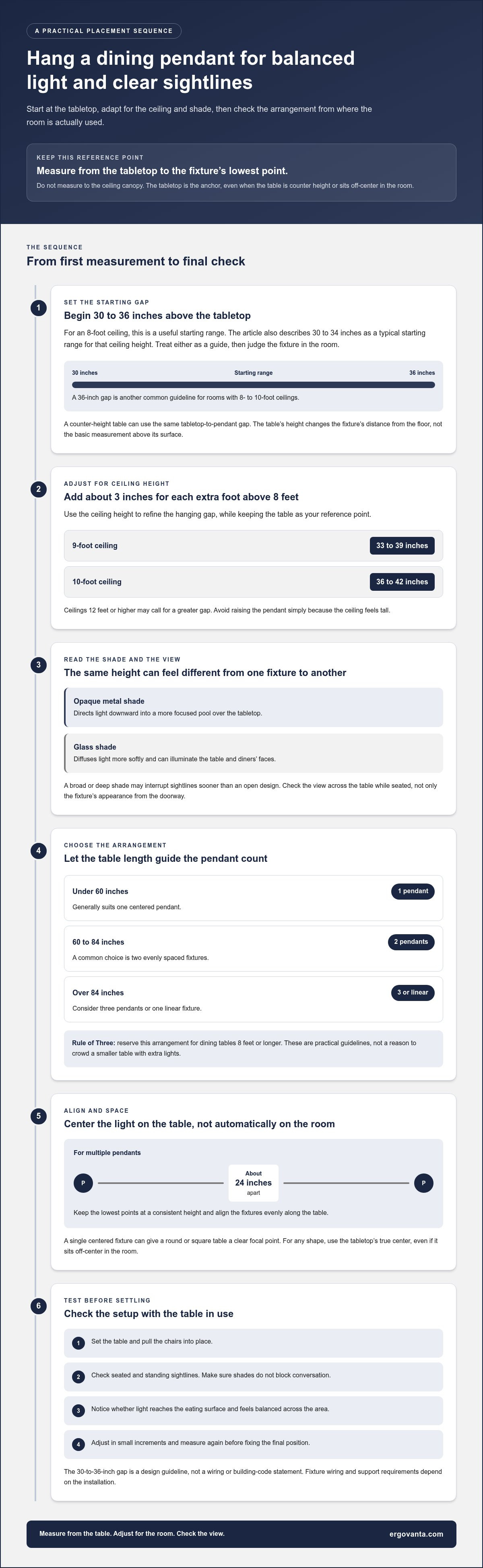
A practical starting point for pendant lighting height over a dining table is 30 to 36 inches from the tabletop to the bottom of the fixture. For ceilings higher than 8 feet, add about 3 inches of hanging height for each additional foot. Treat the measurement as a starting point, then consider the shade and how the room feels when people are seated.
The right fixture can still feel wrong if it blocks sightlines, casts uneven light, or sits off-center. Measuring before hanging it can prevent a second round of adjustments. This guide explains how to set pendant lighting height over a dining table, adapt placement to ceiling height and shade design, space multiple pendants, and choose a diameter that suits the table. It also covers common mistakes, such as centering the light on the room instead of the table or overlooking how the setup works when people are seated. Aim for balanced light and clear sightlines, with the fixture positioned to serve the table.
Key Takeaways
- Set the fixture height by considering ceiling height, shade shape, and seated sightlines, not by relying on one measurement alone.
- For a rectangular table, choose the number of pendants to suit its length, then align them evenly along the table.
- Compare pendant diameter with the tabletop width so the fixture feels proportionate and leaves space around the edges.
- Center the light over the table, even when the table sits off-center in the room.
- Test the placement and light level before settling on the final setup. Small adjustments can make the whole dining area feel more balanced.
1. How Far Should a Pendant Light Hang Above a Table?
Start with the bottom of the pendant 30 to 36 inches above the tabletop. That range suits many dining setups with an 8-foot ceiling, but the best position depends on the room and fixture. For an 8-foot ceiling, 30 to 34 inches is a typical starting range. A 36-inch gap is another common guideline for rooms with 8- to 10-foot ceilings. To judge pendant lighting height over a dining table, use these measurements as a starting point, then assess the fixture in the room.
Measure from the tabletop to the lowest point of the shade or chandelier, not to the ceiling canopy. This keeps the measurement consistent across fixtures with different stems, cords, and shades. For example, if the tabletop is 30 inches above the floor and the pendant’s lowest point sits 32 inches above it, the fixture’s bottom is 62 inches from the floor. The practical question is whether people can see across the table comfortably and whether the light reaches the surface. A broad, opaque shade may feel lower than a narrower, open one at the same height.
Electrical and building requirements can apply to fixture wiring and support, while the hanging gap is a design measurement. The 30-to-36-inch range is a layout guideline, not a statement of code. Requirements for wiring and fixture support depend on the installation. Keep the fixture secure and its wiring compliant with the requirements that apply to your home.
To calculate the height for different table sizes, measure upward from the tabletop rather than using the table’s length or width. Choose a starting gap within 30 to 36 inches, then assess sightlines, shade size, and light spread. A counter-height table that measures 36 inches high can use the same 30-to-36-inch gap above its surface. The tabletop’s height changes the fixture’s distance from the floor, but not the basic tabletop-to-pendant measurement. Getting pendant lighting height over a dining table right starts with the tabletop, not the floor.
Spacing matters when you use more than one pendant. Keep the fixtures aligned over the table, with their lowest points at a consistent height; about 24 inches apart is one general spacing guideline. A single centered fixture often gives a round or square table a clear focal point. On any table, center the light over the tabletop, not automatically over the room. A small offset becomes easier to spot once place settings and chairs establish the table’s true center.
Test the pendant’s position with the table set and chairs pulled into place. Check whether shades block conversation, whether the light pools where people eat, and whether the overall atmosphere feels balanced. A few inches can change the view across the table, so adjust before committing to a final position. Compare styles and proportions in the lighting collection as you decide what works above your table.
2. Adjusting pendant height for ceiling height and shade type
Ceiling height changes how far a pendant should hang above the table. The familiar 30-to-36-inch tabletop gap assumes an 8-foot ceiling. For each additional foot above 8 feet, add about 3 inches to the hanging height. That adjustment keeps the fixture visually connected to the table instead of floating high in the room. Use the ceiling measurement as a starting point, then consider the fixture’s size and the room’s layout.
For a 9-foot ceiling, a dining pendant should hang 33 to 39 inches above the table. With a 10-foot ceiling, use 36 to 42 inches as the guide. These ranges follow the 3-inch adjustment for each extra foot. Ceilings 12 feet or higher may call for a greater gap than usual, especially in a room with generous vertical space. Keep the table as the reference point, rather than raising the pendant simply because the ceiling feels tall.
Shade design affects how a pendant feels at the same height. An opaque metal shade directs light downward, creating a more focused pool over the tabletop. A glass shade diffuses light more softly and can illuminate both the table and diners’ faces. A broad or deep shade may interrupt sightlines sooner than an open design. Before finalizing the position, sit at the table and check how the shade frames the people across from you. The fixture should work for meals, not just look balanced from the doorway.
Adjustable cords and stems make height changes easier, particularly with ceilings taller than 9 feet. Extend the suspension to keep the pendant at a useful distance above the table, and measure from the tabletop to the fixture’s lowest point. For two or more pendants, set each one to the same drop so they hang evenly. Check their alignment from both ends of the table; a level row looks deliberate, while uneven drops can make the whole arrangement feel accidental.
Test the position before cutting a cable to its final length. Temporarily hold or secure the fixture at the intended height, then view it from seated and standing positions. Check sightlines, light spread, and how the shade sits within the room. Make changes in small increments, measuring each time rather than relying on visual guesswork. If you have a question about choosing a fixture for your room, send a lighting question.
3. Number and spacing of pendants over rectangular tables
Start with the table’s length, then choose a fixture arrangement that spreads light across its surface. A table under 60 inches long generally suits one centered pendant. For a table measuring 60 to 84 inches, two evenly spaced pendants are a common choice. Tables over 84 inches can use three pendants or one linear fixture. These are practical guidelines, not a reason to crowd a smaller table with extra lights.
The Rule of Three is best reserved for dining tables 8 feet or longer. On a shorter rectangular table, one statement chandelier can provide a clear focal point without adding unnecessary visual weight. A table up to 6 feet long can suit a single statement fixture, while larger or longer tables may benefit from multiple pendants or a linear suspension. Match the arrangement to the table’s usable length, not the empty space around it.
For multiple pendants, arrange the fixtures in a straight row along the table’s centerline. A spacing of about 30 inches is a useful starting point; another guideline suggests 30 to 35 inches between lights. Keep each pendant at the same height above the table so the row reads as one considered arrangement. If the table is long, adjust the layout so the outer fixtures sit a few inches inside each end.
Two pendants work well when they divide a 60-to-84-inch table into balanced zones. Place one over each half, then check that the gaps from each pendant to the table ends feel similar. For a table over 84 inches, three fixtures can distribute light more evenly than two widely separated pendants. A linear fixture offers another option, especially when several individual shades would make the ceiling feel busy.
How high should multiple pendants hang over a dining table? Keep their bottoms at one consistent height, using the same tabletop-to-fixture gap you’d choose for a single pendant. For standard 8-foot ceilings, a common range is 30 to 36 inches above the tabletop. Taller ceilings call for adjusting the hanging height, while the fixtures should still align evenly with one another.
Before settling on the layout, mark the center of each pendant above the rectangular table. Pull out the chairs and check the row from both ends, not just from the room entrance. Bright pools directly beneath the fixtures can leave darker gaps between them, so consider how the light overlaps across the tabletop. Keep the row centered on the table and adjust the spacing before changing the number of fixtures.
4. Pendant diameter relative to table width
Begin with the tabletop width, then compare it with the pendant’s diameter. A round pendant often looks balanced at about one-half to two-thirds of the table’s width. For a 48-inch-wide table, that suggests a fixture around 24 to 32 inches across. A 36-inch-wide table pairs with a pendant around 18 to 24 inches in diameter. These examples give you a useful scale before you consider shade shape or visual weight.
Use the ratio as a starting point, not a rigid formula. A 60-inch table, for example, can suit a pendant around 30 to 40 inches wide. Other sizing guides give broader ranges: a 36-to-48-inch table may suit an 18-to-30-inch pendant, while a 48-to-60-inch table may suit 24 to 36 inches. Those ranges overlap because fixture proportions and table designs vary. Compare the actual shade width, not just the overall fixture height.
Check the edge clearance before choosing a large diameter. A pendant should sit at least 6 inches inside the table’s edge on every side, which means the fixture should be at least 12 inches narrower than the tabletop. For a 48-inch-wide table, a 36-inch fixture leaves 6 inches on either side. That spacing helps the pendant feel centered without crowding the place settings or dominating the surface.
Shape changes the calculation. For a round table, compare the pendant diameter with the tabletop diameter; a fixture measuring one-half to three-quarters of the table’s diameter can work. For a rectangular table, judge the fixture against the width, then consider its length separately. A 6-foot table can use two medium pendants or one large rectangular fixture. A long linear pendant spreads its visual weight along the table instead of concentrating it in one broad circle.
Before deciding, mark the proposed diameter on paper or temporarily outline it above the table. View the shape from across the table and from the room entrance. A 30-inch fixture can feel modest over a wide tabletop but substantial above a narrow one. If your table extends, size the pendant for its everyday closed length, then assess the arrangement with the leaves in place. The goal is a centered fixture with enough breathing room, not a shade that competes with the table’s full length.
5. Common dining room lighting mistakes
A common placement mistake is centering the fixture on the dining room instead of the table. The table may sit off-center because of a doorway, cabinet, or room layout. Stand at each end, find the tabletop’s centerline, and align the pendant with it. This keeps the light above the dining area people actually use, rather than over empty floor.
Another mistake is judging the hanging position from only one viewpoint. A pendant can look centered from the doorway but appear shifted from a chair. Pull out the chairs, sit on both sides, and check the fixture’s position against the table. Then check the view from the room entrance. These simple checks can reveal awkward placement before you set the final cable length.
Choosing a shade without considering its light direction can leave the table too stark or the room unevenly lit. An opaque metal shade directs light downward, which can suit focused dining. Glass shades diffuse light more softly and illuminate the table and diners’ faces. Compare the effect from a seated position, not only the fixture’s appearance in an empty room.
Without a dimmer, one fixed light level has to serve every occasion. A dining pendant connected to a dimmer lets you use brighter light for setting the table and lower light during a meal. Warm white bulbs are a common choice for dining areas. Match the bulb to the fixture’s requirements, then test the light with the room’s other lights switched on.
Too little or poorly directed light is another common miss. A dining pendant should provide 60 to 100 watts, or the LED equivalent. This is a total for the fixture, not a target for every bulb. Check the combined output, then consider whether the shade directs light onto the table or softens it across the room. The right balance depends on the fixture design and the atmosphere you want.
Plug-in pendants create a separate placement challenge: the cord runs from a ceiling hook to an outlet and must not cross a walkway. Trace its route before choosing the hanging position. A cord across the path between the dining table and a doorway can turn a tidy setup into an obstacle. Keep the cable route clear of foot traffic and chair movement.
Finally, do not assume the first position is final. Set the table, switch on the pendant and dimmer, then check sightlines and brightness from several seats. Adjust the placement if the shade interrupts conversation or the light misses the eating surface. A few deliberate tests can reveal more than another glance from the doorway.
Ergovanta: desk lamps
Ergovanta offers lighting for spaces beyond the dining table. Choose a desk lamp for focused tasks, or use floor lamps, wall lights, and ceiling lights to shape how different parts of your home feel and function. A pendant can anchor the dining area, while a separate light source makes a reading nook or work surface useful without asking one fixture to do every job. Plan lighting around how you use each room, rather than choosing a matching set for its own sake. Explore Ergovanta’s lighting selection to find fixtures for your home.
Make the dining space yours
Let the way you use the room guide your final choice. Consider whether the dining table is mainly for quick meals, long conversations, or work between meals. That routine can shape decisions beyond pendant lighting height over a dining table, including the shade style and how its light works with the rest of the room. The fixture should suit your everyday use, not just meet a measurement.
Take time to make a considered choice. A change in placement, finish, or shape can alter the feel of the dining area. Let the table, the room, and your habits guide you. The right setup is the one that feels natural when the room is in use.
Build a dining space that feels like yours, one thoughtful choice at a time.
Frequently Asked Questions
How Far Should a Pendant Light Hang Above a Table?
Place the fixture’s lowest point about 30 to 36 inches above the tabletop as a starting range. Measure to the bottom of the shade, including any lower decorative detail, rather than to the canopy. Then sit in the dining chairs and check whether the fixture interrupts views across the table. A deep shade may need a little more visual breathing room than a compact, open design.
Can I use a plug-in pendant over a dining table?
Yes, a plug-in pendant can hang over a dining table using its cord and a ceiling hook instead of hardwiring. Plan the route from the hook to the outlet before choosing the fixture’s position. The cord should not cross a walkway, such as the path between the table and a doorway. Keep it clear of chair movement and everyday foot traffic.
How many pendants do you need?
Let the table’s length guide the count. A table under 60 inches long generally suits one centered pendant; a 60-to-84-inch table often suits two, while one over 84 inches can use three or a linear fixture. For example, two pendants over a table around 72 inches long can divide the light across its center. Keep their spacing visually even and the outer fixtures inside the table ends.
What is the recommended height for a pendant light above a dining table?
For a typical dining arrangement, begin with the fixture’s bottom 30 to 36 inches above the table. The recommendation is a starting point, not a substitute for checking the room in use. A heavy shade can feel imposing at the lower end, while an open fixture may feel unobtrusive. Test the view from seated positions before fixing the final hanging length.
How far above the tabletop should a pendant hang in inches?
Measure from the tabletop to the pendant’s lowest point, then use 30 to 36 inches as the usual starting range. For standard 8-foot ceilings, a typical placement is 30 to 34 inches. Keep the measurement consistent if comparing fixtures: a long finial or low-hanging shade counts as the bottom. That detail prevents the apparent gap from being smaller than your tape measure suggests.
Does pendant hanging height depend on ceiling height?
Yes. The usual table-to-fixture starting range assumes an 8-foot ceiling. For every additional foot of ceiling height, add about 3 inches to the hanging height. That gives a 33-to-39-inch range for a 9-foot ceiling and 36 to 42 inches for a 10-foot ceiling. Consider the shade and room proportions as well, so the pendant stays connected visually to the table.
How should pendant height change for a two-story or vaulted ceiling?
In a two-story or vaulted room, use the dining table as the visual anchor rather than hanging the pendant near the ceiling peak. A tall ceiling may require a longer cord or stem, while the fixture should still relate clearly to the table below. Assess it from both seated and standing positions. The pendant’s scale, shade depth, and the room’s open volume all affect its placement.
What is the ideal pendant size and width for a dining table?
For a round pendant, a useful proportion is about one-half to two-thirds of the table’s width. A 48-inch-wide table, for example, can pair with a 24-to-32-inch diameter fixture. Leave at least 6 inches between the fixture’s edge and the table edge on every side. For a rectangular table, compare the pendant’s width with the tabletop, then consider whether a linear shape better follows its length.
Disclaimer
Ergovanta publishes these guides to help people set up better workspaces. Product recommendations reflect what we sell. Specifications, prices and availability are accurate at the time of writing and may change. Nothing here is medical, ergonomic or professional advice; if you have a specific health concern about your workstation, speak to a qualified professional.
From the catalog