September 29, 2026
Best Black Desk Lamps for a Sleek Modern Workspace
A black desk lamp can look right and still leave your page in shadow. Choosing a black desk lamp for a modern workspace means balancing its shape and finish with the light you need for reading, writing, or screen-based work. The look matters, but it has to work once you switch it on.
Start with how you use the space. An angled arm, compact base, or matte finish may suit your desk, but the lamp should direct light where you need it without crowding your work surface or creating avoidable glare. Think about where you can place it, what you do at the desk, and how much light the room already has.
This guide explains how to compare styles and practical details, including brightness, color temperature, adjustability, controls, and dimensions. You’ll learn how to weigh those details against your desk layout and personal style, and what to check on a product listing before deciding. The aim is a workspace that feels considered, with lighting that does more than look good in a photo.
Key Takeaways
- Think of black as a finish, not a lighting feature. A well-placed lamp can anchor your desk without making the setup feel dark.
- Match brightness to your tasks and existing room light, then check color temperature and color rendering for the kind of work you do.
- Compare streamlined, articulated, and sculptural shapes by their visual weight, adjustability, and fit with your desk.
- Before choosing a black desk lamp for a modern workspace, measure the available space and verify the lamp’s dimensions and specifications.
- Choose based on task, placement, and personal style. Check current listings to confirm finishes and features before you buy.
Why a Black Desk Lamp Can Work in a Modern Workspace
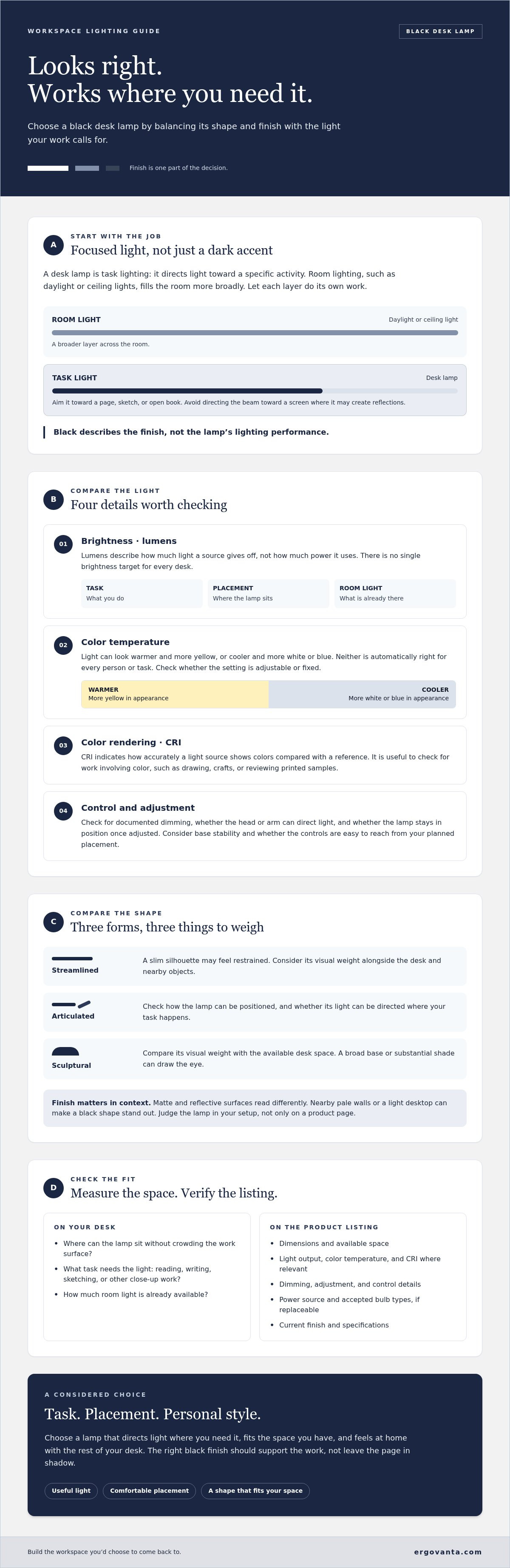
Task lighting puts light where a specific activity happens. A desk lamp can direct light toward a notebook, sketch, or open book, while the rest of the room stays at a softer level. That differs from ambient lighting, which fills the room more broadly. Think of ceiling lights or daylight from a window as the room’s general layer, with a desk lamp handling close-up work.
Task lighting is about making the work area easier to see, not simply making the whole room brighter. Placement matters: light aimed at a page can be useful, while a beam pointed toward a screen may create distracting reflections. A desk lamp is focused workspace lighting, directed toward the task rather than spread across the whole room.
Black describes the lamp’s finish, not its performance. A black desk lamp for a modern workspace still needs to suit your tasks and direct light where you need it. Visually, black can give the desk a clear anchor and connect with a dark monitor stand, keyboard, or chair. Nearby accessories do not all need to match. One dark accent can be enough to make the setup feel coordinated.
What makes a desk lamp suitable for focused work?
Look for a lamp that lets you direct light toward the activity in front of you. Reading and writing may call for illumination across a page; sketching or other close-up work may benefit from being able to reposition the light as you move. A lamp’s usefulness depends on its placement, the task, and the room’s existing light, not its appearance alone. Check how the lamp can be positioned and whether its light source and controls suit your routine.
How does a black finish shape the desk?
Black can visually connect with other dark accessories, giving a desk a sense of structure. Its visual weight depends on more than color: a slim silhouette may feel restrained, while a broad base or substantial shade can draw the eye. A matte surface may read differently from a reflective one, and nearby pale walls or a light desktop can make a black shape stand out. Judge the lamp in your actual setup, rather than in isolation on a product page.
Browse Ergovanta’s lamp selection to compare options, then confirm current finishes and specifications in each listing. A considered choice balances the light you need with the shape your desk can comfortably accommodate.
Which Desk Lamp Features Matter Beyond the Black Finish?
A lamp’s finish tells you how it may look on your desk. Its specifications help you decide whether it suits the work. When comparing a black desk lamp for a modern workspace, weigh the light output, light quality, adjustment options, and placement details against your tasks and room, rather than choosing by appearance alone.
How should you assess brightness and light quality?
Start with lumens, the measure of how much light a source gives off. Lumens describe light output, not power consumption. There is no single brightness target for every desk: the amount you need depends on the task, where the lamp sits, and how much other light is already in the room. Compare listings using the same measure, and consider whether the lamp’s light can be adjusted if your needs change.
Color temperature describes whether light looks warmer, with a more yellow tone, or cooler, with a whiter or bluer tone. Neither is automatically right for every person or task. Consider the atmosphere you want and whether the lamp’s listed settings let you adjust it. If the setting is fixed, use the stated specification to compare it with other options.
If your work involves choosing colors, such as drawing, crafts, or reviewing printed samples, check the color rendering index (CRI). It indicates how accurately a light source shows colors compared with a reference. Treat it as a useful comparison point, not a promise that one number suits every task.
Which controls and adjustments are worth checking?
Look for documented dimming or brightness controls if you want to change the light for different tasks or times of day. Check whether the lamp head, arm, or both can direct light toward your work area, and whether the lamp can stay in position once adjusted. A steady base matters too, particularly if your desk gets regular use or has limited clear space. Guidance on desk lamps recommended by designers also highlights practical features such as adjustability and base type.
Switch location and type can affect everyday convenience. A control on the base may be easier to reach than one on the cord, depending on where you plan to place the lamp. Confirm the power source and, if the lamp uses a replaceable bulb, which bulb types it accepts. Do not assume that lamps with a similar look share the same controls or light source.
Check brightness, color temperature, color rendering, controls, power source, bulb compatibility, adjustability, and dimensions on each product page, because these specifications vary from lamp to lamp. If a listing leaves a detail unclear, use Ergovanta’s contact page to ask about it before deciding.
Black Desk Lamp Styles Compared: Shape, Finish, and Workspace Fit
Shape affects more than a lamp’s appearance. It changes how much desk space the lamp occupies, where its light can reach, and how strongly it stands out. Use this comparison to narrow down a form that fits your work, then check the specific lamp’s dimensions and adjustment range before deciding.
| Form | Silhouette | Adjustability | Visual weight | Likely use |
|---|---|---|---|---|
| Streamlined | Simple lines, often a compact profile | May be limited, depending on the design | Light and unobtrusive | A tidy setup where the lamp should recede |
| Articulated | Visible joints or an extending arm | Often offers more ways to redirect light | More structural, with the arm drawing the eye | Tasks that shift between different parts of the desk |
| Sculptural | Distinctive, expressive shape | Varies; check how the head directs light | Can become a focal point | A desk where the lamp also contributes to the overall look |
Should you choose an articulated, compact, or sculptural lamp?
An articulated form may suit a desk where reading, writing, or other close-up work happens in different spots. Its extra movement is useful only if the lamp holds the position you need. A compact design can leave more room for other desk essentials, but “compact” is a visual impression, not a measurement. Check the base, height, and reach. Sculptural shapes add presence, so make sure their light still reaches the work area.
For a black desk lamp for a modern workspace, consider how the finish and shape work together. Against a light desktop, black creates clear contrast and makes the outline easy to notice. On a dark desk, it may blend in, while a contrasting shade or nearby object can keep the setup from feeling flat. A monitor stand, screen frame, or desk hardware can provide a point of connection without requiring every accessory to match.
Use design references as a starting point, not a rulebook. Browse modernist lighting styles for one visual direction, or look for minimalist lighting options if you prefer fewer lines and details. Then picture the lamp beside your actual monitor, notebook, and other daily tools. A striking silhouette is not automatically the most adaptable task light, and a quiet one does not have to disappear. Choose a balance that feels right for your desk and the work you do there.
How to Choose a Black Desk Lamp for Your Desk and Daily Tasks
Choose for the work first, then check whether the lamp fits your space. This checklist turns product pages into a useful comparison, instead of a guessing game based on a polished photo.
- List your tasks and when you’ll use the lamp. Note whether you mainly read, write, sketch, or handle close-up work, and whether you need light during the day, in the evening, or both.
- Map your desk and existing light. Consider desk depth, monitor position, nearby walls, windows, and overhead or other room lighting. Mark a possible lamp position that does not take over the space you need for work.
- Decide how you want to adjust it. Consider whether the light needs to reach different parts of the desk. Identify the controls you would actually use, such as a switch that is easy to reach or a documented dimming option.
- Measure the available space. Check the intended spot, including the area a base would occupy and any room needed for an arm or lamp head to move. Compare those measurements with the product’s listed dimensions. Photos can suggest scale, but they cannot confirm it.
- Compare the listed lighting details. Check light output, color temperature, and controls against your tasks and room lighting. Verify the power source and, if relevant, bulb compatibility. If a feature is not named in the specifications, confirm it rather than assume.
- Review the finish and purchase details. Decide whether black will connect with existing items, such as a monitor stand, or create contrast against the desk. Read the product description alongside the photos, and check the listed return details before ordering.
Use the same checklist for every candidate. This makes it easier to compare a black desk lamp for a modern workspace by its fit and documented features, rather than by a finish or shape that happens to catch your eye. If a listing leaves a detail unclear, ask Ergovanta about current lamp options before you decide.
Ask about current lamp options
Find a Black Desk Lamp That Earns Its Place in Your Workspace
A good choice balances four things: the task, the lamp’s position, verified specifications, and how its shape and finish sit with the rest of your desk. Appearance matters, but it should not be the only deciding factor.
Ergovanta’s desk lamps and lighting options are a place to browse, but use current listings to confirm the specifics. Do not assume a black finish or a feature is available unless the product page confirms it. Checking the details can help you avoid choosing a lamp that looks right in a photo but does not fit the work or the space.
What should you confirm on a product listing?
Check the details that affect how the lamp will work at your desk. Look for the listed finish, dimensions, light source, controls, and any components included. If it uses a replaceable bulb, see whether the listing explains compatible bulb types or replacement details. Photos can help you understand the design, but they cannot confirm the full specification. If a detail matters to your setup and is not listed, ask before relying on an assumption.
- Finish: Is black explicitly listed for that lamp?
- Fit: Do the dimensions work with your available desk space and intended placement?
- Light: Is the light source described, and can you verify its listed features?
- Use: Are the controls and any included components clear?
- Bulb details: If relevant, does the page specify compatibility or replacement information?
When is it useful to contact the retailer?
Reach out if you cannot confirm whether a lamp is currently offered in black, or if you need to clarify its dimensions, light source, or controls before deciding. Share what your desk setup requires, such as a compact base or light that can be directed toward a particular area. A specific question is easier to check than “Will this work?” and keeps the decision focused on details that matter to you.
Choose a black desk lamp for a modern workspace when its verified features suit your tasks and placement, and its visual presence feels right in your space. If a listing leaves you unsure, contact Ergovanta about current lamp options before making your choice.
Choose a Lamp That Fits the Work Ahead
The right lamp earns its place through useful light, a fitting shape, and specifications that match your desk. Start with the tasks you do most, measure the space available, then compare light output, controls, and adjustability. A black desk lamp for a modern workspace should feel considered in your setup and practical once the work begins.
Ergovanta offers desk lamps and a broader lighting range, but current finishes and product details can vary. Check each listing for its finish, dimensions, light source, controls, and bulb information where relevant. If something you need to know is not clear, ask before making assumptions.
Build your workspace one thoughtful choice at a time. The right fit supports your work and feels like it belongs in your space.
Frequently Asked Questions
Is a black desk lamp a good choice for a modern workspace?
Yes, a black desk lamp can suit a modern workspace if its shape and finish work with your setup. Black can tie in with a monitor stand or other dark details, or create deliberate contrast against a light desk. Treat color as a design choice, not a lighting feature. The lamp still needs to direct useful light toward your tasks and fit the available space.
What should I look for in a desk lamp for focused work?
Look for light output suited to your tasks and room, plus a way to direct the light where you need it. If you switch between reading, writing, and close-up work, consider whether the head or arm can be adjusted and whether brightness controls are listed. Check color temperature and, if accurate color matters, the color rendering index. Confirm each feature on the product page rather than inferring it from a photo.
Is LED lighting a good option for a desk lamp?
LED lighting can be a practical option, but check how it is used in the specific lamp. Some lamps have an integrated light source, while others may use a replaceable bulb. The product listing should clarify which applies, along with any relevant bulb compatibility details. Compare the listed light output and controls with your needs as well. The LED label alone does not tell you whether a lamp’s light, shape, or placement will suit your desk.
What color temperature is best for a desk lamp?
There is no single color temperature that is best for every desk or task. Color temperature describes how light appears, from warmer, more yellow tones to cooler, whiter or bluer ones. Consider the feel you want and how the lamp’s light will sit alongside daylight or room lighting. If a product lists adjustable color temperature, check which settings it offers. Otherwise, use the stated specification to compare lamps on equal terms.
How do I keep a desk lamp from creating glare on my monitor?
Position the lamp so its light falls on your work area rather than reflecting directly off the screen. Try placing it to the side of your monitor and adjust the head or arm, if the lamp allows, until the beam is aimed away from the display. Your screen angle and nearby windows can also affect reflections, so check the setup from your usual seat. Reposition the lamp if glare appears during normal use.
How do I know whether a black desk lamp will fit my desk?
Measure the space where you plan to put it, then compare those measurements with the lamp’s listed dimensions. Consider the base footprint, height, and how much room the arm or head may need to move. Check clearance around your monitor and other desk items too. Product photos can help you judge the silhouette, but they are not a reliable scale reference. Confirm the finish and dimensions in the listing before deciding.
Disclaimer
Ergovanta publishes these guides to help people set up better workspaces. Product recommendations reflect what we sell. Specifications, prices and availability are accurate at the time of writing and may change. Nothing here is medical, ergonomic or professional advice; if you have a specific health concern about your workstation, speak to a qualified professional.
From the catalog