October 7, 2026
Lamps: How to Choose the Right Light for Every Room
The right lamps make a room easier to use, not just nicer to look at. A desk lamp can leave your notes in shadow if it’s aimed poorly, and a floor lamp can get in the way if it crowds a walkway. Start with the activity, then decide where the light needs to land.
It’s easy to get caught up in shapes, sizes, and lamp categories. But a work surface, reading chair, and living-room corner don’t need the same kind of light. A desk may need focused task lighting, while a living room often works better with broad ambient light and a separate source for reading. Think about how you use each space before choosing a style.
This guide explains how to choose lamps by purpose, placement, and everyday routine. We’ll look at desk and floor lamps, wall lights, ceiling lights, pendants, and chandeliers, and how to balance task, ambient, and accent light. Build a setup that supports reading, working, relaxing, and moving around, with choices that feel like yours.
Key Takeaways
- Start with what the room needs to support, then choose light that serves that activity.
- Combine ambient, task, and accent lighting to balance general coverage with focused light.
- Compare lamps by purpose, placement, footprint, and visual presence before settling on a style.
- Map daily activities and existing light to identify where a room needs more support.
- Choose between desk, floor, wall, ceiling, pendant, and chandelier lighting based on your space and routine.
What Are Lamps For, and How Do They Change a Room?
Light shapes how a room works, not just how it looks. It can make a desk easier to use, give a reading spot its own pool of light, or draw attention to an object you like seeing. A lamp is a light source chosen and positioned for a particular purpose: broad illumination, focused light, or visual emphasis.
Choose a lamp for the job its light needs to do, then place it where that job happens. This is more useful than choosing by appearance alone. A lamp can look right in a room and still leave the page you’re reading in shadow. The category narrows the options; the activity and placement make the choice practical.
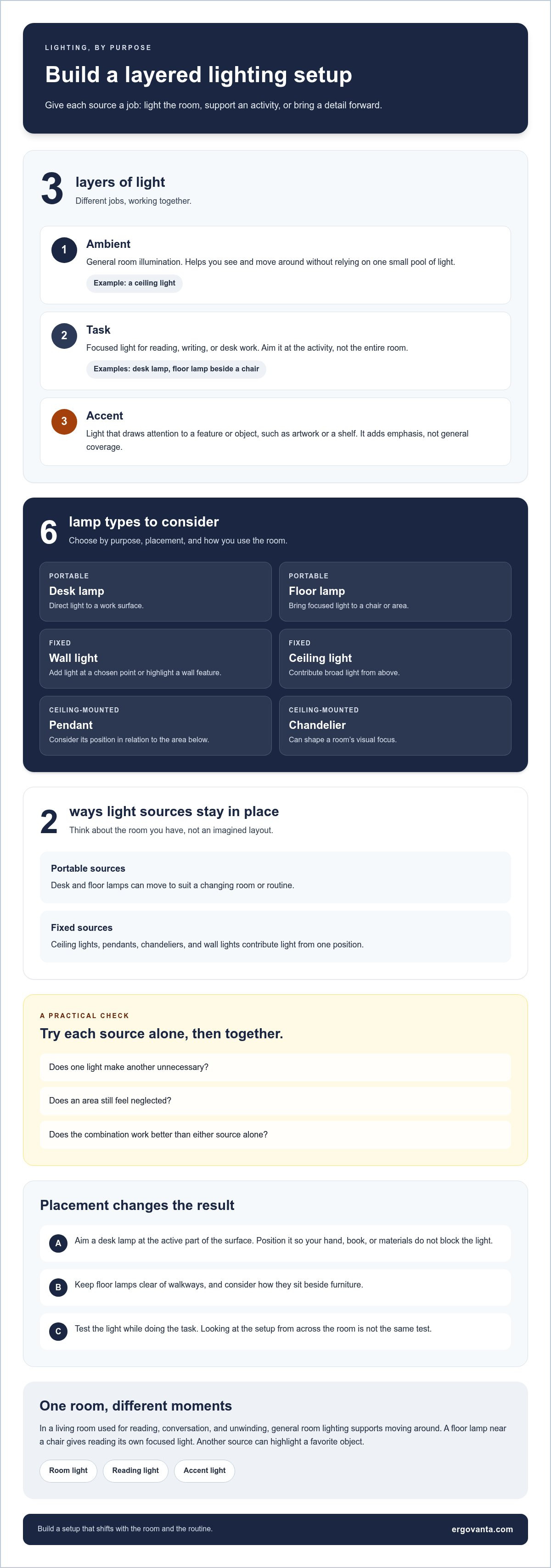
Portable lamps, such as desk and floor lamps, can be moved to suit a changing room or routine. Fixed lighting, including ceiling lights, pendants, chandeliers, and wall lights, stays in one position and contributes light from that point. Each can serve a different role. When browsing lighting options for your space, start by identifying where light is missing or where you want it to have a particular effect.
What is the difference between ambient, task, and accent lighting?
Ambient lighting is the room’s general layer of illumination. It helps you see and move around without relying on one small pool of light. A ceiling light may provide this layer, while other sources can contribute to it too.
Task lighting supports a focused activity, such as reading, writing, or desk work. A desk lamp can direct light toward a work surface, while a floor lamp beside a chair can help with reading. The goal is to light the activity, not the entire room.
Accent lighting draws attention to a feature or object, such as artwork or a shelf. It adds emphasis rather than general coverage. These layers work together: lighting design principles and applications also describe how different kinds of light can shape a space.
Why does one room often need more than one lamp?
A single overhead source may light much of a room while leaving a desk, reading chair, or corner less comfortable to use. That doesn’t mean the room needs more light everywhere. It may need light in a different place, aimed at a specific task.
Consider a living room used for reading, conversation, and unwinding. General room lighting helps people move around, while a floor lamp near a chair gives reading its own focused light. Another source might highlight a favorite object. You can switch on only what suits the moment instead of asking one ceiling light to handle every scene. The right mix depends on the room, its existing light, and how you use it.
How Do Different Lamps Build a Layered Lighting Setup?
Layers work best when they have different jobs and can be used independently. Begin with the light that makes the room usable, then add a closer source for activities that need focus. Accent light can bring a detail forward without asking general room lighting to do the same job. Aim for a setup that shifts with your plans, not one where every source has to be on at once.
Think in combinations. A ceiling light can provide broad coverage while a desk lamp lights one work area. Later, you might switch off the broader source and keep a smaller light on for a quieter task. In a room used for both work and downtime, separate sources help mark those modes without moving furniture or rebuilding the setup.
Try each source on its own, then in combination. Notice whether one light makes another unnecessary, whether an area still feels neglected, or whether the combination works better than either source alone. This test can reveal more than choosing fixtures by category. It can also show whether your next addition should reach a particular surface, soften a corner, or add visual emphasis.
Which lamp types support focused activities?
A desk lamp can support work, study, drawing, or reading when its light reaches the active part of the surface. Place it so your hand, book, or materials won’t block the light. Test the position while doing the task, not only while looking at the desk from across the room. A floor lamp can also bring focused light to a particular area.
How can lamps add softer or more focused light around a room?
A floor lamp can create a distinct pool of light without changing the room’s broader lighting. Wall lights offer another fixed source, useful for adding illumination at a chosen point or drawing attention to a wall feature. Their effect depends on how they sit in relation to furniture and the parts of the room you want to notice.
Ceiling lights contribute light from above, while pendants and chandeliers are ceiling-mounted options that can also shape a room’s visual focus. Consider how their position relates to the area below and to the way you use the room. In a workspace, broad overhead light and a closer source can complement each other when tasks shift from screen work to paper.
Think of lighting options as parts of a flexible setup. Combine sources that solve different problems, and leave out anything that doesn’t earn its place. Ergovanta offers lighting options for different spaces, including desk, floor, wall, and ceiling lights, pendants, and chandeliers. For general questions, visit Ergovanta’s contact page.
How Should You Compare Lamps Before Choosing One?
A lamp earns its place by working in the room you have, not an imagined version of it. Compare options against the job, the available space, and the way people move through the room. Category is a starting point, not a verdict: a floor lamp might suit one layout and crowd another.
Before considering appearance, write down the functional needs you won’t compromise on. Does the light need to reach a particular surface? Must the lamp stay clear of a walkway or leave room for other desk items? Once those questions have answers, style becomes a more useful choice than a hopeful guess.
What should you consider about placement and available space?
Start at the point where light is needed. Note the surface or area it should reach, then look at what surrounds it: furniture, walkways, outlets, and existing light sources. A desk lamp may suit a work surface but compete with a monitor or materials. A floor lamp may fit beside a chair but interrupt a route people use often.
Picture the room in use, not just empty. If someone reads in a chair, check where the lamp could sit without making the seat awkward to approach. If a desk faces a wall, consider where a light source will be least intrusive. The intended spot should work for the actual routine.
How do shade, material, and form affect the feel of a lamp?
Shape and material contribute to visual balance. A sculptural form can draw the eye; a simpler silhouette may sit quietly among other objects. A shade also affects how light appears and where it travels, so consider whether you want a directed effect or a gentler presence in the room.
Compare the lamp with colors and objects already there, including the desk, seating, artwork, and finishes. Matching everything isn’t necessary. A useful contrast can feel intentional, while a repeated material or shape can help connect the room. Browse lamp options for different spaces with your practical needs in view. Let function set the boundaries, then let personal preference make the final call.
How Can You Plan Lamps Around Each Room’s Daily Use?
Plan lighting around what people actually do in a room. A quick walk-through is more useful than choosing a lamp for a room’s name alone. A bedroom may be used for reading and getting ready, or mostly for sleep. A living room might host quiet evenings, shared meals, and visitors. Start with the routine, then identify what the existing light supports and where it falls short.
Use this simple sequence:
- List the activities. Note what happens in the room, and where.
- Locate existing light. Notice daylight, ceiling sources, and any light already near activity areas.
- Identify the gaps. Look for places that feel dim, uneven, or awkward to use.
- Choose a lamp type. Match the missing light to a desk, floor, or wall light, or consider a ceiling-mounted option where it fits.
Then test the plan at different times. Daylight changes, and so do routines. A space that works in the afternoon may feel different after dark. Turn on the lights you already have and notice which activities feel easy, and which still require squinting, shifting seats, or moving things around. The goal is comfort and ease, not a room that looks equally bright at every hour.
How can you plan lighting for a bedroom or living room?
Map activities to places: reading beside the bed, getting ready near a dresser, relaxing on a sofa, or gathering around a table. A floor lamp may suit a seating area if it fits beside furniture without narrowing a walkway. A wall light can provide a source near a bed or seating spot when the layout supports it. Let the room’s furniture and routines guide the choice, not a one-size-fits-all arrangement.
For example, if the bedroom is mainly for winding down, general light may be enough for moving around, while a more localized source can support reading. In a living room, the useful spot might be beside a chair, near a sofa, or somewhere else entirely. Keep the plan flexible. People use rooms differently, even under the same roof.
What should you consider for a desk or study area?
Start with the work surface and tasks that need focused light, such as writing, drawing, or reading notes. Check where your screen sits, how much clear desk space remains, and whether existing room light reaches the area comfortably. A desk lamp should help you see your work without crowding the surface or creating an irritating reflection in your usual line of sight.
Try the setup during the tasks you do most. If you keep leaning closer, moving papers, or shifting position to see clearly, try adjusting the lamp’s placement. Keep the lighting decision focused on visibility and ease; monitor accessories and broader workstation choices solve different problems. Build around your actual study or work routine, then adjust as it changes.
How Can You Find Lamps That Fit Your Space and Routine?
A good choice comes down to three things: purpose, placement, and personal preference. Start with what the room needs the light to do. Then picture where the fixture will sit and how it fits into your routine. Only after that should appearance have the deciding vote. Style matters, but it can’t make a poorly placed light useful.
There’s no need to recreate someone else’s room. Your desk, reading corner, or shared living area has its own habits and constraints. Choose what supports those habits, then decide what belongs visually. The small objects that earn their place are often the ones that make an everyday task easier without demanding attention all day.
How do you choose a lamp without following someone else’s room?
Begin with the spot and the activity, not a photo of a room arranged for someone else’s routine. If you read at a desk, think about light for that surface. If you mostly unwind in a chair, consider what would make that spot easier to use. Practical needs set the direction; color, shape, and material make the choice yours.
Ergovanta’s lighting categories include desk, floor, wall, and ceiling lights, as well as pendants and chandeliers. Each offers a different way to bring light into a space, but the category alone doesn’t settle the choice. A desk lamp may suit a work surface, while a floor lamp may fit beside seating. Start with the use, then browse lamps with that specific need in mind.
What is a simple final check before choosing a lamp?
Pause before deciding and run through the practical details. Name the lighting gap the lamp should address. Check that its planned position works with nearby furniture and doesn’t disrupt everyday movement. Then consider whether its appearance feels at home among the objects and colors already in the room. If those answers line up, you have a considered choice, not just a good-looking guess.
- Purpose: Can you name the activity or area this light supports?
- Placement: Does the intended spot work with furniture, surfaces, and movement?
- Preference: Does the form feel right for your space, not just someone else’s?
Keep the decision personal and practical. The right light should make sense in the room you use, as you use it. Ergovanta’s lighting range includes options for desks, floors, walls, and ceilings.
Make One Thoughtful Change to Your Space
Let your next step be small and specific. Choose one spot that could work better, then picture how you want to use it: a clearer place to read, a desk that feels easier to settle into, or a softer end to the day. You don’t need to rethink the whole room at once. One considered choice can give you a practical starting point, and you can build from there as your routine shifts.
Keep the decision yours. A useful light should fit the room you have and the habits you actually keep, not an idealized setup that looks good but gets ignored. Explore the lamps collection with that everyday purpose in mind.
Your space doesn’t need to look like anyone else’s to feel right. Start with what would make it work better for you, and build from there.
Frequently Asked Questions
What are the main types of lamps?
The main types include desk and floor lamps, along with fixed wall and ceiling lights, pendants, and chandeliers. Desk lamps suit smaller work or reading areas, while floor lamps can serve a broader spot near seating. Wall lights stay at a fixed point, and ceiling-mounted options contribute light from above. Think about where you want light to come from before narrowing the category. That usually makes the choice less abstract.
How many lamps should a room have?
There’s no standard number; a room needs enough light sources for its activities and layout. Spend time in the room after dark and notice whether you rely on one spot or keep moving to find useful light. A room used for several things may benefit from more than one source, while a smaller space with one main activity may need less. Add light to solve a real gap, not to meet a count.
Can one lamp provide ambient, task, and accent lighting?
One lamp can contribute to more than one lighting role, but it may not serve all three equally well. For example, a floor lamp can add general light while supporting reading near a chair. It might draw attention to the lamp itself, too, though that’s different from deliberately lighting another feature. Decide which role matters most, then judge whether the lamp’s position and the room’s layout let it do anything else usefully.
How do I choose a lamp for a desk?
Choose a desk lamp based on the work you do and the space available around it. If you switch between a keyboard and handwritten notes, position the light so it reaches both without making you rearrange your setup each time. Consider whether your hand or tools cast a shadow across the work. A lamp should help you see clearly while keeping the surface usable for the things you actually do there.
Are floor lamps good for reading?
Yes, a floor lamp can work well for reading if it places light where your book or e-reader sits. Test the position from your usual seat, since a lamp that seems well placed while standing may shine into your eyes once you sit down. Check that the base won’t catch your feet or obstruct access to the chair. A small shift in position can make the reading spot much more usable.
What should I look for in a lamp shade?
Look at how the shade directs and softens the light, as well as how its shape fits the lamp and room. A more open shade can let light spread outward, while a more enclosed one may focus it in a narrower direction. Color and material also affect the shade’s visual presence. Consider it alongside the furniture and finishes nearby, rather than choosing it as an isolated detail.
How do I make lamps work with the lighting already in a room?
Notice where existing light falls before adding another source. A lamp can fill a dim corner, bring light closer to a chair, or balance a bright area without duplicating what’s already there. Check the room at the time you’ll use it, since daylight and other sources can change how the lamp feels. If nearby lights look noticeably different together, try using them separately and decide which combination feels more comfortable.
Disclaimer
Ergovanta publishes these guides to help people set up better workspaces. Product recommendations reflect what we sell. Specifications, prices and availability are accurate at the time of writing and may change. Nothing here is medical, ergonomic or professional advice; if you have a specific health concern about your workstation, speak to a qualified professional.
From the catalog