October 5, 2026
Optimizing University Library and Study Room Lighting
One lighting plan can’t serve every kind of study. A student annotating a book needs clear light on the page; someone working on a laptop needs to avoid reflections; a group around a table needs light that reaches the shared surface without casting shadows across one seat. In a university library, overhead fixtures alone may not meet every need. Thoughtful library and study room lighting for universities responds to the task, the room, and the people using it.
Comfort matters over a long session. Glare, uneven brightness, and a poor balance of daylight and electric light can make a space harder to use. The answer isn’t simply to make every room brighter. Start with ambient light for general visibility, add task lighting where close work happens, and account for changes in daylight and screen use. This guide covers practical ways to review quiet reading areas, study carrels, computer zones, and shared rooms. Use the steps to spot glare and shadows, coordinate light sources, and make each space more adaptable without losing its purpose.
Key Takeaways
- Map how each area is used, from quiet reading to group work and screen-based study.
- Combine ambient, task, and accent lighting according to each zone’s needs instead of aiming for the same effect everywhere.
- Review each zone for glare, shadows, and uneven light before deciding what to adjust.
- Observe rooms at different times to see how daylight and study activity affect the lighting.
- Plan library and study room lighting for universities around the work each space supports, then consider desk, ceiling, wall, and floor lighting as practical layers.
Why University Library and Study Room Lighting Needs More Than One Setting
A university library is several kinds of workspace sharing one address. People read quietly, take notes, work in groups, use screens, and move between shelves and desks. Library and study room lighting for universities is a coordinated approach to visibility, comfort, and the different ways people use each space. One setting rarely fits all of them. Even light can help people move through a busy area, while focused reading calls for light on the page, not simply more light everywhere.
A practical definition: Layered lighting combines general room light with focused and supporting light, so each study task has what it needs without forcing every area into the same setting. To plan those layers, consider what people are doing, where they look, and how long they stay. The history and importance of library lighting offers context on lighting’s role in making libraries functional for visitors and staff.
For a visual introduction to reading-room and study lighting, watch this overview:
Which library and study activities shape lighting needs?
Sustained reading calls for clear, steady visibility across a page. Note-taking adds the movement of a hand across the work surface, while screen use brings reflections and viewing angles into the mix. In a group, attention shifts between faces, shared materials, and sometimes a display. The activity, the direction people face, and the time spent in a zone all affect how the light feels.
A uniform setup can leave a shared library with competing needs. Quiet desks, collaboration tables, computer areas, and circulation routes serve different purposes. Planning for those differences helps the library feel connected without making every space interchangeable.
What makes a study space visually comfortable?
Start with three basics: enough visibility for the task, balanced contrast between the work surface and its surroundings, and controlled glare. A bright patch beside a dim desk can distract. Reflections on a screen can make someone shift position just to see clearly. Comfort isn’t a single brightness or color-temperature setting. It depends on layout, surface finishes, daylight, viewing direction, and personal preference.
Observe the room in use before deciding what to adjust. Note where shadows fall, which surfaces reflect light, and how daylight changes a desk over the day. Then consider which fixtures could support the plan. Ergovanta’s lighting collection includes ceiling lights for general illumination, along with desk and floor lamps for more localized light. The aim is a considered mix, not a room that expects every task to happen under the same conditions.
How Layered Lighting Works in University Libraries
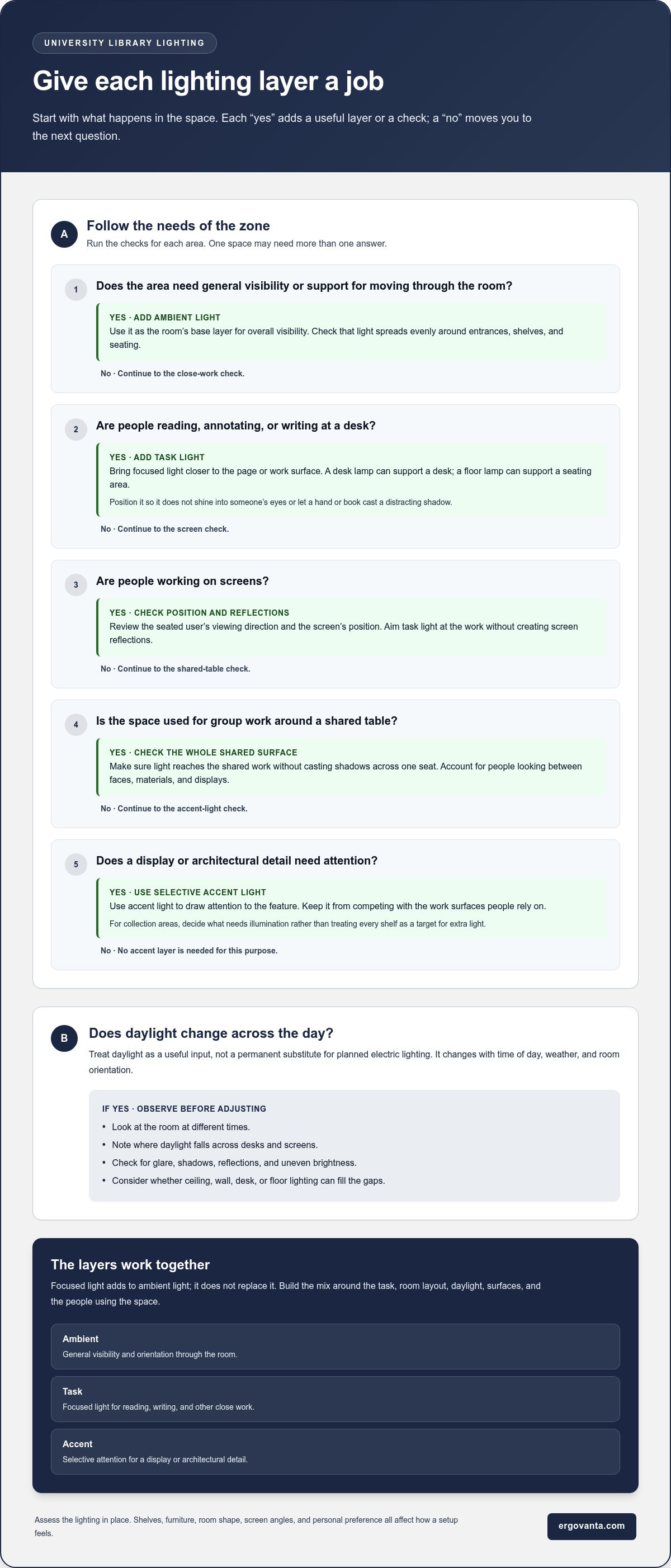
Build the lighting around what the room needs to do, not around a single fixture or setting. In a shared study space, layered lighting combines general illumination, focused task light, and selective accent light so different activities can coexist without every area being lit the same way. Each layer has a job. Together, they help a library feel connected while allowing a reading desk, circulation route, and display area to have distinct lighting needs.
Ambient lighting for orientation and overall visibility
Ambient lighting is the room’s base layer. It supports general visibility and helps people move between entrances, shelves, and seating areas. Ceiling lights, pendants, or wall lights may contribute, depending on the room and its layout. Aim for an even spread, then assess the result in place. Tall shelves can block light, furniture can cast shadows, and room shape can leave some areas brighter than others. A plan on paper is a start, not the final word.
Task lighting for reading, writing, and screen work
Task lighting brings light closer to a specific activity. A desk lamp can serve a reading or writing surface, while a floor lamp may support a seating area. These options add focused light; they don’t replace the ambient layer. Position a light so it reaches the work without shining into someone’s eyes or creating reflections on a screen. Check the seated user’s viewing direction, the screen’s position, and whether a hand or book creates a distracting shadow.
Accent lighting has a different role. It can draw attention to architectural details or a display, but it shouldn’t compete with the work surfaces people rely on. In collection areas, light also calls for care: the Library of Congress explains how exposure can cause light damage to library collections. Decide what needs illumination instead of treating every shelf or feature as a target for extra light.
Daylight is another layer, but it changes with the time of day, weather, and the room’s orientation. Treat it as a useful input, not a permanent substitute for planned electric lighting. A desk near a window may feel well lit in the morning and need a different balance later. Observe how light falls across seating and screens, then consider whether ceiling, wall, desk, or floor lighting can fill the gaps without washing out the room. For a closer look at lighting options, browse Ergovanta’s lighting categories.
Questions about choosing lighting for your space? Contact Ergovanta.
Match Library Lighting to Quiet Study, Group Work, and Screen Use
Match the light to the activity and the people using the space. A library table may serve someone reading a printed book one hour and a laptop user the next. For library and study room lighting for universities, use zones as a planning guide, not a fixed recipe. Room layout, daylight, surface finishes, and individual preference matter more than one brightness or color-temperature setting.
| Zone | Primary task | Lighting need | Planning consideration |
|---|---|---|---|
| Quiet reading | Sustained reading | Steady visibility across the page with limited glare | Check shadows from shelves, furniture, and nearby readers. |
| Individual study desks | Reading and handwritten notes | General room light, with focused light where needed | Consider writing-hand shadows and how daylight reaches the work surface. |
| Collaborative areas | Discussion and shared table work | Light that supports both conversation and materials on the table | Account for face-to-face viewing, movement, and multiple seats around the table. |
| Computer-based work | Reading and writing on screens | Balanced surrounding light with attention to reflections | Review screen angles, window positions, and shiny desk surfaces. |
These are general planning cues, not technical targets. Verify any proposed illuminance, glare, or equipment values against current guidance and the conditions of the specific space.
What changes between reading, writing, and screen-based study?
Printed pages and screens reflect light differently. Handwritten notes also introduce a moving hand that can cast a shadow across the page. For screen work, a bright window or fixture in the wrong direction may appear as a reflection, prompting users to shift a screen or change their posture. Review the light from the seated position. Consider where the user looks, where the light falls, and how the work surface reflects it. No single color temperature or brightness suits every task and person.
How should quiet and collaborative zones differ?
Quiet study benefits from a consistent visual environment with fewer distractions. Collaborative tables need light that works across the shared surface while people look up to speak, move around, and see one another. Separate controls or distinct lighting scenes may help where the room supports them. Assess each zone in use, rather than assuming one arrangement will work everywhere. A well-planned library doesn’t need every corner to feel identical; each area needs to make sense for the work happening there.
A Practical Process for Reviewing University Study Room Lighting
Review the room before choosing what to change. A useful plan for library and study room lighting for universities starts with how people use the space, then checks what the light is doing at different times. Treat this as a practical observation process, not a technical measurement or compliance assessment.
What to observe before changing a room
Map the room as people experience it. Mark windows, seating, shelves, screens, study surfaces, and circulation paths. Visit at different times of day and note how daylight shifts, where people sit, and which areas stay busy. A desk that seems clear in the morning may have screen reflections later. A shelf or partition may cast a shadow that’s easy to miss from the doorway.
Ask students and staff what feels distracting or difficult to use. Their feedback can point to a glare issue or a dim work surface, but treat it as lived experience, not a technical measurement. Pair comments with direct observations: Where does a reflection appear? Which seat gets a shadow? Does the light feel uneven across a shared table?
How to prioritize considered improvements
Use this sequence to turn observations into a practical review:
- 1. Map activities. Note where people read, write, use screens, collaborate, and move through the room.
- 2. Observe conditions. Check the space at different times, including how daylight interacts with electric light.
- 3. Identify issues. Record glare, shadows, uneven distribution, dim work surfaces, and whether users can adjust their immediate lighting.
- 4. Prioritize changes. Separate simple adjustments, such as repositioning a task light, from changes that may need a broader facilities plan. Consider whether controls or different ceiling, wall, or floor lighting could address the issue.
- 5. Reassess. After a change, revisit the same areas and tasks. Check whether the original problem has eased and whether the adjustment created a new one nearby.
Map the work, observe the light, name the problem, prioritize a response, then check the result. This keeps decisions tied to actual room use instead of assumptions. Explore Ergovanta’s lighting categories as you consider which fixture types may suit different functions.
Keep a simple record of the time, location, activity, and issue observed. This makes patterns easier to spot and helps distinguish a one-off complaint from a recurring condition. It also gives a facilities team a clearer starting point for deciding which adjustments are immediate and which belong in a wider plan.
For product questions as you consider lighting for a study space, get in touch with Ergovanta.
Build a More Adaptable Study Environment with Considered Lighting
Start with the work each area needs to support. Coordinate the lighting layers around those activities, the room layout, and the daylight it receives. That’s the practical foundation of library and study room lighting for universities: a reading desk, a shared table, and a passage between shelves can have different needs without feeling like separate worlds.
Choose lighting categories by the job they need to do
Think in functions before choosing fixtures. Ceiling lighting can contribute general illumination across a room. At a desk where someone reads or writes for a longer stretch, a desk lamp can provide more localized light. Wall lights can support areas where a fixture on a work surface isn’t the right fit. A floor lamp may suit a seating nook or a corner that needs a localized layer without adding another object to a desk.
Every category still depends on position and layout. A floor lamp, for example, needs a suitable location that won’t interrupt circulation or shine directly into someone’s view. Explore Ergovanta’s floor lighting options as one way to consider localized light beyond the desktop.
Keep the plan adaptable as study needs change
Rooms change. Furniture moves, a quiet corner becomes a group area, and daylight shifts with the season and time of day. Revisit the lighting after changes to layout or use, and listen to how students and staff describe the space. Feedback can reveal that a setup that once worked now creates reflections, shadows, or an awkwardly dim spot.
Where a room allows it, separate controls or distinct lighting scenes may help people adjust the environment for different activities. The aim is a setup that responds to the way a space is actually used, rather than asking every student to adapt to one fixed arrangement.
Build deliberately, then review. A considered mix of ceiling, desk, wall, and floor lighting can help different areas feel made for their purpose while keeping the overall environment coherent. Start with the rooms and routines you have, gather feedback, and refine the plan as those needs shift.
For questions about Ergovanta’s lighting, contact the team.
Build a Study Environment That Works for More People
Good library and study room lighting for universities starts with the way each space is used. Reading, screen work, group discussion, and circulation have different needs, so one setting rarely serves the whole library well. Coordinate ambient, task, and accent lighting with the room’s layout, and treat daylight as a changing part of the plan.
Review spaces in use before making changes. Look for glare, shadows, uneven light, and surfaces that feel difficult to work at. Prioritize adjustments, then revisit them as furniture, activities, and daylight conditions change. The goal isn’t to make every corner identical. It’s to build a considered environment that feels clear, adaptable, and ready for the work happening there.
Small, intentional decisions can make shared study spaces work better for the people who use them. Start with one room, observe what it needs, and build from there.
Frequently Asked Questions
What type of lighting is best for a university library?
There’s no single lighting setup that fits every university library. Start by identifying what happens in each area, such as reading, writing, group work, or screen use. Combine general room lighting with task lighting where it supports focused work, then review daylight, glare, shadows, and user comfort. Treat brightness and color-temperature figures as context-dependent guidance, not universal settings for every room or person.
How should lighting differ between reading areas and computer study rooms?
Reading areas need comfortable visibility across pages and desks, while computer rooms also need careful attention to light direction and screen reflections. Both benefit from balanced room lighting and controlled glare. Review the layout, windows, and reflective surfaces from the seated position. Then consider how people use each area and what feels comfortable to them. One lighting setting won’t necessarily suit every task or user.
Can natural daylight replace electric lighting in a university study room?
No. Daylight is best treated as a changing contribution to the room’s lighting, not a complete replacement for electric light. Its availability and direction shift throughout the day and across seasons. Windows may also create glare or uneven brightness, depending on room layout and screen placement. Plan electric lighting to complement daylight, and observe the space at different times before deciding what needs adjustment.
How can a university reduce glare in library study spaces?
Start by finding where glare occurs and what users are looking at when it happens. Check window positions, reflective desk surfaces, screens, and the direction of nearby light sources. Adjusting a light’s position or direction may help, as may reviewing the balance between daylight and electric lighting. Test changes in the actual space, then gather feedback. A practical fix should address the observed problem, not rely on one rule for every desk.
Is cool white lighting always best for studying?
No. One color temperature shouldn’t be treated as best for every activity, user, or university space. Some study-lighting guides recommend cool-toned options, but that doesn’t make them a universal fit for quiet reading, collaborative areas, and screen work alike. Consider the task, the room’s overall lighting, and user comfort. Verify technical recommendations against appropriate current guidance before applying them to a specific space.
How do you plan lighting for different university library zones?
Begin by listing the activities in each zone, then note the layout, daylight, screens, and common comfort concerns. Compare quiet reading, individual desks, collaborative tables, and computer areas instead of treating the library as one room. Use those observations to consider ambient and task lighting together. For library and study room lighting for universities, gather feedback from students and staff, then adjust based on how each space is actually used.
What should a university check before updating study room lighting?
Map the existing lights, windows, desks, screens, shelves, and circulation paths. Observe the room at different times and record glare, shadows, uneven light, and areas users find uncomfortable. Identify the main activities in each zone before prioritizing changes. Feedback can help flag problems, but it isn’t a technical measurement. If you use lighting values or standards, verify them with current authoritative guidance rather than relying on generic online figures.
Disclaimer
Ergovanta publishes these guides to help people set up better workspaces. Product recommendations reflect what we sell. Specifications, prices and availability are accurate at the time of writing and may change. Nothing here is medical, ergonomic or professional advice; if you have a specific health concern about your workstation, speak to a qualified professional.
From the catalog