October 8, 2026
Ceiling Lights: How to Choose the Right Fixture for Every Room
The best-looking ceiling light can still be the wrong fit for the room. Ceiling lights do different jobs, but product pages can make the choice look like style alone. A fixture above a dining table, in a low-ceilinged bedroom, or alongside lamps you already own needs to work with the room, not just look good in a product photo.
Start with appearance, since you’ll live with the fixture every day. Then check whether it suits the room’s size, ceiling height, and lighting needs. This guide explains common ceiling-light types and offers practical ways to narrow the options based on how you use each room.
We’ll cover room-by-room considerations, how ceiling lights work with other light sources, and the product details that can shape your decision. From a flush fixture to a pendant or chandelier, choose for the room first, then for its character. Ergovanta’s ceiling-light selection gives you options to compare once you know what your space needs.
Key Takeaways
- Start with how you use the room and the light you need, not just the fixture photo.
- Compare flush mounts, semi-flush mounts, pendants, and chandeliers by their form and visual presence.
- Choose ceiling lights with room size, ceiling conditions, and clearance in mind.
- Before deciding, review the fixture’s listed dimensions, bulb information, dimming compatibility, and installation requirements.
- Use this simple order to narrow your options: room needs, ceiling conditions, fixture type, then product details.
Ceiling Lights Start with the Room: What Should You Think About First?
Ceiling lights provide overhead illumination from a fixture mounted or suspended at the ceiling. That makes them a natural starting point for lighting a room, but it doesn’t tell you which fixture to choose. First consider what happens in the room, the ceiling’s shape and height, and whether you need broad light, focused light, or a more decorative presence.
Choose the light for the room you use, not the room in the product photo. A fixture can look right online and still feel out of place if it blocks a sightline, leaves a work area dim, or competes with lighting you already have.
What role should the ceiling light play in the room?
Start by separating three jobs light can do. Ambient light provides general illumination for moving through and using the room. Task light helps with a specific activity, such as reading, cooking, or working at a desk. Accent light draws attention to a feature or adds visual interest. One source can contribute to more than one job, but a single ceiling fixture won’t necessarily cover them all.
Picture a living room used for relaxing, reading, and conversation. An overhead fixture can contribute general light, while a floor or table lamp brings light closer to a reading spot. In a kitchen, overhead light can help illuminate the room, but food preparation also calls for clear light at the work surface. Think about where each activity happens, not just where the room’s center is.
Some ceiling fixtures make a stronger visual statement than others. A suspended fixture can draw the eye, while a lower-profile option keeps the ceiling line quieter. For a basic reference to one suspended form, see Wikipedia’s Pendant light overview. The useful question is whether the fixture’s presence supports the room and works with any focused or decorative lighting you want.
Which room details affect the starting point?
Take stock before browsing. Note the room’s main function, approximate dimensions, ceiling height, and current light sources. Include daylight and lamps, not just other fixed fixtures. These details help you decide whether overhead illumination should provide a broad base, complement existing sources, or add a visual feature without crowding the space.
- Notice the light: Does the room feel dim in particular areas, unevenly lit, or bright enough for some activities but not others?
- Check the ceiling: Is it low, open, sloped, or interrupted by beams or other features? Consider how the fixture’s position and shape will affect clearance and sightlines.
- Look at what’s already there: Existing lamps or wall lights may already provide task or accent light, changing the role an overhead fixture needs to play.
- Consider visual space: Furniture, shelves, and the fixture itself all occupy attention. A busy room may call for a simpler presence; a quieter one may have room for a focal point.
There’s no need to force the room into a sizing formula. Use its actual conditions to narrow the choice, then compare fixture details with the way you want the space to feel and function.
Ceiling Light Types Explained: Flush Mounts, Pendants, and Chandeliers
Fixture names describe form, not a guaranteed lighting result. A flush mount, pendant, and chandelier can each contribute overhead lighting, but their shape and position affect how they occupy a room. Use the categories to narrow the look and placement you want, then assess each fixture’s details before deciding.
Flush mounts sit close to the ceiling, with little visible separation between the fixture and mounting surface. Their compact profile can suit spaces where a hanging form might interrupt the room’s visual flow. Semi-flush mounts also stay near the ceiling but leave a visible gap. That small drop gives the light a more distinct presence without the extended suspension of a pendant.
When might a close-to-ceiling fixture suit the room?
Flush and semi-flush formats are worth considering when overhead clearance matters, such as in a room with a lower ceiling or along a route where people regularly walk beneath the fixture. Their closer placement can feel less intrusive than a suspended light, though the exact impression depends on the fixture’s shape and dimensions. Check the listed measurements and mounting details, then picture the fixture in relation to doors, furniture, and sightlines.
Pendants hang from the ceiling and create a more concentrated visual point in the room. Their suspended position can make them a natural option above a dining area or another defined spot, provided the placement works with how people use the space. Pendant shapes and scales vary, so the category alone doesn’t tell you how prominent a particular fixture will feel.
When do pendants or chandeliers make more sense?
Chandeliers are generally more elaborate fixtures, often formed from multiple arms or light-bearing elements. That structure gives them a noticeable focal-point quality. They may suit an entryway, dining area, or another space where a more present fixture feels intentional. They aren’t reserved for large rooms, but their form should make sense alongside the room’s dimensions, ceiling, and furnishings.
Suspended fixtures need a little more thought about position. Consider what sits beneath them, how people move through the room, and whether the fixture will interrupt a view or draw attention in a way you want. A chandelier can be a visual anchor; a pendant can define a smaller zone. Neither category guarantees more useful light. The fixture’s design and bulb information matter, too, and one ceiling light may need to work alongside other sources.
Once you know which form feels right, browse Ergovanta’s ceiling-light collection with those room conditions in mind. Ergovanta also offers pendants and chandeliers, so you can compare distinct fixture formats without treating them as interchangeable. For questions about choosing a fixture, send Ergovanta a message.
Flush Mount vs. Pendant: Compare Ceiling Lights by Fit and Function
Compare fixture formats by what they ask of the room. A close-to-ceiling design keeps the profile compact; a pendant or chandelier occupies more visual and physical space. Neither is automatically the better choice. The right fit depends on clearance, placement, sightlines, and how much attention you want the fixture to draw.
Format | Clearance | Visual presence | Placement to consider
Flush mount: Close to the ceiling | Keeps the overhead profile compact | Areas where a suspended fixture could feel intrusive
Semi-flush mount: Near the ceiling with a visible gap | Adds some depth while staying relatively close | Rooms where you want a defined fixture without a longer drop
Pendant: Suspended below the ceiling | Creates a noticeable point of focus | A specific zone, such as above a table, if headroom and sightlines allow
Chandelier: Suspended, often with a more elaborate form | Can make a strong visual statement | A space where its scale and presence feel balanced, not only a large room
Use the comparison as a first filter, not a verdict. A broad or visually weighty fixture may dominate a compact room, while a small fixture can seem lost in a more open one. Shape matters, too. Look at the fixture against nearby furniture, windows, doorways, and other prominent features. Imagine the view from the places you sit and walk, not just the straight-on product image.
Fixture style and light output are separate questions: choose the form for the room, then check the lighting details for the job. A pendant’s suspended shape doesn’t guarantee focused light, and a flush mount’s compact profile doesn’t tell you how bright it will feel. Review the product’s listed information rather than using category names as a shortcut.
How does ceiling height change the comparison?
Available headroom matters most where people walk or gather beneath a fixture. A suspended light may feel at home over a defined area but awkward along a busy path or in a room with limited clearance. Before choosing, review the fixture’s dimensions and suspension details, then consider the actual route people take through the space. There’s no single minimum height that suits every room and fixture.
How do wall lights fit into a layered lighting plan?
Overhead and wall-mounted sources can play different roles. A ceiling fixture may contribute general room light, while wall lights add illumination to a particular part of the room or support its visual balance. They can complement overhead light without replacing every ceiling fixture. Explore wall lighting options as part of the overall plan, especially if the ceiling fixture alone doesn’t address every lighting role.
Once you’ve weighed clearance, placement, and visual scale, compare the listed details for the fixtures on your shortlist. Ergovanta’s contact page is available for questions about your options.
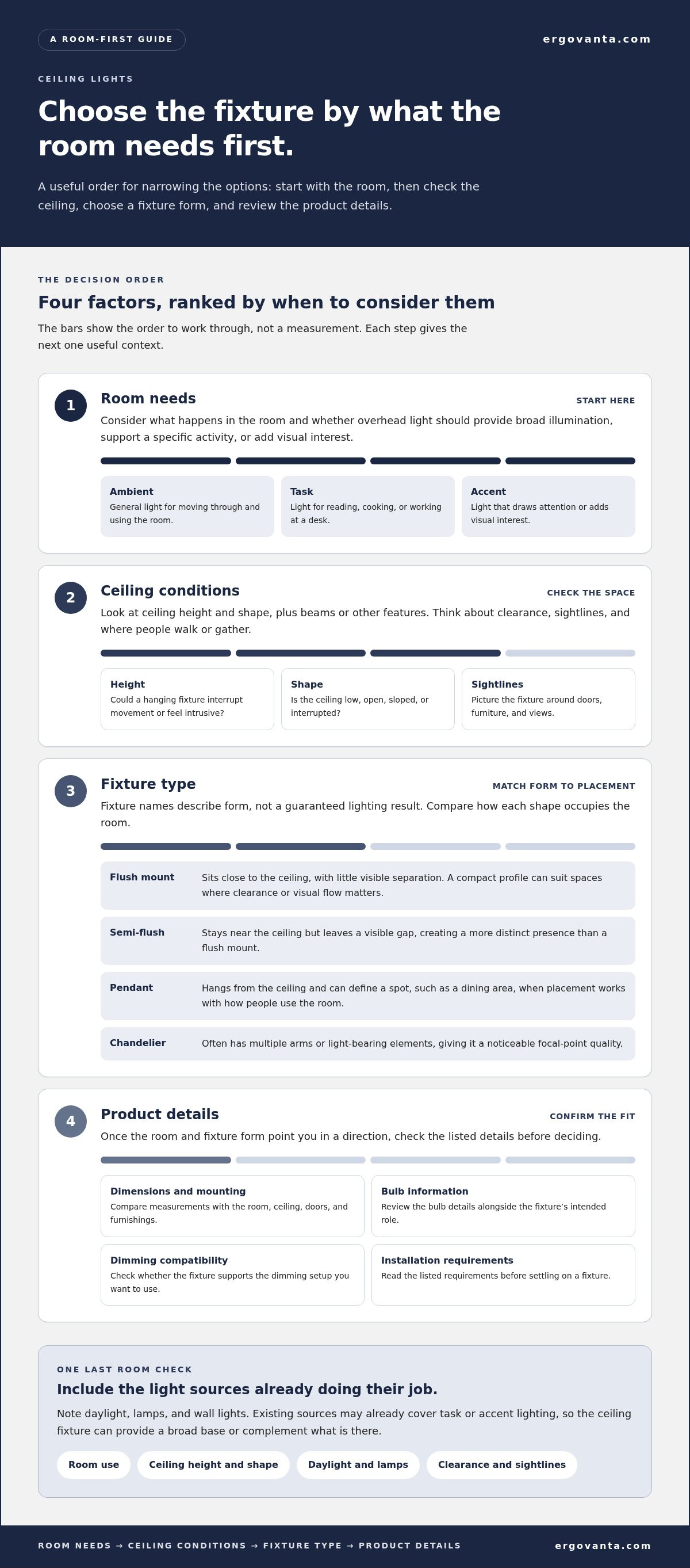
How to Choose Ceiling Lights for Your Room: A Practical Checklist
Turn what you’ve noticed about the room into a shortlist. Work through these steps in order, and product details become easier to compare. A fixture can look right and still be a poor match for the ceiling or the controls already in place. Better to find that out on the listing page than after it arrives.
- 1. Define the room’s use. Note the activities the light should support and whether it needs to provide general illumination, complement another source, or contribute a visual focal point. If the room serves several purposes, identify which one matters most for this fixture.
- 2. Assess the ceiling and surroundings. Consider ceiling height, available clearance, the mounting location, and nearby features such as beams or shelving. For a suspended fixture, think about the space beneath it and the paths people use through the room.
- 3. Choose a fixture format. Narrow the options to a close-to-ceiling fixture, a pendant, or a chandelier based on clearance, placement, and the visual presence you want. The format helps establish fit, but it doesn’t tell you how much light the fixture will provide.
- 4. Compare the listed details. Review dimensions, mounting method, bulb information, stated dimming compatibility, and installation requirements. Compare those details with your ceiling, existing controls, and intended use before choosing.
What should you check on a fixture listing?
Read the dimensions as a description of the actual space the fixture will occupy. For suspended designs, look for the fixture’s overall size and suspension details, then consider its position against sightlines and walking paths. Check the listed mounting method, bulb type or information, and whether dimmer compatibility is stated. Don’t assume every fixture accepts the same bulb or works with the same controls.
Bulb type and fixture design both shape the lighting experience. The listed bulb details help you understand what the fixture is designed to use, while its form and placement affect how it sits in the room. Check the information for the specific option you’re considering. If dimming matters to your routine, look for compatibility details rather than assuming a dimmer will work with every fixture or bulb.
How can you make the fixture feel intentional?
Look at shape, finish, and visual weight alongside the room’s existing elements. A fixture can relate to a table, hardware, or another light without matching every finish in sight. A considered fixture earns its place by fitting the room’s everyday use, not by matching every object in it.
Once you’ve defined the room’s needs, compare lighting options for different rooms to see how ceiling fixtures sit alongside other lighting categories. Keep your shortlist grounded in the actual ceiling and the details on each listing.
Find Ceiling Lights That Fit the Room You Actually Use
A good choice starts with the room, not the scroll. First decide what the light needs to do. Then account for the ceiling and the space around it. Narrow the options by fixture type, and finish by comparing the details on each listing. That order keeps an appealing shape from distracting you from an awkward fit.
Before browsing, jot down a few priorities: what happens in the room, where people walk or sit, what light sources are already there, and what the ceiling can accommodate. These notes don’t need to become a design brief. They just give you a useful filter for deciding which formats deserve a closer look.
How can you narrow the options without overthinking it?
Start with the room’s everyday purpose, then rule out formats that conflict with its constraints. If a suspended fixture would interrupt a walking path or feel too present above the furniture, focus on closer-to-ceiling options. If you want a more noticeable focal point and the placement works, include pendants or chandeliers in your shortlist. No fixture type earns extra credit for being more dramatic.
Keep the shortlist small enough to compare thoughtfully. For each option, consider:
- Shape and scale: Does the fixture feel in proportion to the room and nearby furnishings?
- Placement: Will it sit comfortably with sightlines, movement, and the features around it?
- Product details: Do the listed dimensions, mounting information, bulb details, and stated dimming compatibility fit your needs?
A considered choice doesn’t have to match every object in the room. Look for a detail that connects with the space, such as a shape that relates to the furniture or a finish that sits naturally alongside existing elements. Coordination is useful. Matching everything is a hobby, and not everyone needs one.
What is the next step when you are ready to choose?
Once your priorities are clear, browse Ergovanta’s ceiling lights with your room in mind. Compare fixtures against the conditions you’ve noted, rather than judging them in isolation. A listing can help you assess dimensions and other stated details; your own room tells you whether its form feels right there.
Still deciding between formats or unsure which room details to weigh most? Bring your room priorities and fixture questions to Ergovanta. The goal is a light that works in the space you actually use and feels like it belongs there.
Choose a Light That Belongs in Your Everyday
The right choice should make sense after the novelty wears off. Picture an ordinary evening in the room: the usual routines, people moving through it, and the things you want to see clearly. That’s the test. A fixture doesn’t need to match every detail or become the room’s main event. It needs to feel considered and work with the way you live.
Before you decide, take one last look at your shortlist and ask which option you’ll be glad to see overhead day after day. Ergovanta can help you think through your ceiling-light plans and remaining questions. Start with what matters in your space, then choose at your own pace.
Build a room that feels like yours, one thoughtful choice at a time.
Frequently Asked Questions
Can a ceiling light be the only light source in a room?
Yes, a ceiling light can be enough in a room with straightforward, occasional use, such as a pantry or a short-use hallway. In a room you spend hours in, judge it by what you actually do there. Notice whether the light creates uncomfortable glare on a screen, leaves faces in shadow during conversation, or makes evening routines awkward. Your experience in the room is a better test than a rule about how many fixtures it needs.
How do I know what size ceiling light to choose?
There isn’t one size rule that works for every room. Think about the fixture’s visual footprint in relation to the area it needs to serve, rather than using floor area alone. A long or irregular room may call for a different arrangement than a compact, open one. Also consider whether the fixture is one of several in the space. The goal is a considered fit, not the largest fixture the ceiling can hold.
Are LED ceiling lights better than fixtures that use replaceable bulbs?
Neither option is best for everyone. An integrated LED fixture has its light source built in, so check the listing for information about the LED unit and what happens if it needs attention later. Replaceable-bulb fixtures let you change the bulb separately, but you’ll need to follow the stated bulb requirements. Choose based on the maintenance approach you prefer, not just the word “LED” on the product page.
Can I put a pendant light in a room with a low ceiling?
Sometimes. A pendant with an adjustable suspension may work if it can be positioned appropriately for the room, but some fixtures have a fixed drop. Check the product details for how the suspension is configured instead of assuming it can be shortened. If the available options won’t suit the space, consider a close-to-ceiling form. The right choice depends on the specific fixture and room, not the category name alone.
Can ceiling lights work with a dimmer switch?
Yes, if the fixture or bulb and the dimmer are designed to work together. The dimmer itself matters, too: an existing wall control or smart control may have its own compatibility requirements. Check the fixture and bulb information alongside the control’s instructions. If the light flickers, buzzes, or behaves inconsistently after setup, stop using that combination and get advice from an electrician rather than assuming the fixture is faulty.
How do I choose a ceiling light for a dining table?
First consider where the table sits in relation to the ceiling’s existing electrical point. If the table moves or expands, a fixture centered over its usual position may no longer align with the setup. Think about how the dining area changes for meals, homework, or other activities, too. A light that suits a fixed arrangement may be less practical if the table regularly shifts around the room.
Can I install a ceiling light myself?
Possibly, if the work is within your experience and the existing mounting point is suitable for the fixture. Before starting, read the manufacturer’s instructions and check what mounting hardware and support the fixture requires. Don’t assume an existing ceiling box is appropriate for every replacement. If the wiring, support, or installation steps are unfamiliar, pause and hire an electrician. A careful stop is better than an improvised connection.
Disclaimer
Ergovanta publishes these guides to help people set up better workspaces. Product recommendations reflect what we sell. Specifications, prices and availability are accurate at the time of writing and may change. Nothing here is medical, ergonomic or professional advice; if you have a specific health concern about your workstation, speak to a qualified professional.
From the catalog