October 12, 2026
Energy-Efficient Home LED Lighting: A Buying Guide
A brighter bulb isn’t automatically the better choice. Choosing energy efficient LED lighting for home means looking past wattage to the light a room actually needs.
Labels can feel like a small puzzle: watts describe energy use, lumens indicate brightness, and color temperature gives a sense of whether light appears warm or cool. You also need to know whether a bulb fits your fixture, works with a dimmer, and suits the way you use the room. Choose by wattage alone and you could end up with light that feels too bright, too cool, or wrong for the task.
This guide shows you what to compare and how to make the choice room by room. Start with the activity, then check light quality, fixture fit, and energy use. From focused light at a desk to softer light in a living area, the aim is to build a considered plan around everyday use, not give every room the same bulb.
Key Takeaways
- Compare lumens, watts, color temperature, color rendering, and dimmer compatibility to understand what a bulb will do beyond its wattage.
- Choose energy efficient LED lighting for home by balancing energy use with the look and function each room needs.
- Separate ambient, task, and accent lighting so different activities get the right kind of light.
- Use a simple room-by-room process to match lighting choices to existing fixtures and daily routines.
- Start with room purpose, light quality, and fixture fit, then compare energy use.
What Makes Energy-Efficient LED Lighting a Good Fit for Home?
LED lighting produces light using light-emitting diodes. It can provide useful illumination while using less electricity than less-efficient lighting options, making it a practical choice for rooms you use every day. The important part is matching the light to the space instead of choosing by one number on a label.
Brightness is the visible light a lamp gives off; wattage is the electricity it uses. That distinction makes shopping easier. A bulb’s wattage describes its energy consumption, not how bright it will look. Lumens measure visible light output, so they’re a more direct way to compare brightness. A lower-wattage option can still provide enough light for a task. Whether it does depends on the output and how you use the room.
LEDs are available as replaceable bulbs or as light sources built into fixtures. The form affects how you choose a light and what replacement may involve later. Wikipedia’s overview of LED lamps explains how the technology works and its use in energy-efficient lighting. To consider the fixture as well as the bulb, explore home lighting options.
How LED Efficiency Differs from Brightness
Wattage alone can’t tell you how bright a bulb will appear. It tells you how much electricity the bulb uses, while lumens indicate its light output. Check both figures: lumens help you judge whether the light suits the room, and watts help you compare energy use. You can also divide lumens by watts to compare how much light different bulbs provide for the energy they use. A more efficient bulb still needs to provide enough light for the task.
For example, a reading spot needs light that makes the page easy to see, while a room used for winding down may call for gentler illumination. The useful question isn’t simply, “Which bulb uses less?” It’s, “Does this bulb provide the light I need without unnecessary energy use?” That’s the point of energy efficient LED lighting for home: choose for the room, not the label alone.
LED Bulbs and Integrated LED Fixtures
A replaceable LED bulb fits into a compatible existing fixture. It can be a straightforward way to update a lamp or ceiling light, as long as the base, size, and other requirements suit the fixture. Integrated LED fixtures have the light source built in, so there isn’t a standard bulb to unscrew and replace.
Consider the fixture’s design and future replacement needs before choosing. With a replaceable bulb, you can swap the bulb when it reaches the end of its use. With an integrated fixture, replacement may involve servicing a component or replacing the fixture, depending on its design. Neither option suits every room by default. Choose based on your existing setup, the light you want, and how you prefer to maintain your space.
Which LED Lighting Details Matter Beyond the Wattage?
Product labels are most useful when you compare several details side by side. Rather than picking the smallest wattage figure, look for a combination that suits the room’s purpose, the fixture, and the light you want to live with. For energy efficient LED lighting for home, the right choice is a fit across the label, not a win in one column.
Lumens, Watts, and Color Temperature
Use the lumens and watts on the label to compare light output and energy use. Color temperature describes whether light appears warmer or cooler; it doesn’t indicate efficiency. Treat it as a matter of preference and use. A label can help you compare options, but the right appearance depends on your space and routine.
| Specification | Compare on the label | Consider for your room |
|---|---|---|
| Lumens | How the listed light output compares with other options. | Whether the amount seems suited to the task and area. |
| Watts | How much electricity each option uses. | Energy use alongside the light you need, rather than alone. |
| Color temperature | The stated light appearance, from warmer to cooler. | The mood and activity you want the light to support. |
| Color rendering | Any information about how naturally colors appear. | Whether accurate-looking colors matter for the room’s activities. |
| Dimmer compatibility | Whether the bulb is identified as compatible with dimming. | Whether the bulb and control are specified to work together. |
Read the full label instead of comparing one figure in isolation. A bulb may have an appealing color temperature but not enough output for the task, or it may not be compatible with the controls in your fixture. Compare the specifications against the room and the setup you already have.
Color Rendering and Dimming Compatibility
Color rendering affects how familiar objects look under a light source. It matters in places where color influences the task, such as when reading printed material, preparing food, choosing clothes, or displaying artwork. Compare the color-rendering details on labels when seeing colors naturally is important to you. It’s a practical consideration, not a promise that one specification will feel right in every room.
Dimming requires a separate compatibility check. Look for a clear indication that the bulb is dimmable, then compare its product information with the dimmer’s specifications. A bulb may fit the socket and still be a poor match for the control. Dimming behavior can vary by bulb and dimmer, so check the pairing rather than assuming the switch will work with any bulb.
Use these details to narrow your choices by room and fixture. As you compare lighting for different rooms, weigh the label against the effect you want. Explore Ergovanta’s lighting options to find a fixture type that suits your space.
Does the Most Efficient LED Always Make the Best Home Lighting?
No. Efficiency matters, but it can’t tell you whether a light feels right over a dining table, supports a focused task, or fits the fixture you already own. A considered choice balances energy use with the room’s purpose, the light’s appearance, available controls, and practical fit.
Think about the whole setup. A shade can soften or direct light; a desk lamp can place it close to a work surface; an overhead fixture spreads it differently through a room. The same light source can feel different depending on its position and the fixture around it. Choose for the experience you want in the space, not for a label in isolation.
When Efficiency and Room Comfort Need Balancing
Start with what happens in the room. Reading or another focused activity may call for clear, directed light. A space used for relaxing may feel better with a gentler effect. A shared room can serve both purposes at different times, so consider which activities matter most and how the lighting can support them.
Placement shapes the experience, too. A source aimed at a work surface has a different role from one that spreads light across the room. Weigh energy use alongside the comfort and function you need. The goal is to support the room’s actual use without letting one lighting choice dictate how every corner feels.
Common LED Selection Mistakes to Avoid
Before settling on a bulb or fixture, watch for choices that seem convenient but may not suit your setup:
- Choosing by one label detail. Compare the full set of specifications with the room’s purpose and the light you want there.
- Overlooking control pairing. Confirm that a bulb and dimmer are specified to work together, since their behavior can vary by product.
- Forgetting the fixture itself. Check the bulb’s fit and stated requirements against the fixture’s shape and placement.
- Using identical specifications everywhere. Rooms with different routines can call for different light qualities and arrangements.
Before buying, picture the light in its actual position. Does it suit the activity, feel right in the room, and work with the fixture and controls? Then weigh energy use against those practical needs. Explore lighting options for your space as you work through the setup.
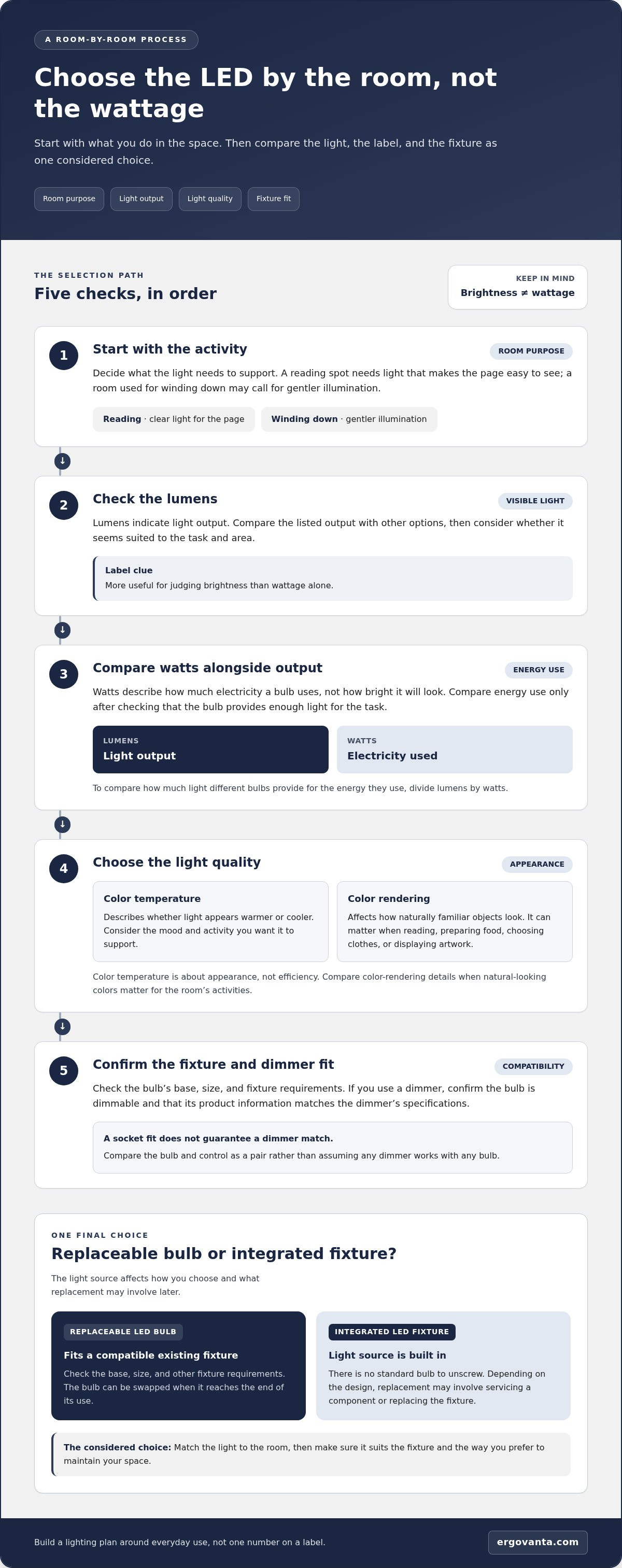
How to Choose Energy-Efficient LED Lighting Room by Room
A simple process keeps the decision grounded in how each room is used. Work through these steps before you buy, and you’re less likely to end up with a bulb that fits the label but not your life.
- Identify the activity. Is the room mainly for reading, cooking, relaxing, or several things? Name the main task first. A kitchen work surface and a bedroom used for winding down don’t need identical lighting.
- Assess existing fixtures and daylight. Notice where natural light reaches, when it fades, and what your fixtures already do. Check bulb bases and any stated requirements before choosing replacements.
- Compare product labels. Match light output and appearance to the activity, then consider energy use, color rendering, and dimmer compatibility where relevant. The label is a comparison tool, not a room plan by itself.
- Decide where light should land. Choose a position that serves the task or fills a darker area. That can be more useful than adding a fixture where it won’t help.
Match Light to the Room's Main Activity
Ambient lighting provides general visibility across a room. Task lighting directs light toward focused activities, such as reading, preparing food, or working at a desk. Accent lighting draws attention to a feature or object. These are different roles, and one fixture doesn’t have to do all three.
In a kitchen, consider the difference between general room light and illumination where food is prepared. In a bedroom, existing daylight and the evening routine may shape what feels useful. A living room might need general light plus a reading spot, while a work area benefits from light directed at the task. Explore home lighting options by fixture type as you plan what each room needs.
Check Fixture Fit and Plan Light Layers
Before buying, check the bulb base, fixture requirements, and dimmer compatibility. Then consider placement: ceiling fixtures can provide general light, while wall lights can add light at a particular point. A desk lamp can direct light onto a work surface. For a freestanding source beside a chair or in a darker corner, compare floor lighting options with the room layout.
Layering ambient, task, and accent light gives each source a clear job. Start with the light the room needs most, then add another layer only if it solves a real problem. That’s a practical way to build energy efficient LED lighting for home around use, not habit.
Energy-use formula: Multiply a light’s watts by the hours it’s used, then divide by 1,000 to estimate electricity use in kilowatt-hours for that period.
The formula helps compare use without assuming an electricity rate. Apply it to the period you care about, such as a day or week, and use the same period when comparing lights.
Build a Home Lighting Plan Around LED Choices That Fit Your Space
A useful lighting plan starts with the room, not the product label. Decide what the space needs to support, choose the light quality that suits those activities, check fixture compatibility, and then compare energy use. This order keeps efficiency in the decision without letting it make every decision for you.
A plan can also show where another fixture would solve a real problem. A dark work surface may need focused light, while a room that feels dim overall may call for broader illumination. Build energy efficient LED lighting for home around those specific needs instead of adding lights by default.
Choose Fixtures for the Light a Room Needs
Desk lamps can direct light toward a reading or work area. Ceiling fixtures can provide broader illumination across a room, making ceiling lighting options worth considering when general visibility is the priority. Wall lights offer another way to arrange light around your layout.
Think about where people sit, read, work, or move through the room. A desk lamp near a work surface may complement existing ceiling light; a wall light may suit a spot where a floor fixture would take up useful space. In another room, the ceiling fixture alone may do the job. Choose by layout and routine, not by a rule that every room needs the same combination.
Make the Next Step a Considered Choice
Before selecting a bulb or fixture, review the details that shape its fit: light output, wattage, color temperature, color rendering, and dimmer compatibility. For a replaceable bulb, check its base and the fixture’s requirements. If the light has an integrated source, consider how that design fits your preferences for the fixture and future replacement.
Then match the fixture category to the role you need it to play. Browse desk lamps for focused light, ceiling lights for broader room illumination, or wall lights for another arrangement. These are fixture categories, not a promise that every option uses LED technology. Review product details and choose an option that works with your space and lighting plan.
A considered plan doesn’t need to be complicated. Give each light a job, check its practical fit, and compare energy use once the room’s needs are clear. That’s a better starting point than buying the same bulb for every socket and hoping the rooms agree.
Make Your Next Lighting Choice Work Harder
Start with one room and one clear need. The best next step for energy efficient LED lighting for home is to choose a fixture and light source that make sense for how you use that space, rather than changing everything at once. A focused choice is easier to live with than a house full of bulbs bought on autopilot.
Ergovanta offers desk, floor, wall, ceiling, pendant, and chandelier lighting categories to consider as you shape your setup. Explore fixture types that suit your layout, then review each product’s details before deciding whether it fits your lighting plan. The room is yours. The plan should be, too.
Choose with intention, make room for what works, and build a home that feels right to return to.
Frequently Asked Questions
Can I use LED bulbs in my existing light fixtures?
Often, yes, but a bulb that screws in may still be too large or unsuitable for the fixture’s design. Check clearance around the bulb, especially inside a shade or enclosed housing, and review the fixture’s label or manual for restrictions. If the fixture has several sockets, make sure each bulb fits without touching neighboring bulbs or the shade.
Do LED bulbs work with dimmer switches?
Some LED bulbs work with dimmers, but the result can vary. Choose a bulb and dimmer specified to work together, then try the light at the settings you’ll actually use. Watch for flicker, sudden shutoff, or a narrow dimming range. If several bulbs share one switch, testing one first can help you spot an unwanted effect before changing them all.
Why do some LED lights flicker?
Flickering can come from the bulb, its controls, or an electrical issue. If it happens with a dimmer, note whether it appears only at certain settings. If it continues at full brightness, turn the light off before checking that the bulb is seated securely. You can also see whether the flicker follows the bulb to another suitable fixture. Persistent flickering deserves attention from a qualified electrician.
How do I choose LED lighting for a room with little natural light?
Notice where the room feels darkest and when you use it, then position light to address those spots. Light-colored walls and surfaces may help distribute illumination, while glossy surfaces can create glare if a lamp points directly at them. In a work area, keep the light source out of your direct line of sight and check that it doesn’t reflect on a screen.
Are integrated LED fixtures different from LED bulbs?
Yes. The practical difference is how you plan for replacement. With a bulb-based fixture, you replace the bulb; with an integrated design, future replacement depends on the fixture. Consider this before choosing a fixture style, particularly if you want to keep the same fixture in place for a long time. Product information can clarify what maintenance the design allows.
How can I calculate how much electricity an LED light uses?
Use the light’s wattage and its actual hours of use with the calculation described earlier. For a room with several lights, work out each one over the same period, then add the results. This gives a more realistic estimate than treating every bulb as if it runs for the same number of hours. Keep a short usage note if your routine changes from day to day.
Should every room in a home use the same color temperature?
No. The choice can vary with the room’s use and the atmosphere you prefer. In open-plan areas or rooms visible from one another, consider how the lighting looks across the shared sightline. You may prefer a consistent appearance between connected spaces, or a deliberate change where the use shifts. Judge the transition from the places where you spend time, not only beneath each fixture.
Disclaimer
Ergovanta publishes these guides to help people set up better workspaces. Product recommendations reflect what we sell. Specifications, prices and availability are accurate at the time of writing and may change. Nothing here is medical, ergonomic or professional advice; if you have a specific health concern about your workstation, speak to a qualified professional.
From the catalog