October 1, 2026
Guide to Vintage and Mid-Century Desk Lighting Styles
The lamp with the strongest vintage look may be the wrong one for your desk. A sculptural shade can set the mood, but your daily work also needs light that suits the task. Vintage and mid-century desk lighting can be easy to confuse, especially when a listing uses the labels loosely.
You don’t have to choose between character and function. This guide explains the visual cues that distinguish vintage pieces from mid-century styles, then shows how to compare lamps for your workspace. You’ll also find what to check in a listing, including condition, construction, and bulb compatibility. Start with the work your desk needs to support, then choose a design that fits the space and your routine.
Key Takeaways
- Vintage describes a lamp’s age or provenance; mid-century modern describes a design movement. A lamp can be both, but the labels aren’t interchangeable.
- Judge vintage and mid-century desk lighting by how well it directs light toward your actual work, not just by its silhouette.
- Compare authentic vintage, vintage-inspired, and contemporary options by provenance, condition details, and how clearly the listing answers your questions.
- Before choosing a lamp, define the task, measure your desk, and consider nearby screens, placement, and visual weight.
- Choose a considered design that works for your routine and earns its place in your space.
What Makes Desk Lighting Vintage or Mid-Century Modern?
Vintage desk lighting refers to older lamps, while mid-century modern describes a design movement and its visual language. The distinction matters: age is about when an object was made; style is about how it was designed. A lamp may fit one label, both, or neither.
Clean lines and purposeful shapes are common mid-century cues, but they’re not proof of age. A streamlined lamp could be a newer design inspired by the period. For a broader overview of the style, see Mid-century modern design.
This example offers a closer look at a lamp presented as vintage and mid-century modern:
How to recognize mid-century modern desk lamp design
Look at the lamp as a composition. The shade gives the upper part of the lamp its visual weight, the stem connects it to the desk, and the base anchors the silhouette. Mid-century modern designs often use simple, purposeful forms with restrained decoration. Together, those parts can create a balanced shape without ornate detail.
No single material, color, or shade shape defines the style. Consider how the parts relate: Is the shade in proportion to the stem? Does the base look like an intentional part of the design? Use these cues to describe the look, not as a checklist that every lamp must pass.
Vintage, vintage-inspired, and contemporary: what is the difference?
An authentic vintage lamp is an older item. A vintage-inspired lamp borrows period cues but may have been made much later. A contemporary lamp can use a mid-century-influenced silhouette without claiming to be vintage or a reproduction. A familiar shape alone doesn’t establish age, maker, or authenticity.
Check the listing for information about age or provenance, maker details, and condition. Look for close-up photos of marks and signs of wear, and ask about details that matter to you but aren’t provided. A shape tells you about appearance, not history. For another way to explore the look, browse vintage-style lighting, then compare each option using the information in its listing.
Which Design Details Make a Mid-Century Desk Lamp Useful?
A desk lamp earns its place by helping with the work in front of you. Before choosing one for its silhouette, consider where its light will fall. A shade that directs light toward a notebook may suit writing; a lamp that mostly adds a glow around the room may be better for atmosphere. Neither is automatically the right choice. It depends on what you do at your desk.
Think through a typical work session. Do you read printed pages, write by hand, work on a screen, or switch between tasks? One lamp can contribute to your overall lighting without meeting every need. For screen work, consider whether the lamp’s planned position could create reflections. For reading or writing, check that its light can reach the area you use without forcing you to shift the page or your position.
Does the lamp support focused work or mainly add atmosphere?
Task lighting puts light where a specific activity happens. Ambient lighting contributes to a room’s general brightness, while accent lighting draws attention to an object or corner. A desk lamp can contribute to more than one, but its shade and direction affect how useful it is for each purpose. Check product details for where the light is directed and compare that with your routine, rather than judging from the styling in a photo.
The shade can direct light downward, outward, or elsewhere depending on its design. If the listing says that parts are adjustable, check what moves and whether that range would help you aim light at your work. Don’t assume a joint or arm moves just because it looks as if it could.
How shape, shade, and placement affect desk use
Picture the lamp in its intended spot. Would the shade sit in your line of sight? Could light fall onto your screen? Would the base take up room you need for a notebook or other frequently used items? Consider the lamp’s height and footprint alongside nearby screens, shelves, and work materials. A striking design can still feel awkward if it crowds the surface or interrupts your view.
Comfort is personal, so consider whether the light feels too direct, too dim for the task, or distracting in your actual setup. Product details can help you assess the shape and stated features, but they can’t tell you exactly how a lamp will feel in your room. If bulb type or compatibility matters, verify it in the listing. The U.S. Department of Energy’s history of the light bulb offers context on how lighting technology has changed. For a specific lamp, use its own product details to confirm what it supports.
Use the same practical checks for vintage and mid-century desk lighting: identify the task, consider the direction of light, and make sure the lamp fits the available space. If you have a question about a particular listing, you can get in touch through the contact page.
Vintage vs. Mid-Century-Inspired Desk Lamps: How to Compare Your Options
Three lamps can share a similar silhouette and have very different stories. One may be an older piece with documented provenance, another a newer design borrowing vintage cues, and a third a contemporary lamp with a mid-century-influenced shape. Compare the available evidence and product details, not just the label.
| Option | Provenance | What to check | Confidence in details |
|---|---|---|---|
| Authentic vintage | Older item; age or maker may be documented | Condition, repairs, included parts, electrical state, and compatibility | Depends on evidence and listing detail |
| Vintage-inspired | Newer design that borrows period cues | Construction, lighting details, and any stated features | Depends on how clearly the seller describes the lamp |
| Contemporary mid-century-style | Newer lamp using a mid-century-influenced look | Materials, dimensions, light direction, and compatibility | Depends on the product information provided |
None is automatically the more durable or useful choice. Condition and compatibility vary by lamp, so confirm the details that matter before purchasing. Clear photos and specific descriptions make comparison easier; a style label alone doesn’t tell you how a lamp was made or how it has been cared for.
When an authentic vintage lamp may suit your space
Choose this route if you’re drawn to visible age, one-of-a-kind character, or a history you can trace. Read condition notes closely and inspect photos for wear, damage, repairs, or missing parts. If the listing leaves questions about wiring or electrical condition, ask the seller and have a qualified source assess the lamp before use. Check bulb and electrical compatibility for that specific piece.
When a vintage-inspired desk lamp may be a more practical fit
A newer lamp can bring period-influenced lines to your desk without being an antique. Its condition and product information may differ from those of an older piece, so read the listing rather than assuming what it includes. Check what it says about construction, light direction, bulb compatibility, and adjustable parts. Weigh those details against how much character and provenance matter to you.
Use the same checklist across vintage and mid-century desk lighting: what’s known, what’s shown, and what still needs verifying. The right choice is the one whose history, condition, and specifications make sense for your space and daily work.
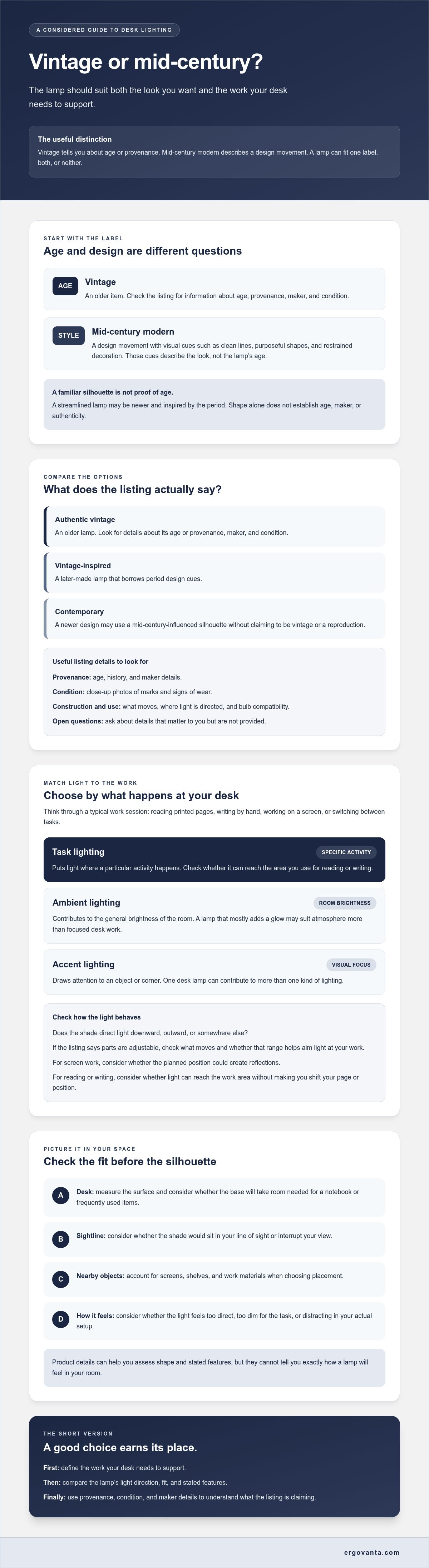
How to Choose and Place Vintage Desk Lighting in Your Workspace
Choose a lamp for the desk you actually use, not an imaginary one with nothing on it but a notebook. A simple sequence keeps the decision grounded: define the task, measure the space, shortlist styles, verify the listing, then consider placement.
A quick checklist before you choose
- Define the task: Name the main job, such as reading, writing, screen work, or a mix.
- Measure the available space: Check desk depth and the room left for your usual objects. Compare those measurements with the lamp’s listed dimensions, if provided.
- Shortlist styles: Decide whether you want the lamp to blend with your setup or bring in a distinct shape or period reference.
- Verify product details: Check listed materials, light source, controls, and any other features you need. If a detail matters but isn’t stated, don’t treat it as a given.
- Assess placement: Consider nearby screens, your line of sight, and where the light is directed from the lamp’s intended position.
This order helps separate useful product information from attractive photography. If a detail is missing from the listing, don’t assume it based on the lamp’s silhouette.
Make the lamp feel at home on your desk
Use your current setup as context, not a matching game. Notice the desk’s materials and colors, along with the finishes of nearby objects. A lamp can echo one of those details, contrast with them, or become a focal point on its own. Matching every finish can make a room feel more like a showroom than a space you use.
Think about visual weight as well as footprint. A broad shade or substantial-looking base may draw the eye even if it fits on the desk. If your surface already holds screens, notebooks, or tools, a quieter silhouette might feel more at home. If the desk is otherwise spare, a distinctive lamp can give it a clear point of focus.
Browse vintage-style lighting for visual references, then compare any option with your measurements and the details in its listing. The best fit supports your routine and feels intentional in your room. Vintage and mid-century desk lighting can bring character to a workspace, but it still has to work on your actual desk.
Build a Workspace That Works With Vintage and Mid-Century Lighting
A desk lamp can support your work and bring a considered shape to the room. You don’t have to choose between useful light and a style you enjoy looking at. The best fit is the one that makes sense for your routine, your desk, and the way you want the space to feel.
Bring the style into a lived-in workspace
Let the lamp relate to what’s already there. It might pick up on the tone of a desk, echo a finish on a nearby object, or add contrast beside everyday tools. It doesn’t need to match every surface. A little difference can make a workspace feel more personal than a perfectly coordinated set.
Think about the room you actually use. A desk shared with notebooks and supplies has different needs from a compact setup built around a screen. In either case, consider how the lamp’s shape sits among the objects you reach for. Should it quietly fit in, or become a focal point? There’s no single right arrangement, only the one that feels intentional and works for you.
Useful rooms are built around the people who use them, not an idealized photo. Leave room for the habits and tools that make your desk yours. Vintage and mid-century desk lighting can add character, but the lamp still needs to earn its place in your everyday setup.
Explore lighting that fits your space
If you’re comparing a desk lamp with lighting elsewhere in the room, Ergovanta offers desk lamps alongside floor lamps, wall lights, ceiling lights, pendants, and chandeliers. Browse the broader lighting collection to consider options across the space. Check each listing for the details that matter to your setup rather than assuming every lamp shares the same features.
Keep your decision simple: choose for the work, consider how the lamp fits with your existing materials and objects, and verify the product details before you commit. The result doesn’t need to look like anyone else’s desk. It needs to feel right for yours.
Choose a Lamp That Earns Its Place
Vintage describes age or provenance; mid-century modern describes a design language. Keep that distinction in mind as you compare lamps, and treat a familiar silhouette as a style cue, not proof of a lamp’s history.
Then bring the choice back to your desk. Think about the work you need the light to support, whether the lamp can direct light where you need it, and how its size and shape will fit among your everyday tools. For older pieces, review condition and verify electrical details and compatibility before use. For newer designs, check the product listing rather than assuming features from the look.
Ergovanta sells desk lamps and offers a broader lighting collection alongside a vintage-style category. Use them as starting points while you decide what belongs in your space. The right vintage and mid-century desk lighting can bring practical use together with a shape you enjoy seeing each day.
Build a workspace that feels like yours, one considered choice at a time.
Frequently Asked Questions
What is the difference between vintage and mid-century modern desk lighting?
Vintage describes a lamp’s age or provenance, while mid-century modern describes a design movement and its visual language. A lamp can be vintage without being mid-century modern, or newly made with a mid-century-inspired shape. With vintage and mid-century desk lighting, treat clean lines or a distinctive shade as style clues, not proof of age or maker. Check the listing and provenance details before relying on the label.
Is a mid-century desk lamp practical for focused work?
Yes, if its shade and light direction suit your work and the lamp can be placed well. For reading or writing, check whether light can reach the page. For screen work, consider whether the planned position could cause distracting reflections. Review the listing for adjustable parts rather than assuming they move. A desk lamp can help with focused tasks, though one fixture may not meet every lighting need.
Can vintage desk lamps use modern bulbs?
Some vintage desk lamps may work with modern bulbs, but compatibility depends on the individual lamp. Check the required bulb type and any limits stated in its product details. Don’t assume a modern bulb will fit or be suitable. If an older or modified lamp has unclear electrical condition, ask a qualified professional to assess it before use. Prioritize the lamp’s actual specifications over general claims.
How do I choose the right desk lamp for my workspace?
Start with the task, then check the space and product details. Consider whether you mainly read, write, work on a screen, or switch between tasks. Measure the room available on your desk and compare it with the lamp’s listed dimensions. Check where its shade directs light and whether any listed controls suit your routine. Finally, picture it beside your screens and everyday tools before deciding.
What should I check before buying an authentic vintage desk lamp?
Look for evidence supporting its age or maker, then review the condition description and photographs closely. Ask about repairs, missing parts, and details that aren’t clear in the listing. Confirm the lamp’s electrical condition and bulb compatibility with a qualified source, especially if it’s old or has been modified. A distinctive shape can catch your eye, but it can’t confirm provenance or tell you whether the lamp is ready to use.
Can a desk lamp provide both task lighting and ambient lighting?
It can contribute to both, depending on its design, light direction, and placement. A lamp aimed at a page provides more localized light, while light that spreads into the room may add to the overall atmosphere. Check the product details and consider how the lamp feels in your setup. One desk lamp doesn’t have to do everything; it can be one useful part of your room’s lighting.
How do I style a vintage desk lamp without making my desk feel cluttered?
Give the lamp room to work and keep the objects you use most within easy reach. Consider how its size and visual weight sit beside your screen, notebooks, and existing decor. You might echo a nearby finish or add contrast, but there’s no need to match everything. If the lamp is a focal point, let a few surrounding objects stay simple. A clear surface helps each item earn its place.
Disclaimer
Ergovanta publishes these guides to help people set up better workspaces. Product recommendations reflect what we sell. Specifications, prices and availability are accurate at the time of writing and may change. Nothing here is medical, ergonomic or professional advice; if you have a specific health concern about your workstation, speak to a qualified professional.
From the catalog