August 1, 2026
Office Wall Lighting Ideas: Build a Workspace That Works for You

Your desk lamp is taking up space your work actually needs. If you've ever pushed your lamp aside to make room for a notebook, a second monitor, or just room to think, you already know the problem. Office wall lighting ideas exist precisely to solve this: get the light off the surface and onto the wall, where it can do its job without crowding yours.
Most people default to a desk lamp because it feels like the obvious move. It's familiar, it's easy, and it ships fast. But that default costs you real estate on the one surface where everything happens. A cluttered desk isn't just an aesthetic issue; it's a friction issue. The more stuff competing for space, the harder it is to settle in and actually work.
This guide walks you through practical office wall lighting ideas that free up your desk, reduce eye strain from harsh overhead fixtures, and help your workspace feel like a place you chose rather than one you're just tolerating. No cords snaking across your surface. No lamp base eating into your elbow room. Just considered light, placed where it actually helps.
Key Takeaways
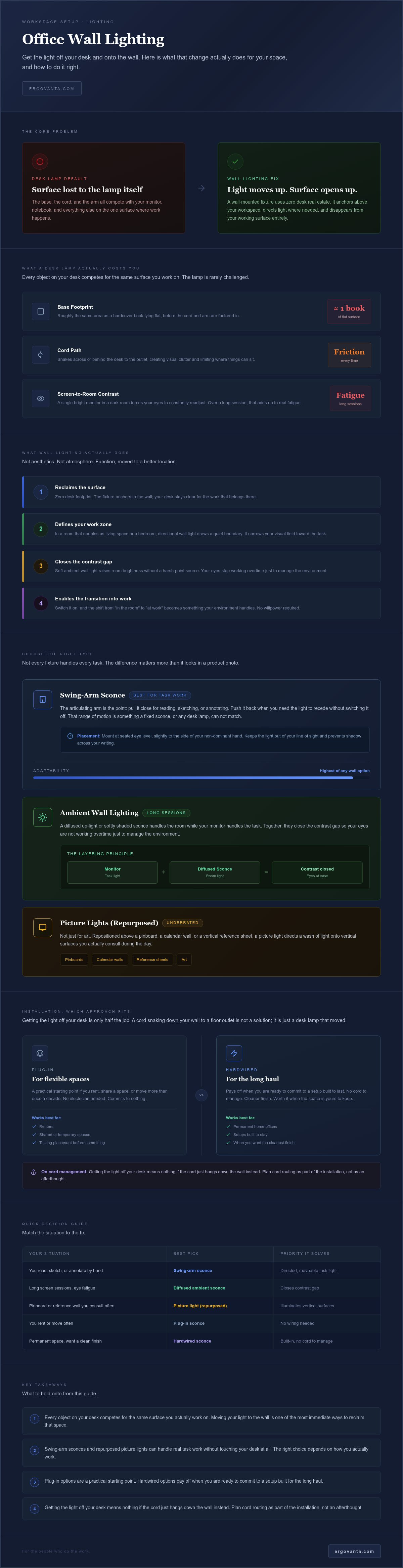
- Every object on your desk competes for the same surface you actually work on; moving your light to the wall is one of the most immediate ways to reclaim that space.
- The right office wall lighting ideas go beyond aesthetics: swing-arm sconces and repurposed picture lights can handle real task work without touching your desk at all.
- Plug-in wall lights are a practical starting point if you rent or move often, but hardwired options pay off when you're ready to commit to a setup built for the long haul.
- Getting the light off your desk means nothing if the cord just hangs down the wall instead; this article covers how to manage that so the fix stays clean.
Why wall lighting earns its place in your workspace
Every object on your desk made a case for being there. Your monitor earned its spot. So did your keyboard. The question is whether your lamp did the same, or whether it just showed up by default and never got challenged.
Wall lighting earns its place by doing the job without taking the surface. That's the argument. Not aesthetics. Not atmosphere. Pure function, moved to a better location.
Reclaiming your desk surface
A standard desk lamp base occupies roughly the same footprint as a hardcover book lying flat. That's before you account for the cord running to the nearest outlet, the arm extending over your work area, and the mental friction of working around something that doesn't move when you need it to. A wall-mounted fixture uses none of that real estate. It anchors above your desk, directs light where it's needed, and disappears from your working surface entirely.
Clearing that space does something quieter than you'd expect. Less visual noise means fewer micro-decisions about where to put things. Your desk stops being a negotiation and starts being a surface you actually use. If you're building a setup from scratch, that shift is worth treating as a foundation, not an afterthought. The right workspace essentials work together to keep the surface clear and the setup considered.
Defining the work zone
Office wall lighting ideas do something a ceiling fixture can't: they anchor a specific area. In a room that doubles as a living space, a bedroom, or a guest room, a wall light positioned above your desk draws a quiet boundary. It says this part of the room is for working.
That boundary is more useful than it sounds. Directional light narrows your visual field toward the task in front of you. It reduces the pull of everything else in the room. You sit down, you switch it on, and the transition from "in the room" to "at work" becomes something your environment handles for you instead of something you have to manufacture through willpower.
Build the space so it does some of that work. You'll notice the difference.
Functional office wall lighting ideas to equip your space
Knowing you want light off your desk is the easy part. Knowing which type of wall light actually fits the work you do is where most people stall. Not every fixture handles every task, and the difference matters more than it looks in a product photo.
Swing-arm sconces for task focus
A swing-arm sconce is the most adaptable office wall lighting idea you can install. The articulating arm is the point: pull it close when you're reading a printed document, sketching, or annotating something by hand. Push it back when you're focused on a screen and need the light to recede without switching it off entirely. That range of motion is something a fixed sconce, or any desk lamp, can't match.
Placement matters here. Mount it roughly at eye level when seated, slightly to the side of your non-dominant hand. That positioning keeps the light out of your direct line of sight and prevents it from casting a shadow across whatever you're writing. Browse the wall lights collection if you're looking for functional options that work for real task hours, not just mood.
Ambient wall lighting for the long haul
A single bright monitor in a dark room is a recipe for eye fatigue. The contrast between the lit screen and the surrounding darkness forces your eyes to constantly readjust, and over a long session that adds up. Soft, diffused wall lighting solves this by raising the ambient brightness of the room without introducing a harsh point source.
Think of it as layering. Your monitor handles the task. A diffused up-light or softly shaded sconce handles the room. Together, they close the contrast gap, so your eyes aren't working overtime just to manage the environment.
Picture lights are worth considering here too, not just for art. Repositioned above a pinboard, a calendar wall, or a vertical reference sheet, they direct a wash of light onto vertical surfaces you actually consult during the day. That's a specific, practical use case most fixture guides skip entirely.
If you're building out your setup and want to see how wall lighting fits alongside the rest of what's on your desk, the full lighting range is a good place to map it out.
How to install and layer wall lighting for the long haul
Getting the light off your desk is only half the job. The other half is making sure the installation doesn't trade one problem for another. A cord snaking down your wall to a floor outlet isn't a solution; it's just a desk lamp that moved.
Plug-in solutions for flexible spaces
Not everyone can hardwire a sconce. Renters, people in shared spaces, and anyone who moves more than once a decade have real constraints here, and most office wall lighting ideas guides skip past this entirely. Plug-in wall lights are a legitimate answer, not a compromise, as long as the cord is treated as part of the installation rather than an afterthought.
Two approaches work well in practice:
- Cord covers: Rigid plastic or fabric cord channels mount flush to the wall and can be painted to match. They route the cord vertically down to the baseboard, where it disappears into the room's existing visual logic.
- Intentional routing: Run the cord behind a bookshelf, along a desk leg, or through a cable management tray. The goal is a single clean line, not a hidden mess.
If you're eventually planning to hardwire, a plug-in sconce in the right position now still earns its place. You're testing the location before committing to it.
Equipping the room for the work
Wall lighting doesn't operate in isolation. It works best when the rest of your setup is also considered. A monitor or laptop stand raises your screen to eye level, which changes where shadows fall and how much ambient light your wall fixture actually needs to contribute. Get the screen height right first, then position your wall light to complement it rather than compensate for a poorly placed monitor.
The same logic applies to materials. A fixture that looks right in a product photo but feels flimsy after six months of daily use isn't made for the work. Choose wall lights with the same criteria you'd apply to anything else on your desk: will it hold up, and does it do its job without requiring your attention? That's the standard worth building to.
The full picture comes together when every object earns its place. Browse the full lighting range to see what fits the setup you're actually building.
Build the Space You'll Actually Use
The case for office wall lighting ideas comes down to one thing: every object on your desk should earn its place, and a lamp base rarely does. Moving your light to the wall clears the surface, reduces eye strain from contrast-heavy screens, and draws a quiet boundary around the space where you actually work. Those aren't small wins over a long day.
Getting there doesn't require a full renovation. A swing-arm sconce in the right position, a cord routed cleanly down the wall, a fixture chosen because it holds up to real hours rather than just photographs well. That's the whole job. Ergo: purposeful function in action. Vanta: your competitive advantage. Built for the people who do the work.
If you're ready to equip your space with wall lighting that's considered and functional, reach out and we'll help you find the right fit. The desk you come back to every morning is worth getting right.
Frequently Asked Questions
How high should I mount wall lights in my office?
Mount your wall light so the bottom of the fixture sits roughly 15 to 18 inches above your desk surface. That puts the light source close enough to illuminate your work without shining directly into your eyes when you're seated. For swing-arm sconces specifically, aim for a mounting height that keeps the arm at or just below eye level when extended, so you're pulling light toward the task rather than fighting the angle.
If your desk height isn't standard, adjust accordingly. The goal is a light that reaches your work surface at roughly a 30 to 45 degree angle. That geometry minimizes shadow and keeps the beam where it belongs.
Do wall lights provide enough light for reading and writing?
Yes, but fixture choice matters. A swing-arm sconce with a focused shade directs enough concentrated light for reading printed documents, annotating pages, or working through handwritten notes. A diffused up-light or softly shaded ambient sconce won't cut it on its own for close-up task work; it's designed to reduce contrast across the room, not replace a dedicated task source.
Office wall lighting ideas work best in layers: one directional fixture for the task, one ambient source for the room. That combination handles the full range of what a serious work session actually demands, from reading fine print to staring at a screen for three hours straight.
Can I use wall lights if I rent my office space?
Plug-in wall sconces are a practical answer here. They mount with minimal hardware, and a cord routed cleanly through a wall-mounted cord cover looks considered rather than improvised. When you move, the fixture comes with you and the wall needs nothing more than a small patch. That's a meaningful difference from hardwiring, which requires an electrician and leaves a more permanent mark.
Test the position with a plug-in option first. If the location works for the way you actually use your desk, you'll know exactly where to hardwire it if you ever have the option. It's a low-commitment way to get the setup right before committing to it.
How do I avoid glare on my computer screen with wall lighting?
Keep the light source out of the reflection zone behind your monitor. If you can see the fixture's glow mirrored in your screen, it's positioned too close to your direct line of sight or angled toward the screen rather than away from it. A sconce mounted to the side rather than directly behind your monitor, aimed downward toward your desk surface, avoids this almost entirely.
Diffused shades help too. A bare bulb or a highly directional spotlight creates a harsh point source that's far more likely to bounce off your screen than a frosted or fabric-shaded fixture. If glare is still an issue after repositioning, a matte screen filter is a simple fix that works alongside your wall lighting rather than against it.
From the catalog