August 28, 2026
Office Wall Lighting Ideas for a Considered Workspace

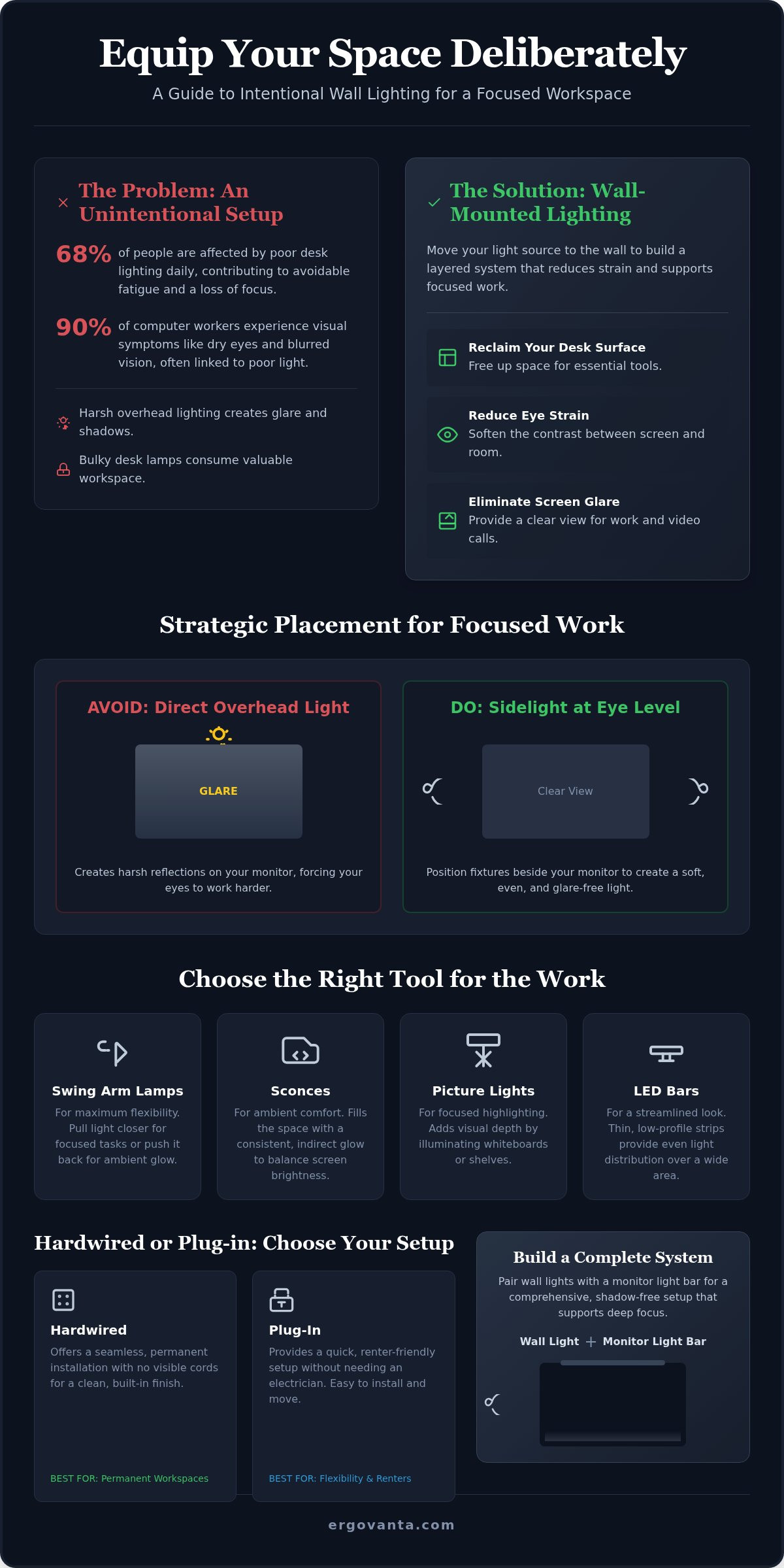
The desk surface is for the work. It shouldn't be a storage unit for bulky lamp bases and tangled cords. If you find yourself squinting under harsh overhead glare or shifting your monitor to avoid shadows, your current setup is working against you. Research shows that poor lighting affects 68% of people at their desks daily, contributing to eye strain and avoidable fatigue. You shouldn't have to choose between a clear workspace and a well-lit one. Exploring intentional office wall lighting ideas allows you to move the light source to the wall, reclaiming your desk for the tools that actually matter.
Build a workspace that supports deep focus by layering light and eliminating the clutter of traditional lamps. This guide explains how to use wall-mounted fixtures to create a balanced environment that reduces strain and provides a clear, shadow-free view for video calls. We will look at how to select objects that earn their place on your walls and how to position them to create a room that feels entirely yours. Equip your space deliberately; the workspace shapes the work.
Key Takeaways
- Reclaim your desk surface by moving light fixtures to the wall, leaving more space for essential tools like monitor arms or laptop stands.
- Implement office wall lighting ideas to build a layered lighting system that reduces eye strain by softening the contrast between your screen and the room.
- Position fixtures to the side of your monitor at a considered height to eliminate screen glare and ensure the bulb stays out of your direct line of sight.
- Decide between the clean finish of hardwired lights or the quick, renter-friendly setup of plug-in sconces based on your current workspace needs.
- Pair wall-mounted lights with a monitor light bar to create a complete, intentional setup that supports focused work throughout the day.
Why Wall Lighting Earns Its Place in Your Workspace
The workspace shapes the work. Equip it deliberately. Many people treat lighting as an afterthought, settling for whatever fixture came with the room. When you spend eight hours a day at a desk, the quality of your environment impacts how you feel. Implementing intentional office wall lighting ideas is about reclaiming your territory. A wall light earns its place by moving the source of illumination off your desk and onto the structure of the room itself. This isn't about status; it's about function.
The Problem with Overhead Lighting
Standard ceiling lights are often the enemy of focus. They create direct glare on monitors, forcing your eyes to work harder just to parse text. According to the National Institute for Occupational Safety and Health (NIOSH), 90% of people who work with computers experience visual symptoms like dry eyes or blurred vision. These issues are frequently linked to poor lighting conditions. Overhead fixtures provide a flat, harsh light that washes out the room. By switching to wall-mounted options, you can direct light exactly where the work happens, creating a more balanced and functional environment.
Reclaiming Your Desk Surface
Your desk is a finite resource. Every square inch taken up by a bulky lamp base is an inch you can't use for a keyboard, a notebook, or monitor stands. Wall lights provide the same utility as a desk lamp without the physical footprint. This shift allows you to equip your space with considered ergonomic tools that actually support your body. When you move your Task lighting to the wall, you create a cleaner, more intentional surface that feels less like a storage unit and more like a workspace made for the work.
A considered wall light provides an ambient glow that reduces the harsh contrast between a bright screen and a dark room. This layered approach is essential for preventing eye fatigue. Instead of one aggressive light source from above, you use wall lights to fill the room with a soft, diffused glow. This reduces the strain on your eyes and helps you maintain focus for longer periods. Research from Cornell University found that workers in optimally lit environments can maintain focus for 27% longer. It's a small change that yields a significant return on your comfort.
Categorizing Wall Lighting by Function and Style
The workspace is an ecosystem. You need to choose the right tool for the specific task at hand. When exploring office wall lighting ideas, it's helpful to categorize fixtures by how they actually serve the work. Not every light is meant to illuminate the whole room. Some are built for focus; others are built for comfort. Understanding these categories allows you to equip your space with intentionality rather than just filling gaps on a wall.
Swing Arm Lamps for Maximum Flexibility
Swing arm lamps are the workhorses of a considered office. These fixtures allow you to pull the light closer for focused reading or push it back to wash the wall with a gentle glow. This flexibility is vital in hybrid spaces where one desk might handle deep, technical work in the morning and video calls in the afternoon. Look for models with sturdy joints and balanced tension. This ensures the light stays exactly where you put it without sagging over time. It's a functional choice for those who need their environment to adapt as quickly as their schedule does.
Sconces for Ambient Comfort
Sconces are about the atmosphere of the room. Place them at eye level when standing to fill the space with a consistent, indirect glow. This helps reduce eye strain and glare by providing a steady background light level that balances the brightness of your monitor. Use frosted glass or fabric shades to diffuse the light and prevent hot spots. In an open-plan home, a pair of sconces can physically define the boundaries of your workspace, signaling that this area is a sanctuary made for the work.
Picture lights aren't just for galleries. In a workspace, they provide a focused beam that can wash over a whiteboard or a desk shelf. This highlights the small objects that earn their place while adding a layer of visual depth to the room. It creates a space that feels personal and intentional rather than corporate. These fixtures are perfect for illuminating reference materials or physical notes without cluttering your primary work surface with a traditional lamp base.
LED bars offer a minimalist alternative for those who prefer a streamlined look. These thin, low-profile strips provide even light distribution across a wide area. They are particularly effective when mounted under shelving or cabinets to provide shadow-free task lighting. Because they are nearly invisible when turned off, they are ideal for maintaining a clean, modern aesthetic. Choosing the right category depends on the specific requirements of your day. If you're unsure which fixture fits your specific desk layout, contact us for guidance on building a setup that works for you.
Strategic Placement to Reduce Eye Strain and Glare
Strategic placement is a matter of biological comfort. If your lighting is in the wrong spot, it doesn't matter how beautiful the fixture is. Workplace lighting standards emphasize that light should support the task without creating visual interference. When testing your office wall lighting ideas, position fixtures to the side of your monitor. Light coming from directly behind you hits the screen and bounces into your eyes; light from directly in front causes a flat, fatiguing glare. You want the light to wash across your workspace, not fight your screen.
Height is equally critical. Ensure the bulb itself is never in your direct line of sight while you are seated. If you can see the filament or the bright surface of the bulb, your eyes will constantly adjust to the high contrast, leading to headaches. Use asymmetrical placement to define different zones in your room. A single swing arm on the left might handle your deep work, while a softer sconce on the right provides ambient fill for the rest of the space. This is how you build a room that gets used for the work.
Avoiding Monitor Reflections
Turn your monitor off to see the truth about your lighting. A black screen acts like a mirror, revealing exactly where reflections hit the glass. If you see a bright spot, adjust the angle of your wall lights. Swing arms are ideal for this because you can bounce the light off the wall behind the monitor rather than aiming it at the screen itself. This creates a soft wash of light that fills the room without compromising your screen clarity. Consider using matte-finish paints on your walls. Glossy finishes act like additional mirrors that complicate your light management and increase visual noise.
Lighting for Video Calls
The way you light your space for work is different from how you light it for a camera. For video calls, wall lights positioned slightly in front of your sitting position act as a fill light, softening shadows on your face. Avoid having a strong light source directly behind you. This creates a silhouette effect that makes you look like a shadow on screen. Dimmable fixtures are a considered choice here, allowing you to tweak the intensity based on the shifting natural light outside. Aim for a color temperature between 3000K and 4000K. This range provides a neutral, crisp light that supports focus without the sterile, blueish tint of higher-temp bulbs. It feels intentional, not clinical.
Choosing Between Hardwired and Plug-In Fixtures
Deciding how to mount your wall lights is a choice between long-term permanence and immediate flexibility. Both options support the goal of a clear, functional desk, but they cater to different living situations. When exploring office wall lighting ideas, consider your current environment and how often you expect to change it. A permanent installation offers a seamless finish that becomes part of the room's architecture. Conversely, a plug-in setup allows you to pivot as your needs change, ensuring your lighting moves with you. The workspace shapes the work; equip it with the mounting style that matches your reality.
The Flexibility of Plug-In Sconces
Plug-in sconces are the practical choice for renters or those who want to build their workspace quickly without a major project. You can install these fixtures with simple wall anchors and a screwdriver; no electrician is required. This portability is a significant advantage for hybrid workers who might move their desk to a different room later. Many modern plug-in models feature high-quality finishes and materials that provide a solid, intentional look without the commitment of hardwiring. If you don't like the look of a dangling wire, you can use metal or plastic cord covers to manage the appearance of the cables. This keeps the lines of your workspace clean and ensures every object earns its place on the wall.
The Permanent Look of Hardwired Lighting
Hardwired lights offer the most streamlined aesthetic for a minimalist workspace design. Because these fixtures connect directly to an electrical box in the wall, there are no visible cords to distract the eye or clutter the space. This is a considered choice for long-term home offices where the desk position is fixed. Hardwiring allows you to control all your office lights from a single wall switch, creating a rhythmic, organized experience every time you start your day. It also frees up your wall outlets for other essential tools like monitor stands or chargers. While it requires more effort upfront, the result is a room that feels integrated and made for the work.
Regardless of the mounting style you choose, you can add smart bulbs to either type of fixture. This allows for app-based control and dimming, which is essential for transitioning from focused morning sessions to the refined ritual of winding down. Smart bulbs give you the ability to adjust your environment without leaving your chair, allowing you to maintain your flow. Whether you choose the clean lines of a hardwired setup or the adaptability of a plug-in light, the goal is to build a space that feels entirely yours through intentionality and personal ownership.
Integrating Wall Lights with Your Desk Setup
The workspace is a collection of tools that must work in harmony. Wall lighting does not exist in a vacuum; it should complement every other object on your desk. When you move your primary light sources to the wall, you create a structural layer of illumination that supports your physical equipment. Pairing wall sconces with a monitor light bar provides a complete lighting solution that covers both the room and the screen. The sconces handle the ambient fill while the light bar focuses on the immediate task area. This combination ensures your eyes don't have to constantly adjust to varying brightness levels.
Physical layout requires careful thought. If you use a monitor arm, check its range of motion before mounting your fixtures. You don't want a rotating screen to collide with a swing arm light. Similarly, you can use wall lights to intentionally illuminate a desk shelf. This highlights the small objects that earned their place on your shelf and makes them easier to find during the workday. When every tool has its own light and its own space, the desk feels less like a storage unit and more like a room made for the work.
Lighting and Ergonomics
Lighting is a fundamental ergonomic tool that is often overlooked in favor of chairs or keyboards. When you cannot see your work clearly, you tend to hunch forward or squint, leading to neck strain and fatigue. Proper office wall lighting ideas prevent these physical compensations by providing clear visibility across your entire workstation. Combine your lighting layers with ergonomic seating to build a space you'd choose to come back to. Ensure the light hits your keyboard and mouse area consistently. This prevents your own hands from casting shadows over your input devices while you type or navigate.
Building Your Visual Identity
Your workspace should feel like yours, not a generic corporate cubicle. Use lighting to draw attention to the personal objects or textures that make the room feel intentional. Coordination of materials is a simple way to maintain a considered look. If your desk features natural textures, select materials like walnut wood or metal for your wall fixtures to match your desk finish. Equip your space with intentionality by choosing lights that serve a specific purpose. Whether it is a task light for reading or a soft wash for a video call, every fixture should earn its place. The goal is a room that feels personal, functional, and entirely yours.
Equip Your Workspace for the Long Term
The workspace shapes the work. Equip it deliberately. By implementing these office wall lighting ideas, you move beyond basic utility and start building a space that supports your physical comfort. You've learned that reclaiming your desk surface isn't just about aesthetics; it's about making room for the tools that actually drive your output. Whether you choose the clean integration of hardwired fixtures or the immediate flexibility of plug-in sconces, the goal remains the same: a room that feels personal and functional.
Effective lighting is more than just a bulb on a wall; it's a structural layer that reduces fatigue and prepares you for the next video call. By choosing considered lighting for focused work and pairing it with no-nonsense ergonomic tools, you create an environment that earns its place in your daily routine. National shipping ensures you can get the essentials you need to finish your setup. Take ownership of your environment. Build the desk setup you'd choose to come back to every morning.
Frequently Asked Questions
Do office wall lights cause glare on computer screens?
Wall lights only cause glare if they are positioned directly in front of or behind your sitting position. To avoid screen reflections, place fixtures at a 90-degree angle to your monitor. This side-mounted approach allows light to wash across the workspace without bouncing off the glass. Testing your setup with the monitor turned off helps identify potential hot spots before you commit to a permanent location. Proper placement ensures your eyes stay comfortable throughout the day.
Can I install wall lights in a rental office without drilling?
Most wall lights require at least minimal drilling for stability and safety. However, plug-in sconces are the ideal choice for renters because they only require small wall anchors rather than full electrical boxes. If you are restricted from making any holes, you might consider using heavy-duty adhesive strips designed for lighting fixtures. Always verify that the weight of the light is within the strip's load capacity to prevent damage to your equipment or your desk surface.
How high should I mount wall sconces in my home office?
Mount your wall sconces so the bottom of the shade is roughly at eye level when you are standing. This usually places the fixture between 60 and 66 inches from the floor. For a sitting desk, ensure the bulb is not in your direct line of sight to prevent headaches. Adjusting the height based on your specific monitor placement ensures the light supports your work without becoming a distraction. A considered height helps define your personal workspace.
What is the best color temperature for office wall lighting?
The best range for office wall lighting ideas is between 3000K and 4000K. A temperature of 3000K provides a warm, inviting glow that feels personal; 4000K offers a crisper, neutral light that supports alertness and focus. Avoid bulbs over 5000K, as they often feel clinical and can contribute to eye fatigue during late-night sessions. Dimmable smart bulbs allow you to shift between these temperatures as your day progresses, matching the natural rhythm of your work.
Should I choose a plug-in or hardwired wall light for my workspace?
Choose a plug-in light if you value flexibility or live in a rental. These fixtures install quickly and can move with you to a new workspace. Hardwired lights are better for permanent home offices where you want a minimalist look with no visible cords. While hardwiring provides a cleaner aesthetic, it typically requires an electrical box and a more involved installation process compared to the simplicity of a plug-in model. Both options effectively help you reclaim your desk surface.
How many wall lights do I need for a small office?
One or two wall lights are usually sufficient for a small workspace. A single adjustable swing arm can provide focused light for specific tasks, while a pair of sconces offers a balanced ambient glow for the entire room. The goal is to create layers of light rather than relying on a single source. Combining one wall fixture with a monitor light bar is often enough to illuminate a standard desk setup effectively while keeping your surface clear for essential tools.
Can wall lights replace a desk lamp entirely?
Yes, wall lights are an excellent replacement for traditional desk lamps. By moving the light source to the wall, you reclaim valuable surface area for tools like keyboards and monitor stands. An adjustable swing arm fixture provides the same directed task lighting as a desk lamp but without the physical footprint. This shift helps you build a more intentional and less cluttered workspace that is entirely made for the work. It allows every square inch of your desk to serve a purpose.
Are LED wall lights better for productivity than traditional bulbs?
LED lights are generally superior for productivity because they offer better control over color temperature and intensity. They produce less heat, which makes for a more comfortable environment during long hours at the desk. Many LED fixtures also feature higher efficacy, meaning they provide brighter light with less energy. This consistent, flicker-free illumination reduces the risk of eye strain and headaches, helping you stay focused on your tasks for longer. They are the modern choice for a functional workspace.
Disclaimer
Ergovanta publishes these guides to help people set up better workspaces. Product recommendations reflect what we sell. Specifications, prices and availability are accurate at the time of writing and may change. Nothing here is medical, ergonomic or professional advice; if you have a specific health concern about your workstation, speak to a qualified professional.
From the catalog