October 15, 2026
Pendant Lights for Dining Rooms: The Right Fit
The table sets the terms; the pendant follows. Choosing pendant lights for dining room use isn’t just a matter of picking a style you like. The fixture needs to suit the table, hang at a comfortable height, and provide useful light without interrupting conversation or sightlines.
It’s easy to second-guess the proportions. A single pendant, a linear fixture, and a chandelier can each work, but the right fit depends on your table shape and the room around it. A few practical checks can make the choice clearer.
This guide covers how to match fixture size and shape to your table, where to start with hanging height, and how to think about brightness and layered lighting. You’ll see when one centered pendant makes sense and when a longer fixture or a row of pendants may suit the room better. The aim is a considered choice for the meals, conversations, and everyday moments your dining room actually holds.
Key Takeaways
- Choose a pendant for the table and room, not just because the fixture looks right on its own.
- Use the 30-36-inch hanging-height guideline as a reference, then account for ceiling height, fixture shape, and clear sightlines.
- Compare a single pendant, multiple pendants, a linear fixture, and a chandelier against your table layout.
- Plan the table’s lighting needs first, then consider ambient and accent light for the rest of the room.
- Use this guide to assess scale, configuration, and supporting light before choosing pendant lights for dining room spaces.
Dining Tables: What a Pendant Light Needs to Do
Choose for the table and room, not the fixture alone. A dining pendant is a suspended light that focuses illumination around a dining area. Its position can help the table feel like the room’s focal point and give meals, conversation, and other table-time a clear centre. For a basic overview of the fixture type, see What is a pendant light?
What makes a pendant suitable for a dining room?
A downward-facing pendant directs attention and light toward the tabletop, helping define the dining area. It doesn’t need to light every corner. General room illumination and focused table lighting do different jobs, and one overhead fixture may not do both equally well. Think about how you want the table to feel, too. The light should support a welcoming atmosphere without making it harder to see faces or hold a conversation.
The fixture also affects the room’s visual balance. A pendant creates a distinct point above the table; a chandelier may have a broader, more decorative presence. A ceiling light can suit a room where a lower-profile fixture feels more appropriate. None is automatically the right choice. Match the form to the room’s proportions and the way you want the dining area to feel.
Begin with the table, not a trend
Before comparing finishes or shapes, take stock of the table you have. Note its shape, dimensions, and position in the room. Is it centered beneath an existing ceiling light, or does it sit closer to a wall or open-plan living area? These details help you picture how a suspended fixture will relate to the tabletop and the surrounding space. If the pendant provides focused table light, wall lights can support the room’s wider lighting plan.
Consider how the table is used from day to day. It may host dinner most evenings, double as a place to read or work, or become a gathering spot when people come over. A fixture that works only in an imagined showroom isn’t much help on a regular Tuesday. Choose for the room in use, including the people who share it. In a rental or shared home, weigh the existing layout and lighting against what everyone needs from the space.
- Shape: Note whether the table is round, square, or rectangular.
- Position: Check where it sits in relation to the ceiling and the room around it.
- Use: List the activities the table needs to support through the week.
Keep those observations in view as you compare pendant lights for dining room options. The fixture should serve the table, contribute to the room’s mood, and fit the way people gather there. Start with those needs, and style becomes a useful part of the decision rather than the whole brief.
Get pendant scale and hanging height right for your table
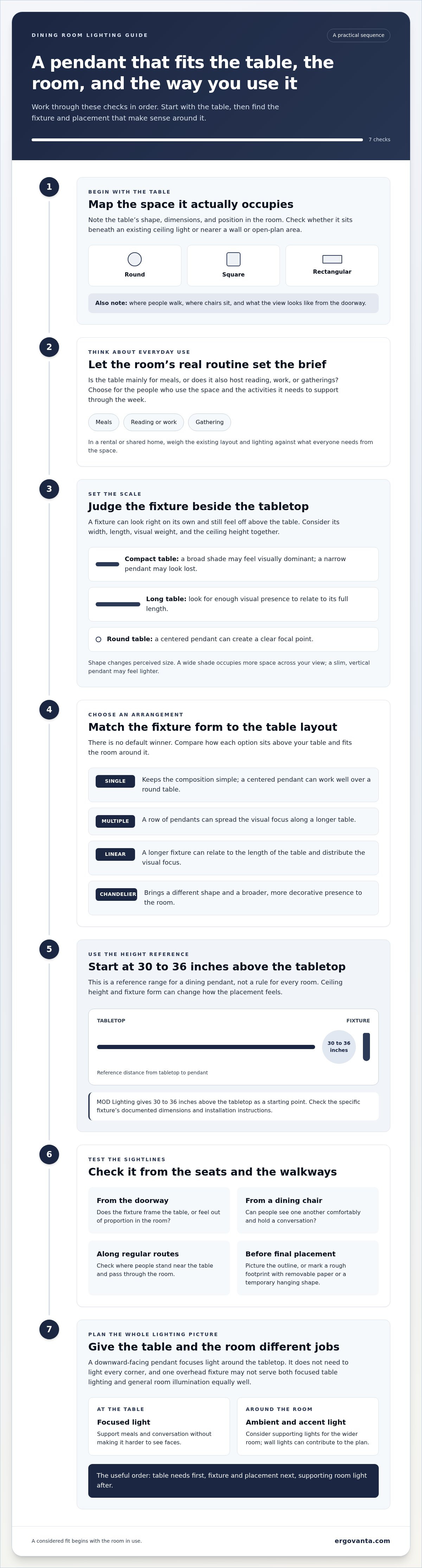
A pendant can be the right style and still feel wrong if its proportions don’t suit the table or room. Scale is about more than diameter. The fixture’s shape, visual weight, ceiling height, and position in your line of sight all affect how it reads. Use the table as your reference point, then judge the full arrangement in the room.
How should a pendant’s size relate to the table?
Picture the fixture and table together rather than assessing the pendant on its own. Above a compact table, a broad shade may feel visually dominant, while a narrow pendant can look lost. A long table may need a fixture with enough visual presence to relate to its full length. Over a round table, a centered pendant often creates a clear focal point, but its shape and visual weight still matter.
Shape changes perceived size. A wide shade occupies more space across your view; a slim, vertical pendant may feel lighter, even if it hangs to a similar depth. Ceiling height adds another consideration. In a room with a high ceiling, a small fixture can seem distant, while a broad, low-hanging form may make a lower room feel crowded. For more guidance on proportions and placement, see Dining room lighting best practices.
Try a sightline check before settling on a fixture. Imagine its outline above the table, or mark a rough footprint with removable paper or a temporary hanging shape. Look from the doorway, then sit in the usual dining chairs. Can people see one another comfortably? Does the fixture frame the table or block the view? The room gets the final vote, not the product photo.
How high should a dining pendant hang?
MOD Lighting gives 30-36 inches above the tabletop as a reference range for a dining pendant. Treat it as a starting point, not a rule that fits every room. Ceiling height can change the balance, as can the fixture’s form. A wide shade may feel closer than a narrow one at the same height, while a long fixture can affect sightlines across the table.
Consider how people move through the space. If they regularly stand near the table or pass through the room, check the fixture’s position from those routes as well as from a seated viewpoint. A comfortable height should connect the table to the light without getting in the way of conversation or movement.
Before deciding on final placement, compare the fixture’s documented dimensions with the table and ceiling, then follow its specifications and installation instructions. For pendant lights for dining room spaces, a general guideline helps you picture the result, but the specific fixture’s instructions guide its placement. If you’d like to explore lighting options for your space, get in touch with Ergovanta.
Compare single pendants, linear fixtures, and chandeliers
Once the table’s size and position are clear, compare how different fixture arrangements will sit above it. A single pendant keeps the composition simple. Multiple pendants or a linear fixture can spread the visual focus along a longer table. A chandelier brings a different shape and presence. None is the default winner. The right choice depends on the table, the room, and how much visual attention you want overhead.
| Configuration | Visual effect | Often suits |
|---|---|---|
| One pendant | Focused, simple focal point | Compact tables or uncluttered settings |
| Multiple pendants | Repeated points of light and shape | Long tables where separate fixtures feel balanced |
| Linear pendant | One connected form that follows the table | Rectangular layouts |
| Chandelier | Broader, more sculptural presence | Rooms where the fixture can share focus with the table |
When does one pendant make sense?
A single pendant can work above a smaller table or in a visually quiet dining area. It gives the eye one clear point to land without adding extra shapes overhead. That restraint can be useful when the room already has a strong feature, such as large artwork, open shelving, or a distinctive table. One fixture won’t necessarily provide all the room’s illumination, so consider its role alongside the rest of the lighting.
When should you consider multiple pendants or a chandelier?
Over a rectangular table, a linear pendant can echo the table’s length. A row of separate pendants creates a similar rhythm, with more visible gaps between fixtures. Either approach can help a long tabletop feel considered from end to end. A chandelier offers another option: its broader outline can become a focal point, especially where the room has space for it to sit comfortably above the table.
Look beyond the tabletop before deciding. A substantial fixture may compete with a tall cabinet or prominent artwork nearby; a minimal one may get lost among other strong shapes. Consider the dining chairs, sideboard, and open space around the table as part of the same view. The aim isn’t to make every element match. It’s to give each one enough room to belong.
Ergovanta offers pendants and chandeliers, alongside ceiling lights for a more flush or overhead look. Compare those forms by the effect you want, then consider how each fits your layout. For pendant lights for dining room use, choose a configuration that relates to the table without making the rest of the room feel like an afterthought.
Plan useful dining-room light beyond the pendant
A pendant can make the table easier to see and help define the dining area, but it may not light every corner. Build the plan around what people do there, then decide whether another source would make the space more useful. A thoughtful setup doesn’t require a fixture in every corner. It does require noticing the dark ones.
Is one pendant enough for the whole dining room?
Start with the table’s tasks: eating, reading, homework, or the occasional laptop session. Next, consider the room’s existing ambient light, meaning the general light that helps people move around and see beyond the tabletop. Check the light from existing ceiling or wall fixtures, as well as daylight at different times. Then decide whether another layer would help with activities or areas the pendant doesn’t reach.
A compact dining nook with nearby room lighting may feel complete with one pendant. In a larger room, a sideboard, reading chair, or walkway may sit outside its pool of light. The layout matters as much as room size. If parts of the room are used after dinner, supporting light can make them feel connected without asking the pendant to do every job.
How can light feel comfortable during meals?
Notice where the light source appears from a seated position. If a bare bulb or bright opening catches your eye across the table, the fixture may feel distracting even if its style works. Consider how light falls on faces and surfaces, and whether the fixture interrupts sightlines. The goal is useful table light that lets people focus on each other, not on avoiding glare.
Dimming can give a room more range, from brighter light for clearing the table to a softer level for a long meal. It works only when the chosen fixture, bulb, and controls support it. If you want flexible management without complicated rewiring, systems found at gemwireless.com.au demonstrate how wireless lighting and switching controls can simplify modern setups. Check the instructions for each component before selecting a combination. Compatibility isn’t something to assume from appearance alone.
Use this quick sequence to plan the layers:
- Identify table tasks. Decide what the light needs to help people see and do.
- Assess ambient light. Note existing ceiling fixtures, daylight, and any dim areas beyond the table.
- Add support where needed. Consider light around the room’s edges, such as wall lights for supporting illumination, rather than adding fixtures by default.
Keep the instructions close as you compare bulbs and controls. The fixture’s guidance should shape decisions about bulb type, dimming, and installation. That makes a layered plan practical, not just atmospheric. For pendant lights for dining room use, let the pendant handle the table while other sources help the rest of the room work for the people in it.
Choose a dining pendant that feels right in your space
You’ve considered the table, the fixture’s proportions, its height, and how the rest of the room gets light. Now bring those decisions together. The best fit isn’t simply the fixture that looks good on its own. It works with your table, keeps conversation comfortable, and makes sense for the room you use every day.
A final checklist before choosing
Before settling on a fixture, compare its documented dimensions and installation details with your room. Product images help you picture the style, but measurements tell you how much space it will occupy. Consider the view from the chairs, the approach to the table, and the surrounding furniture. A fixture that looks balanced from the doorway should still feel comfortable when everyone is seated.
- Table fit: Does the fixture relate to the table’s shape and position?
- Scale: Does its visual weight suit the table and the rest of the room?
- Height: Can it sit above the table without getting in the way of sightlines?
- Configuration: Does one pendant, a linear arrangement, or a chandelier make sense for the layout?
- Light layers: Will the rest of the room need supporting illumination beyond the table?
Then read the fixture’s supplied instructions. Check its installation details and stated bulb requirements, and look for guidance on dimming compatibility if you want adjustable light. Treat each fixture as its own set of instructions, not as a generic ceiling object. That small bit of homework can help you avoid choosing a bulb or control that doesn’t suit the fixture.
Explore lighting options with your room in mind
Use the checklist to narrow your choices, not to make the room follow a formula. A compact table with a clear focal point may call for a different arrangement than a long table in an open dining area. If your room already has other strong features, a simpler fixture may sit more naturally. If the table and surrounding space can carry a more noticeable shape, a chandelier is another option.
Ergovanta’s lighting range includes pendants, chandeliers, and other lighting categories. Browse lighting for different rooms with your table dimensions and room layout in mind. The point isn’t to find a fixture that could belong anywhere. It’s to choose one that makes sense where you live, eat, and gather.
With these checks in hand, choosing pendant lights for dining room use becomes a matter of matching the fixture to your real space, not guessing from a photograph. Keep the measurements, installation guidance, and everyday needs together as you make the final call.
Make the next choice yours
The right pendant isn’t a prize for getting every measurement perfect. It’s a considered choice that suits the table, feels comfortable in the room, and supports the way you gather there. Use the guidance as a starting point, then trust what you notice in your own space. The best pendant lights for dining room use are the ones that feel right in the room you actually live in.
Good lighting earns its place through daily use, not just a first impression. Picture an ordinary meal beneath your choice, then imagine the table set for company. If the fixture works for both, you’re building a space that feels personal and practical. That fits Ergovanta’s message: “For the people who do the work.”
Choose with intention, and make the room yours.
Frequently Asked Questions
Is a pendant light enough to illuminate a dining room?
Sometimes, but it depends on how the rest of the room is used. A pendant may cover dinner at the table while leaving a nearby buffet or walkway dim. Try the room after sunset with its existing lights on, and notice where shadows remain. For pendant lights for dining room use, think of the pendant as one part of the plan, then add another source only where daily activities call for it.
Can you use pendant lights over a round dining table?
Yes. A round table can pair well with a pendant whose outline feels balanced above its center. A compact dome may reinforce the table’s circular shape, while a more angular fixture can create contrast. Before choosing, view the arrangement from the main entrance and from each seat. If the pendant crowds the tabletop visually or blocks faces across it, reconsider its size or position using the fixture’s dimensions and instructions.
What should you consider when choosing a bulb for a dining pendant?
Start with the fixture’s instructions, since they identify suitable bulb types and any stated limits. Then consider how you want the table to feel: a warm, relaxed setting may call for different light than a table also used for paperwork. If you want adjustable light, check the bulb, fixture, and control details rather than assuming they work together. Choose components based on their documented specifications.
How do you clean a dining-room pendant light?
Switch the fixture off and let it cool before cleaning. Follow its care instructions, since glass, metal, and other finishes may need different treatment. Use a suitable cloth or cleaning material, and keep liquid away from electrical components. If the instructions call for removing a part or taking a specific precaution, follow that guidance. Avoid improvising with sprays or abrasive materials that could damage the finish.
Can pendant lights work in a dining room with a low ceiling?
Yes, if the fixture’s overall drop and position leave the room comfortable to use. Compare its dimensions with the ceiling and table, then consider walking routes and seated sightlines. A deep or visually bulky pendant may feel intrusive in a low room, while a more compact form may sit more easily. If a suspended fixture still feels imposing, a ceiling light is another option.
Should a dining pendant match the rest of the room’s lighting?
No, every fixture doesn’t need to be identical. Aim for a connection instead, such as a shared finish, related shape, or similar visual weight. For example, a simple pendant can sit comfortably with more decorative wall lights if their materials feel related. Look at the room from the table and the doorway. A consistent overall feel matters more than a perfectly matched set.
Disclaimer
Ergovanta publishes these guides to help people set up better workspaces. Product recommendations reflect what we sell. Specifications, prices and availability are accurate at the time of writing and may change. Nothing here is medical, ergonomic or professional advice; if you have a specific health concern about your workstation, speak to a qualified professional.
From the catalog