September 17, 2026
The Ultimate Minimalist Desk Lamp Buying Guide
The workspace shapes the work. Equip it deliberately. A lamp isn't just an accessory; it's a tool that dictates how long you can focus before your eyes give out. Most people settle for flickering light or bulky bases that consume half their desk. You shouldn't have to fight your furniture to do the work. Your space should support your effort, not hinder it.
We agree that every object on your desk should earn its place. If a lamp doesn't provide clarity or fit a streamlined setup, it's just more clutter. This minimalist desk lamp buying guide shows you how to choose a light source based on intentionality and function. You'll learn how to identify the specific light quality your work requires while keeping your desk organized and personal.
We're going to cover the technical specs that actually matter, such as color rendering and flicker rates, alongside design features that support a focused environment. By the end, you'll know how to equip your desk with a lamp that reduces eye fatigue and helps you build the workspace you'd choose to come back to every single day.
Key Takeaways
- Lighting is a tool for focus. Learn why intentional light quality is the foundation of a workspace you actually want to use.
- Use this minimalist desk lamp buying guide to navigate technical specs like color temperature and build quality without the jargon.
- Choose the right form factor for your layout. We compare weighted bases and desk clamps to help you reclaim your desk surface.
- Fix your ergonomics. Learn placement strategies that eliminate shadows and reduce the eye strain that cuts your work sessions short.
- Build a cohesive environment. See how considered lighting works with other tools to create a space where every object earns its place.
Why Intentional Lighting Matters for Your Workspace
The workspace shapes the work. Equip it deliberately. When you sit down to start a session, the environment should work with you, not against you. Most people rely on harsh overhead bulbs that wash out the room or dim ambient light that causes squinting. Neither supports focus. This minimalist desk lamp buying guide is about more than just aesthetics; it's about reclaiming your ability to see clearly and work longer without fatigue.
Minimalism in the workspace isn't about having nothing on your desk. It's about removing visual noise so you can focus on the task. A considered lamp reduces cognitive load by providing light only where it's needed, leaving the rest of the room in a soft, non-distracting shadow. This creates a "tunnel" of focus that signals to your brain that it's time to get things done. Visual clutter is a silent productivity killer. Every extra cable or unnecessary ornament competes for your attention. A lamp with a clean, minimalist profile helps you reclaim that mental energy.
The Purpose of Task Lighting
Think of task lighting as a dedicated tool, much like a specific software or a high-quality keyboard. Its job is to illuminate the immediate area where your hands and documents are. Generic room light often fails here, creating shadows that force your eyes to work harder. By using a light source with a high color rendering index (CRI), you ensure that colors are accurate and text is crisp. This reduces the strain of constantly shifting your gaze between a bright monitor and physical notes. It's a functional requirement for anyone who spends serious hours at a desk.
Ambient light is meant for movement and general visibility, but task lighting is made for the work. It provides the contrast necessary to distinguish fine details without overworking your optic nerves. When your lighting is intentional, you don't find yourself leaning in or hunching over just to see what's in front of you. It's about building a setup that supports your posture as much as your vision.
Building a Space You Choose to Come Back To
Your workspace shouldn't feel like a sterile corporate cubicle. It should feel like yours. Turning on a desk lamp is a ritual: a physical action that marks the transition into deep work. We believe in choosing small objects that earn their place through daily utility and clean form. When a lamp is designed with intentionality, it doesn't just sit there; it assists. It's about building a room that gets used and a setup that feels personal. You're equipping a workshop for your own progress.
The goal is a space that feels like home, even when you're in the middle of a difficult project. This isn't about status or following a trend. It's about ownership. When every object on your desk serves a purpose, you feel more in control of the environment. A lamp that fits your specific desk layout makes the whole setup feel cohesive and ready for use. It's one of the few items that can transform the entire atmosphere of a room with a single click.
Technical Essentials: Light Quality and Performance
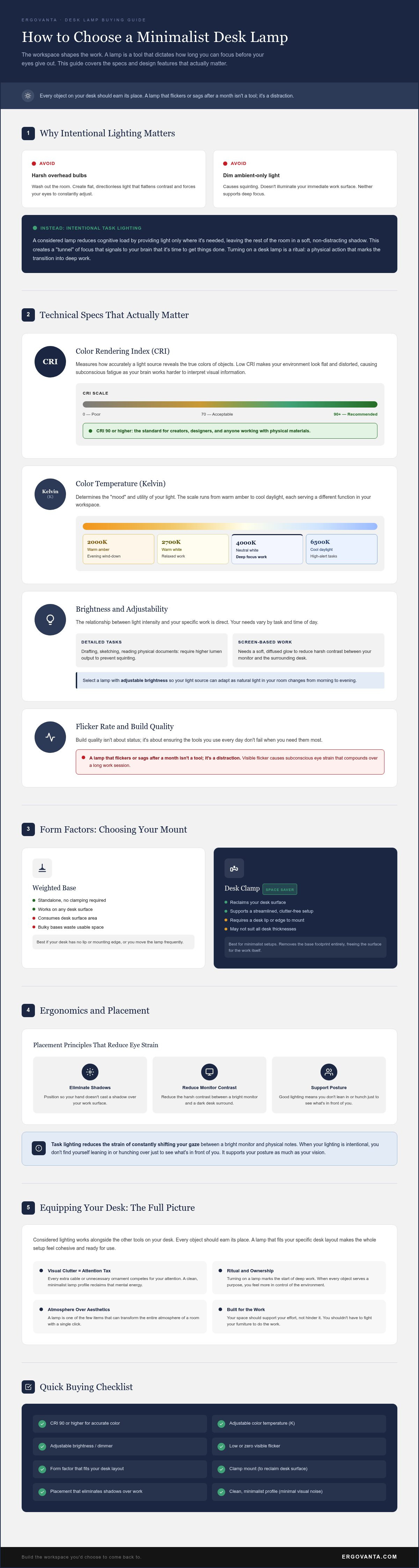
Technical specifications aren't just for manufacturers. They're the metrics that define how your space feels after four hours of deep work. This minimalist desk lamp buying guide cuts through the noise to focus on the performance indicators that actually matter for your daily output. Build quality isn't about status; it's about ensuring the tools you use every day don't fail when you need them most. A lamp that flickers or sags after a month isn't a tool; it's a distraction.
The relationship between light intensity and your specific work is direct. Detailed tasks like drafting, sketching, or even reading physical documents require a higher lumen output to prevent squinting. If your work is primarily screen-based, you need a lamp that provides a soft, diffused glow to reduce the harsh contrast between your monitor and the surrounding desk. Selecting a lamp that allows for adjustable brightness ensures your light source can adapt as the natural light in your room changes from morning to evening.
CRI: Seeing Color as It Truly Is
Color Rendering Index (CRI) is a measure of how accurately a light source reveals the true colors of objects. For creators, designers, and anyone who works with physical materials, a CRI of 90 or higher is the standard because it prevents colors from looking muddy or grey. Light with a low CRI rating makes your environment look flat and distorted. This often leads to subconscious fatigue as your brain works harder to make sense of the visual information it's receiving. When you equip your space with high-CRI lighting, you're choosing clarity over compromise.
Kelvin and Color Temperature
Color temperature, measured in Kelvin (K), determines the "mood" and utility of your light. The scale runs from warm amber (2000K) to cool daylight (6000K). For a workspace that feels natural and keeps you alert, aim for the 3000K to 4000K range. This balance provides enough crispness for focus without the sterile, clinical feel of higher temperatures that can disrupt your sleep cycle later. When using this minimalist desk lamp buying guide to build your setup, remember that your choice in temperature will dictate the atmosphere of your room for hours at a time.
Performance also means consistency. Flicker is the enemy of concentration. Even if you can't see it with the naked eye, low-quality drivers in cheap lamps cause a rapid pulsing that results in headaches and eye strain. A lamp that earns its place on your desk should provide a steady, unwavering beam. It should be made for the work, with heat-dissipating materials that keep the LED housing cool during long sessions. If you're building a new setup and need advice on how to pair lighting with your current equipment, feel free to get in touch with us for a more personal recommendation.
Minimalist Styles: Form That Follows Function
Minimalism is often mistaken for a specific aesthetic. In this minimalist desk lamp buying guide, we define it as intentionality. Every curve and joint should serve a purpose. When you select a lamp, you aren't just choosing a look; you're selecting a form that solves a specific problem in your desk layout. The goal is to remove friction from your workflow by choosing a tool that fits the way you actually move and work.
One of the first decisions you'll make is how the lamp interacts with your desk surface. A weighted base offers the freedom to reposition your light as the day progresses, which is ideal if you frequently switch between digital and analog tasks. However, if your desk is already crowded with peripherals, a desk clamp is the better tool. It secures the lamp to the edge of your surface, reclaiming valuable square footage for your keyboard and mouse. Both options are valid, but the choice should be based on the physical requirements of your space.
Materials also dictate the longevity of your setup. Metal components offer a lifetime of durability and a clean, industrial feel. Wood provides a natural warmth that makes a workspace feel less sterile and more personal. Regardless of the material, pay close attention to the adjustable joints. High-quality friction hinges or tension springs are essential. They ensure the lamp stays exactly where you put it, even after years of daily use. A lamp that sags or requires constant tightening has failed to earn its place on your desk.
Classic Swing Arms vs. Linear Lamps
Swing arm lamps are the workhorses of the desk. They offer maximum reach, allowing you to pull the light close for detailed work or push it away when you need broad visibility. This flexibility is vital for large desks where your focus shifts across a wide area. Linear lamps, often found in architect-style setups, provide even coverage across a wide horizontal plane. If you use a dual-monitor setup, a linear lamp helps prevent the dark spots that often occur between screens, creating a more uniform visual environment.
Monitor Light Bars: The Ultimate Space Saver
Monitor light bars are the ultimate space savers. They equip your workspace without taking up any desk real estate by clipping directly to the top of your screen. These tools use asymmetric lighting to cast light downward onto your desk while avoiding the screen itself. This intentional design eliminates glare and reduces the eye strain often caused by light reflecting off glass. Integrating a light bar with a monitor stand creates a clean, organized look that keeps your desk ready for deep work without the clutter of a traditional lamp base.
Ergonomics and Placement: Avoiding Eye Strain
How your workspace feels is the ultimate metric of success. If you finish your day with a headache or dry eyes, your tools aren't working for you. Ergonomics is often discussed in terms of chairs and desks, but light placement is just as critical for long-term focus. This minimalist desk lamp buying guide prioritizes your physical comfort because a space that hurts to use is a space you'll eventually avoid. Equip your desk to support your vision, not drain it.
Positioning is everything. You want to eliminate shadows on your primary task area without creating new problems. A common mistake is placing the light source directly in your line of sight. If you can see the bulb or the glowing LED panel from your peripheral vision, your eyes are constantly fighting the glare. This causes your pupils to fluctuate, leading to rapid fatigue. Instead, position the lamp so the light falls from above or from the side, keeping the source itself shielded from your direct view.
Dimmable settings are a functional requirement for a considered setup. Your desk lamp should match the ambient light of the room. During a bright afternoon, you might need a higher intensity to compete with the sun. By late evening, that same setting will feel like a spotlight. Matching the brightness of your surroundings reduces the contrast strain your eyes feel when darting between a bright screen and a dark desk. It's about creating a smooth visual transition across your entire field of view.
Reducing Glare and Reflection
Light behaves logically: it bounces. If your lamp is angled poorly, the light will hit your glossy monitor or glass desk and reflect straight into your eyes. To prevent this bounce-back, use the law of reflection to your advantage by angling the light away from your screen. Choosing a lamp with a built-in diffuser is also essential. A diffuser softens the beam, turning a harsh point-source into a gentle glow that minimizes the sharp, high-contrast shadows that make reading physical documents difficult.
Lighting for Video and Calls
Equipping your desk for the work means accounting for virtual meetings. Your desk lamp can double as a fill light to improve your professional presence on camera. Instead of pointing the light at your screen, angle it slightly toward your face or a nearby wall to bounce a soft, even light onto yourself. This prevents the silhouette effect where you appear as a dark shadow against a bright window. It's about finding a balance that makes you visible without washing out your monitor or causing you to squint during the call.
Equipping Your Desk with Considered Lighting
The workspace shapes the work. Equip it deliberately. A desk lamp is one piece of a larger ecosystem where every object must earn its place through utility and form. When you follow a minimalist desk lamp buying guide, you aren't just buying a bulb; you're building a system. Your lighting should work in tandem with your workspace essentials to create a room that actually gets used. It's about selecting a tool that complements your personal style without turning your desk into a sterile corporate showroom.
At Ergovanta, we believe in providing the advantage through purposeful function. Our name is rooted in this philosophy: ERGO, from the Greek for purposeful function, and VANTA, for the advantage it provides to the person doing the work. We don't build for "bosses" or "executives"; we build for the people who spend serious hours at a desk. Your lighting shouldn't just look the part. It should be made for the work you do every single day.
Integrating Tech and Light
Modern setups rely on a variety of tech accessories. Your lamp shouldn't compete for space with your wireless chargers or monitor arms. It should integrate. If you choose a lamp with a small footprint or a desk clamp, you leave more room for the devices that power your day. Cable management is also vital. A minimalist aesthetic fails the moment a tangle of wires takes over your desk. Look for lamps that offer clean routing options or integrated cord clips. Your lighting needs to be flexible enough to scale as you add more equipment to your workspace over time.
Final Checklist for Your Purchase
Before you commit to a new light source, run through this final checklist to ensure the object truly earns its spot on your desk:
- Verify the reach: Does the arm or head cover your primary task area and your secondary references without needing constant adjustment?
- Check the controls: Are they intuitive and easy to access? You shouldn't have to fumble under a shade to find a switch in the dark.
- Invest in build quality: Choose materials like solid metal or considered wood. These aren't just for show; they provide the weight and durability needed for a tool that gets moved daily.
- Confirm the specs: Double check that the CRI is 90 or higher and the color temperature fits the 3000K to 4000K range for optimal focus.
Equipping your space is a personal process. There is no one-size-fits-all solution for a place as important as your desk. Explore the full Ergovanta lighting collection to find the specific tool that helps you build the workspace you'd choose to come back to.
Build a Space for the Work Ahead
You've seen how intentional light quality and considered placement transform your desk from a generic surface into a dedicated task area. Choosing the right tool requires balancing technical specs like CRI with the physical constraints of your layout. This minimalist desk lamp buying guide serves as a starting point for building a setup where every object earns its place. Lighting is more than an accessory; it's a functional requirement for clarity and focus.
Since 2021, Ergovanta has specialized in providing the advantage through purposeful function. We offer a curated selection of minimalist and ergonomic tools designed for the people who do the work. Whether you need a space-saving light bar or a flexible swing arm, your choice should reflect the specific needs of your daily workflow. Every object on your desk should assist your progress rather than adding to the visual noise of the room.
Your workspace is a personal workshop. When you equip it deliberately, you create an environment that supports your effort and respects your time. Build the space you'd choose to come back to every single day.
Frequently Asked Questions
How many lumens do I need for a desk lamp?
Aim for 450 to 800 lumens for standard desk work. If you're drafting or doing fine detail work, lean toward the higher end of that scale. For digital-first work, a lower setting often suffices to reduce contrast with your screen. This minimalist desk lamp buying guide recommends checking for adjustable brightness so you can tune the output to your specific task and eye comfort throughout the day.
What is the best color temperature for focused work?
The ideal range for focus is between 3000K and 4000K. This cool white range provides enough crispness to keep you alert without the harsh, sterile blue light found in higher Kelvin ratings. It mimics natural daylight during its most productive hours. Avoid warm amber tones for deep work sessions, as they can signal to your brain that it's time to wind down rather than engage in the task at hand.
Are LED desk lamps better than traditional bulbs?
LED desk lamps are superior tools because they produce almost no heat and offer a significantly longer lifespan. Traditional incandescent or halogen bulbs consume more energy and can make your workspace uncomfortably warm during long sessions. LEDs also provide better control over light quality, including flicker-free performance and precise color rendering. They are objects that earn their place through efficiency and reliability over many years of daily use.
How do I prevent my desk lamp from reflecting off my monitor?
Place your lamp so the light hits your desk at an angle that bounces away from your eyes and screen. Use the law of reflection: if the light source is directly in front of a glossy monitor, it will bounce back as glare. Positioning the lamp to the side or using a monitor light bar with an asymmetric beam path ensures the light illuminates your surface while keeping the screen clear for the work.
What is CRI and why does it matter for my workspace?
Color Rendering Index (CRI) measures how accurately a light source shows the true colors of objects. A CRI of 90 or higher is essential for anyone doing creative or detailed work where color accuracy matters. Low-CRI lighting makes colors look flat or muddy, which can lead to subconscious fatigue as your brain tries to correct the visual information. It's a technical specification that directly impacts how your space feels and functions.
Can a desk lamp help reduce eye strain during long hours?
Yes, a considered desk lamp reduces strain by providing the necessary contrast for your specific task. When your environment is too dim, your eyes work harder to distinguish details; when it's too bright, glare becomes the issue. By illuminating your physical workspace to match the brightness of your monitor, you reduce the pupillary fatigue caused by your eyes constantly adjusting between different light levels during long hours at the desk.
Do I need a dimmable lamp if I have natural light?
Dimmable controls are vital even in rooms with plenty of windows. Natural light is inconsistent; it shifts in intensity and angle from morning to evening. A dimmable lamp allows you to supplement the sun during cloudy afternoons or dial back the intensity as the day ends. It ensures your light source remains a tool that adapts to your environment rather than a static object that only works in very specific light conditions.
What is the difference between a task lamp and an accent lamp?
A task lamp is a dedicated tool made for the work, providing focused illumination on a specific area. It features adjustable joints and high-quality light specs to support productivity. An accent lamp is designed for atmosphere and decor, often casting a soft, diffused glow that isn't bright enough for reading or drafting. In a minimalist setup, every object should earn its place; task lamps prioritize function and utility first.
Disclaimer
Ergovanta publishes these guides to help people set up better workspaces. Product recommendations reflect what we sell. Specifications, prices and availability are accurate at the time of writing and may change. Nothing here is medical, ergonomic or professional advice; if you have a specific health concern about your workstation, speak to a qualified professional.
From the catalog