September 4, 2026
Best Electric Standing Desks for Your Home Office
The workspace shapes the work. Equip it deliberately. A desk is not just motorized furniture; it is the foundation of your day that must earn its place through intentional function and stability. You've likely dealt with the physical fatigue of sitting too long or the distraction of a wobbly frame that shakes during every video call. Finding the best electric standing desk for home office use is about more than height presets: it's about building a space where you actually want to spend your time.
We agree that a workspace should feel like yours, not a corporate cubicle. The goal is a surface that remains solid at any height and manages cable clutter to keep your room aesthetic intact. This guide will help you choose a desk that earns its place through considered design and functional reliability. We'll preview the most stable frames and surfaces available in 2026, ensuring your setup supports both your physical comfort and your focus.
Key Takeaways
- Movement is a tool for focus rather than just a health metric. Learn to equip your workspace deliberately to stay engaged throughout the day.
- Discover how to find the best electric standing desk for home office needs by matching height ranges and weight capacities to your specific hardware.
- Stability is the foundation of a focused workspace. Understand how frame designs like T-style and C-style impact wobble when working at standing heights.
- A desk is only one part of a room that gets used. Learn to integrate intentional tools like monitor light bars to support your focus and complete the setup.
- Avoid the trap of buying for status or corporate identity. Prioritize functional features that earn their place through daily use and personal ownership.
Why the Right Electric Standing Desk Matters for Your Home Office
The workspace shapes the work. Equip it deliberately. Your desk is more than a surface; it is the anchor of your daily output. Intentionality starts with the tools you choose to use every day. Finding the best electric standing desk for home office use is an act of personal ownership. It's about creating a space that feels like yours, rather than a generic corporate environment. A desk should be a catalyst for focus, not a source of physical fatigue. When you build a room that gets used, every object must serve a purpose.
The Shift from Static to Active Work
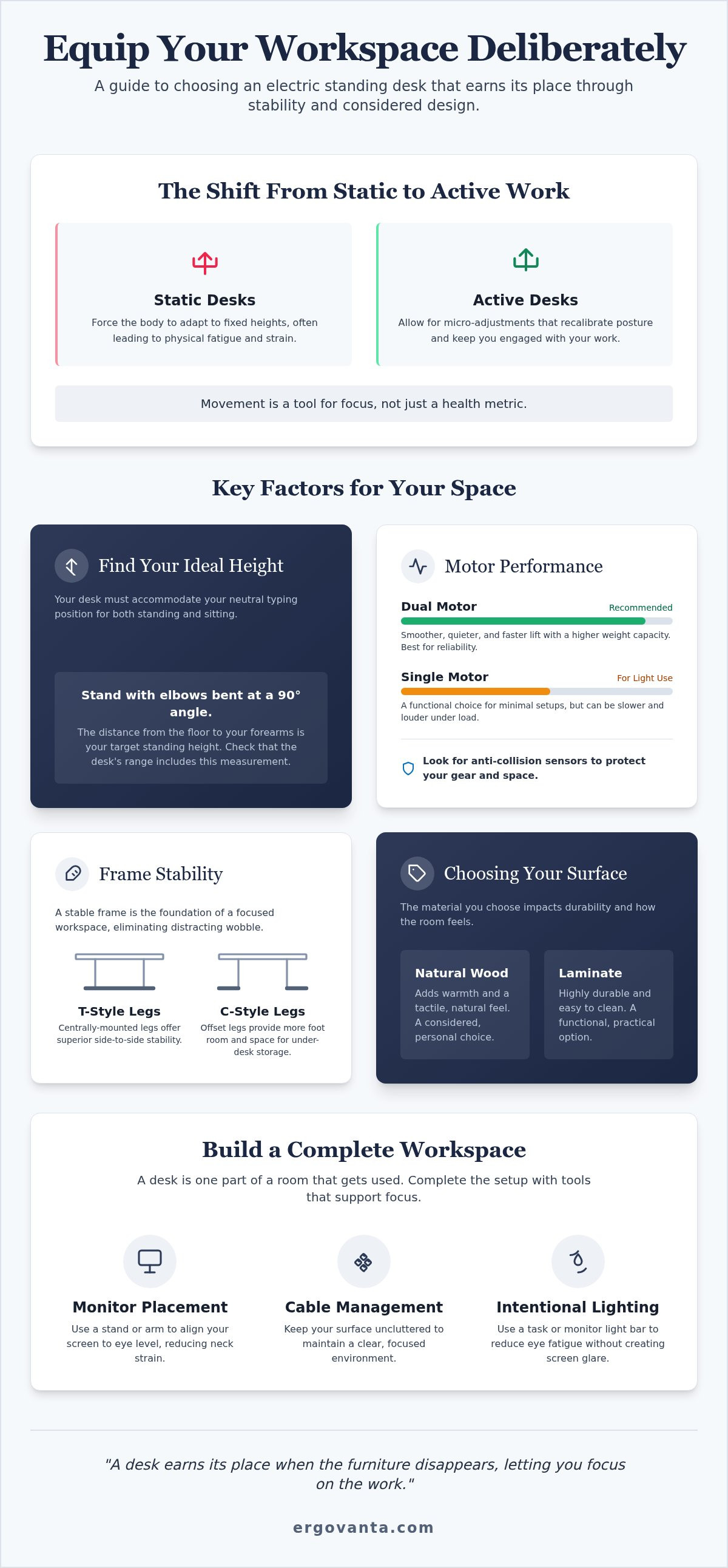
Fixed heights often fail the person doing the work. They force the body to adapt to the furniture, which usually leads to neck and back strain. Movement is a tool for focus, not just a health metric to be tracked. Standing for short intervals changes your perspective on a task. It can break a mental block or provide a second wind during a long afternoon. By examining the history and health implications of standing desks, it becomes clear that movement is essential for long-term comfort. An electric desk allows for micro-adjustments that static desks cannot match. These small shifts in height (even just an inch or two) can recalibrate your posture and keep you engaged with the screen. This builds a rhythm that supports the work rather than distracting from it.
Defining a Desk That Earns Its Place
Function over status is the guiding rule. You don't need a corporate-style setup to achieve your goals. You need a desk that earns its place through stability and considered design. At Ergovanta, we rely on the concept of Ergon (purposeful function) to guide how we equip a space. A desk earns its place when it remains solid during a video call and feels like a natural extension of your home. It should be a room that gets used, focusing on the work itself rather than an image of success. When the surface is stable and the height is exactly where you need it, the furniture disappears. This allows you to focus on the small objects that earn their place on your surface, creating a workspace you'd choose to come back to.
Key Factors to Consider When You Equip Your Workspace
The workspace shapes the work. Equip it deliberately. When you search for the best electric standing desk for home office use, you aren't just buying furniture; you're selecting the foundation for your daily output. This choice requires intentionality. You need to account for your specific hardware, your physical measurements, and the tactile feel of the materials you touch every day. A desk earns its place when it supports your work without becoming a distraction.
Finding Your Ideal Height Range
To find your ideal height, start with your own measurements. Stand naturally and bend your elbows at a 90 degree angle. The distance from the floor to your elbows is your neutral typing position. The best electric standing desk for home office setups must accommodate this height while standing and your seated height when using a task chair. Many people overlook the lowest setting, but it's vital for maintaining proper posture when you aren't standing. If your desk height doesn't perfectly align with your screen, you can use monitor laptop stands to perfect your ergonomics. This ensures your eyes stay level with your work, reducing neck fatigue throughout the day.
Motor Performance and Noise Levels
Dual motors offer a smoother, more considered transition than single-motor alternatives. They provide the necessary torque to lift heavy monitors, lighting, and hardware without struggling. Reliability is the priority here. You want a motor that moves quickly but quietly, especially if you take calls while adjusting your position. Decibel levels matter in a home environment where a loud motor can disrupt the household or your own focus. Modern frames also include safety features like anti-collision sensors. These sensors stop the motor if the desk hits a chair or a filing cabinet, protecting both your equipment and your space.
Material Choice: Wood vs. Synthetic
Choosing between wood, laminate, or metal is about durability and how the room feels. While research from Harvard Health discusses the health benefits of a standing desk, the real value lies in how the surface supports your specific workflow. Synthetic materials are often durable and easy to clean, but they can feel cold and corporate. Many who build a personal workspace prefer the tactile feel of material wood. It adds a natural warmth to the room and ages well with use. Whether you choose a minimalist metal finish or a solid wood top, ensure the material matches your personal style rather than a generic office aesthetic.
If you're unsure which configuration fits your specific workflow, get in touch with us to discuss your workspace needs.
Evaluating Stability and Performance in 2026
The workspace shapes the work. Equip it deliberately. Stability is the foundation of a focused workspace. If your monitor shakes every time you hit the backspace key, your environment is actively working against you. Finding the best electric standing desk for home office use requires looking past the motor speed and into the frame geometry. A solid surface builds confidence in your equipment. You shouldn't have to think about your desk while you're trying to think about your work.
Why Stability Matters for Your Work
The distraction of a monitor that shakes while you type is more than a minor annoyance; it breaks the flow of your task. A desk that earns its place remains solid even when you're typing at your highest standing position. Stability at full extension is the true test of a desk's quality. When the legs are fully extended, any small gap in the frame's construction is magnified into a noticeable sway. You want a surface that feels as solid as a traditional static desk, allowing you to equip your surface with heavy hardware without fear of vibration. When evaluating performance, look for lateral (side-to-side) and front-to-back motion. Front-to-back stability is often the most critical for those who type with intensity.
Frame Engineering and Crossbars
Frame design usually falls into two categories: T-style and C-style. T-style legs are centered, providing a balanced distribution of weight. C-style legs are offset toward the back, which offers more legroom for your chair or a foot rest. However, C-style frames require more precise engineering to prevent front-to-back wobble at high settings. The relationship between foot length and desktop depth is also critical. A deeper desktop on short feet is a recipe for instability.
The crossbar debate is a trade-off between legroom and rigidity. Some frames use a traditional crossbar between the legs to minimize sway. Others rely on thicker steel and reinforced mounting plates to keep the space underneath clear. Column thickness plays a role here too. Heavier, wider columns provide a more stable base, especially at full extension. You should also check for well-fitted glides, which are the small components between the telescopic leg stages. If these glides don't fit perfectly, the stages will click and sway. A considered frame design ensures these components work in silence, providing a stable foundation for the work that matters.
Beyond the Surface: Integrating Your Desk into a Functional Room
The workspace shapes the work. Equip it deliberately. Even the best electric standing desk for home office use is only one part of the room that gets used. A desk acts as a foundation, but the objects you place on it and the environment around it determine if you'll actually stay focused. Building a functional room requires looking beyond the motorized frame to the lighting and organization that support your daily rhythm. Your workspace should feel like a sanctuary of productivity rather than just a place to store hardware.
Lighting Your Workspace Deliberately
Light is a tool for focus. Combining lamps with overhead lighting creates a balanced environment that reduces eye strain. A monitor light bar is particularly essential for those who work late or in rooms with limited natural light. It directs light exactly where you need it (your keyboard and notes) without creating glare on your screen. Intentional light placement helps you stay engaged with the work for longer periods by creating a calm mood. If you can, position your desk to take advantage of natural light, but ensure you have the tools to manage shadows as the sun moves throughout the day.
Organizing the Essentials
We focus on the small objects that earn their place. Using workspace essentials keeps your most used tools within reach while maintaining a clean surface. This is the philosophy of intentional ownership. Every object on your desk should serve a purpose and feel right to the touch. A cluttered surface often leads to a cluttered workflow, making it harder to jump back into a project after a break. When you build a space that feels like yours, you choose items that support your specific tasks rather than following a corporate template. This sense of ownership makes the work feel more personal.
Managing the Tech Clutter
Cables are the visual noise that breaks concentration. Managing the tech clutter is vital for a seamless sit-to-stand transition. If your wires are too short or tangled, you won't use the standing feature of your desk as often as you should. Integrated trays or external cable management tools help hide the mess, providing the psychological benefit of a clear workspace. Routing your power and data lines through a single point creates a cleaner look and prevents snags when the desk moves. A hidden cable setup ensures the room remains a place you'd choose to come back to every morning.
Choosing a Desk That Earns Its Place
The workspace shapes the work. Equip it deliberately. Finding the best electric standing desk for home office use is not an exercise in status. It is a decision about how you want to feel during your most productive hours. Avoid the trap of purchasing a desk just because it looks like it belongs in a corporate headquarters. Instead, buy for the work. Prioritize the features you will actually use every day, such as reliable height presets and a frame that doesn't oscillate when you're typing at full extension. A desk should be a tool that disappears into your workflow, not a piece of furniture that demands constant attention.
Consider the longevity of the materials and the motor. A desk earns its place by remaining functional for years, not months. In 2026, dual-motor frames have established themselves as the benchmark for weight capacity and transition speed. You need a motor that handles your monitors and lighting without strain. The surface material should be durable enough to handle daily use while providing a tactile experience that fits your home. Whether you choose wood or metal, make sure the material is considered and made for the work you do.
The Ergovanta Approach to Design
Purposeful function is our only metric for success. We believe a workspace should be personal and functional, which is why we focus on ergonomics and comfort. This isn't about clinical metrics; it's about how your back and neck feel after a six-hour session. We equip your space for the person who does the work. By using the Ancient Greek "ergon" as our guide, we ensure every tool we offer provides a clear advantage to your workflow. We don't build for an image of success; we build for the reality of the workday.
Next Steps for Your Home Office
Take a moment to assess your current setup for intentionality. Identify the small objects that earn their place and the ones that just create clutter. Your desk should be the anchor for your daily rhythm, supporting both your focus and your physical health. If your current surface feels like a temporary solution, it might be time to build something more permanent. Investing in the right foundation allows you to create a room that gets used. Build the workspace you'd choose to come back to, and the work will follow.
Explore our full collection to build your ideal workspace
Build a Workspace That Supports Your Best Work
The workspace shapes the work. Equip it deliberately. Choosing the best electric standing desk for home office use is about more than just motor speed or surface area. It's about creating a foundation that remains stable at any height and supports your focus throughout the day. We've explored how considered design (from motor reliability to cable management) turns a simple piece of furniture into an intentional tool that earns its place. Every choice you make should support the rhythm of your specific workflow.
Ergovanta is focused on intentional workspace design. We build specifically for the people who do the work, using the principle of Ergon (purposeful function) to guide every selection. A workspace should be a personal sanctuary of productivity rather than a generic corporate setup. When you prioritize stability and integrated lighting, you build a room that gets used. Your desk is the anchor of your daily output; it should be as reliable as the work you put into it.
Build the workspace you'd choose to come back to. Your setup is the anchor for your daily rhythm. Make sure it supports the work you value most and provides the advantage you need to succeed.
Frequently Asked Questions
Is an electric standing desk worth it for a small home office?
The workspace shapes the work regardless of square footage. A compact frame allows you to equip a small corner with the same functionality as a larger room. It's about intentionality. Even in limited spaces, the ability to switch between sitting and standing prevents physical fatigue. This makes the desk a tool that earns its place by maximizing the utility of your specific room.
How much weight can an electric standing desk typically hold?
Most dual-motor frames in 2026 are designed to hold approximately 355 lbs. This capacity is more than enough for multiple monitors, heavy lighting, and hardware. When you look for the best electric standing desk for home office use, ensure the weight limit accounts for your specific tools. A higher capacity usually indicates a more stable frame that won't struggle or wobble during height transitions.
Are electric standing desks loud when they move?
Modern electric motors are designed to operate quietly, typically producing less than 50 decibels of sound. This is roughly the same volume as a quiet conversation or a refrigerator hum. You can make height adjustments during video calls without distracting your team. The transition should feel considered and smooth, allowing you to maintain your focus while the desk moves into its new position.
How do I manage cables on a desk that moves up and down?
Effective cable management requires a setup that accounts for the desk's full range of motion. Use integrated trays or external sleeves to group wires together. Ensure your power cables have enough slack to reach the highest standing position without pulling. Removing this visual clutter is vital for concentration. A hidden setup ensures your room remains a space you actually choose to come back to.
What is the most stable height for a standing desk?
The most stable height is the one that aligns with your neutral typing position, which is usually at elbow height. While frames are naturally most rigid at their lowest settings, a well-engineered T-style or C-style frame remains solid at full extension. Stability is the foundation of a focused workspace. If you experience wobble, check that the floor is level and the frame glides are fitted correctly.
Can I put a standing desk on a carpeted floor?
You can use a standing desk on carpet, but it may impact the lateral stability at higher settings. Thick padding can cause the feet to settle unevenly, which leads to a slight sway. To fix this, use a hard floor mat or ensure the desk feet are adjusted to compensate for the surface. A solid foundation is essential for a workspace that feels like yours.
How often should I switch between sitting and standing during the day?
Current 2026 ergonomic guidelines suggest switching positions approximately every 30 minutes. However, the best rhythm is the one that supports how you feel. Movement is a tool for focus. If you feel your concentration slipping or your back tightening, use the electric transition to change your perspective. This builds a productive habit that keeps you engaged with the work for longer periods.
What should I look for in a standing desk motor?
Prioritize dual-motor systems for better weight distribution and smoother movement. Look for motors with anti-collision sensors, which stop the desk if it hits an object like a chair. Speed and decibel levels are also important for a quiet, efficient home office. A reliable motor ensures your desk earns its place by providing a consistent advantage every time you need to change your posture.
Disclaimer
Ergovanta publishes these guides to help people set up better workspaces. Product recommendations reflect what we sell. Specifications, prices and availability are accurate at the time of writing and may change. Nothing here is medical, ergonomic or professional advice; if you have a specific health concern about your workstation, speak to a qualified professional.
From the catalog