October 24, 2026
Choosing Scandinavian Desk Lamps for Your Workspace
A desk lamp can look quiet and still do serious work. Scandinavian desk lamps are characterised by clean, uncomplicated forms, useful details, and materials such as wood and metal, with light directed to support the task rather than dominate the room. The best choice feels considered on your desk and comfortable to use through a long stretch of work.
Looks matter, but they’re only part of choosing Scandinavian desk lamps. Shade shape, light direction, and dimming can all affect how a lamp works throughout the day. This guide explains the style and how to assess materials, glare control, dimming, and LED efficiency. Use these practical checks to match form and function to your workspace without sacrificing useful light for minimalism.
Key Takeaways
- Recognize how Scandinavian and Japanese design influences shape lighting that feels simple, useful, and intentional.
- Choose a lamp that directs light toward your work while limiting glare in your usual desk position.
- Compare materials and sculptural forms by how they fit your space, not just how they look in a product photo.
- Consider dimming and LED efficiency alongside the way you use your desk throughout the day.
- Use wood, metal, and white finishes to create a look that feels at home in your workspace.
What characterises Scandinavian lighting?
Scandinavian lighting pairs clean forms with practical purpose. Japanese design also values restraint, natural materials, and objects that make everyday use feel considered.
That overlap doesn’t create a single look or fixed formula. For a desk lamp, consider how the shade, base, and support work together. Even a simple silhouette can make an impression when its proportions feel balanced and the light suits its task.
Hygge in Scandinavian Lamp Design
Hygge describes a sense of warmth and ease associated with Danish culture. In lighting, it can mean a welcoming glow and a lamp that feels at home during and after work. Look for a shade that softens the bulb’s presence and a shape suited to your daily routine. A table lamp can make one desk corner feel more settled without separating it from the rest of the room.
Iconic Scandinavian Lamp Designs
Iconic designs show how a strong idea can last beyond a trend. Verner Panton designed the &Tradition Flowerpot collection in 1968, using paired, rounded forms to create a recognizable silhouette. The lesson for choosing a desk lamp isn’t to copy a classic. Notice what gives it character, such as its outline, scale, or contrast, then decide whether that feature belongs in your workspace.
Minimalist Design Principles
Minimalist Scandinavian design removes visual clutter, not useful features. A restrained lamp may have a compact base, a clean shade, and few visible details, yet still give the desk a focal point. Japanese design often shares this preference for simplicity and considered materials. Compare the lamp with nearby objects, such as a notebook or monitor, and look for a deliberate balance rather than a bare-looking setup.
Contemporary Audo Copenhagen designs offer another reference point. Their restrained forms show how a lamp can feel current without relying on decoration. When comparing designs, consider the shade’s shape, the relationship between base and stem, and how the lamp sits among your desk items. These details help distinguish useful minimalism from a look that feels sparse.
Try this quick test: identify the lamp’s main visual feature, then ask what practical role it serves. A rounded shade may soften its outline; an angled arm may help direct light where you need it. The National Institute for Occupational Safety and Health (NIOSH) describes task lights mounted beneath shelves that could slide forward or backward. This example shows how thoughtful design can respond to a workspace, not just decorate it.
For a considered starting point, browse Scandinavian lighting styles and compare the shapes that suit your desk. Choose the design that earns its place through both form and everyday use.
Function, expression, and glare-free light
At a desk, useful light reaches your task without becoming a distraction. Assess a lamp’s direction, adjustability, and effect on nearby surfaces.
Scandinavian Lighting Characteristics
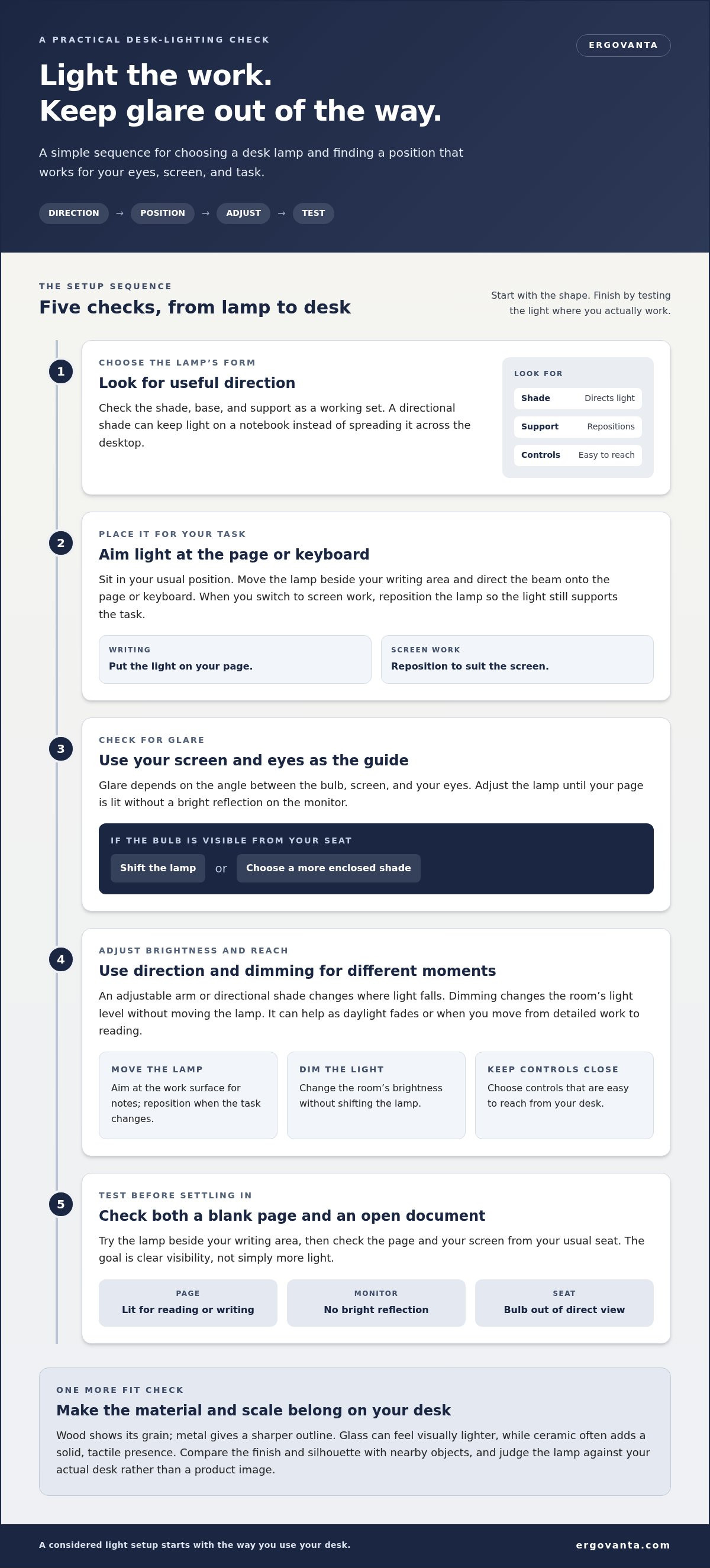
Scandinavian lighting balances a clear silhouette with deliberate light placement. For a desk lamp, check where the shade directs light, whether its support lets you reposition it, and how its brightness works alongside your screen. A directional shade can keep light on a notebook rather than spreading it across the desktop. Function should be evident in the design, not hidden behind it.
Glare often depends on the angle between the bulb, screen, and your eyes. Sit in your usual position and adjust the lamp until your page is lit without a bright reflection on the monitor. If you can see the bulb directly from your seat, shift the lamp or choose a more enclosed shade. Your screen and writing area help determine the best placement.
Adjustable and Dimmable Lighting
An adjustable arm or directional shade lets you control where the light falls. For close work, aim it at the page or keyboard, then reposition it when you switch to a screen. Dimming changes the room’s light level without moving the lamp. It can help as daylight fades or when you switch from detailed work to reading. Keep the controls easy to reach.
Test the setup before settling on a position. Move the lamp beside your writing area, then check a blank page and an open document. A monitor light bar can leave more desk space free by avoiding a lamp base, but check how its light reaches your screen and work surface. The goal is clear visibility, not simply more light.
Bedroom lighting calls for a different balance from focused desk work. A dimmable lamp or frosted shade can provide soft ambient light, while a more directed beam suits reading. For easy reach, align a bedside lamp with mattress height. This puts its switch or shade near your hand at the nightstand, without an awkward stretch.
Consider how the room’s lighting needs change from task to task. A desk used for writing, video calls, and evening reading may need both focused and softer light. Aim the lamp at your work surface for notes, then dim it when the screen becomes the focus. In a bedroom, use a softer setting to wind down and a directed beam for reading.
For another point of reference, compare the forms and placements shown in Scandinavian lighting styles. Choose a lamp whose controls and direction suit your routine, not just the desk’s appearance.
Lamp materials and sculptural forms
A lamp’s material affects how it looks beside a monitor, notebook, and other desk objects. Wood shows its grain; metal creates a sharper, more graphic outline. Glass can make a shade feel visually lighter, while ceramic often adds a solid, tactile presence. Compare these surfaces with what’s already on your desk before choosing a finish.
A sculptural shape matters because the lamp remains in view when it’s switched off. A dome shade, angled arm, or rounded base can give a workspace a focal point. Keep the silhouette in proportion to nearby items. A broad shade, for example, may feel crowded beside a large monitor, while a narrow stem can preserve more open space.
Size is easiest to judge against the actual desk, not a product image. One listed desk lamp measures 15 centimeters wide and 45 centimeters tall. Use those dimensions as a concrete reference, then compare them with the free surface beside your keyboard or monitor. Check both the base footprint and the height of the shade, since either can affect how the lamp fits.
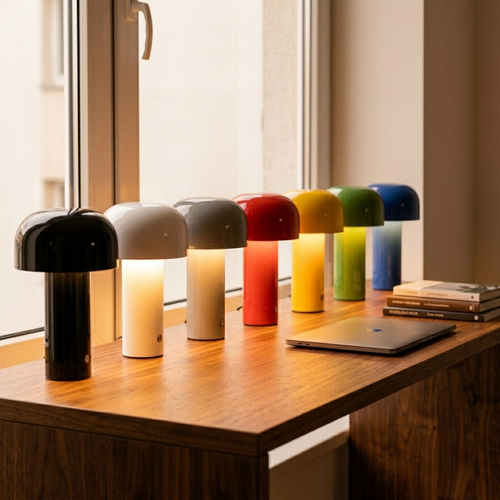
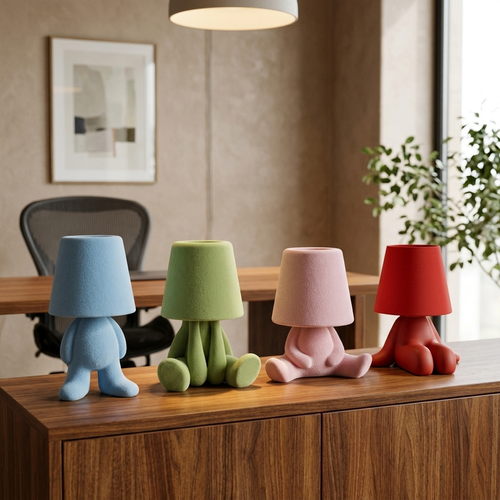
Color also changes a lamp’s visual weight. A white finish can blend with a pale wall or desk, while black creates a stronger outline against light surroundings. Natural wood adds grain and warmth; a metal finish can echo the hardware on a monitor stand. Treat these as pairing ideas, not rules. Choose a finish that works with your existing objects and room colors.
Function should remain part of the decision. Consider the base, support, shade, switch, and cord as one arrangement. A substantial-looking base can make a compact lamp feel grounded, while a sculptural shade can draw attention even when the lamp is off. For a desk used for writing and screen work, prioritize a shape that leaves room for everyday tools.
Placement helps you judge whether a lamp’s shape suits your routine. Set it beside the work area rather than directly in front of the monitor, then see whether its base competes with a mouse or notebook. On a shallow desk, a wide base may take up useful space. A taller lamp can sit behind smaller desk objects without disappearing from view.
Before choosing, picture the lamp in three situations: switched off, aimed at a task, and viewed from your usual seat. This simple comparison tests its appearance, practical use, and visual balance. Its material and silhouette should work in all three, not just look appealing in a staged photograph.
Dimming and LED efficiency
LED efficiency describes how much light a source produces for the electricity it uses. Compare stated light output with power consumption instead of judging efficiency by brightness alone. A lamp that uses less power for a similar amount of light is more efficient. Check both figures in the product information, then consider whether the output suits your usual desk tasks.
LEDs produce light differently from incandescent bulbs, which release much of their energy as heat. This can make LED lighting a practical option for a desk used throughout the day. Efficiency still varies between light sources. Compare the output and energy use of the specific lamps you’re considering rather than assuming every LED performs alike.
Dimming adds a compatibility question. With a replaceable LED bulb, the bulb and dimmer need to be designed to work together. An incompatible pairing can cause flicker, uneven changes, or a limited dimming range. With an integrated LED source, the lamp’s built-in controls and driver determine how dimming works. Look for information specific to the lamp, not just the word “LED.”
Treat the lowest setting as a practical test, not an afterthought. A bulb may dim smoothly through much of its range but flicker near the bottom. If possible, assess the light at the levels you expect to use, including a low setting for quiet desk tasks. Smooth adjustment matters more than a dimming control that performs poorly where you need it.
To compare options, check these details together:
- Light output: How much light does the source provide?
- Power use: How much electricity does it consume for that output?
- Compatibility: Does the bulb work with the dimmer or driver?
- Low-level performance: Does the light remain steady at a dim setting?
Consider efficiency in the context of regular use, not just the lamp’s brightest setting. A dimmer can lower light output when full brightness isn’t needed, but the energy reduction depends on the LED and its control system. A well-matched combination avoids excess brightness while keeping the light useful for the task.
Make your final comparison with the lamp’s everyday role in mind. A light source that meets your usual needs without unnecessary output can be a considered choice. Pair it with a compatible dimming system, and you can use less light when the task calls for it, without guessing how the setup will perform.
Wood, metal, and white finishes
Choose a finish by considering the colors and surfaces already around your desk. A wood-finish lamp can relate to a wooden tabletop, shelves, or a nearby frame without matching exactly. A similar tone can create continuity, while a contrasting tone can give the lamp a deliberate place in the room.
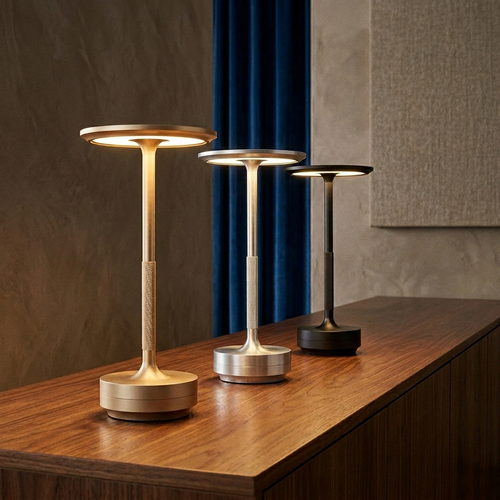
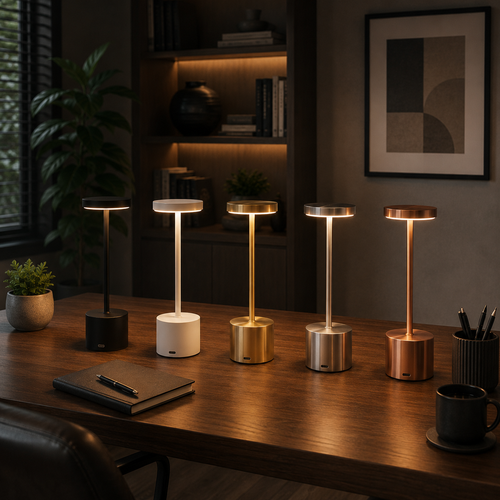
Metal finishes can echo details elsewhere in your setup. For example, a lamp with a dark finish may relate to a monitor frame, chair base, or desk hardware. Repeating a finish can connect separate objects. If those details already compete for attention, a different finish can keep the lamp from blending into the same visual line.
White can work well when you want a lamp to sit quietly among pale surfaces. Against a light wall, it may blend into the background; beside a darker desk, it can create contrast. Check the lamp against both the wall and desktop, since they affect how its finish looks from your chair.
Before choosing a color, consider the whole desk rather than one object at a time. Note the main surface, the wall behind it, and the largest nearby accessories. Then decide whether the lamp should repeat an existing color, soften a strong contrast, or add a distinct accent. This ties the choice to the room you actually use.
Use these comparisons to narrow the options:
- Repeat: Match a finish to a visible detail, such as a monitor frame or shelf support.
- Balance: Use a lighter or darker finish to offset the dominant desk color.
- Blend: Choose a finish close to the wall or desktop when you want less visual contrast.
- Accent: Pick a contrasting finish when the lamp should stand apart from surrounding objects.
Room lighting can also affect how a finish appears. A lamp beside a bright window may look different from one seen under evening room light. If you’re comparing options online, consider where it will sit and which colors surround it during your normal workday. The aim isn’t a perfectly matched set, but a combination that feels intentional in your space.
For a final check, picture the lamp beside your most noticeable desk items, not on its own. A finish that works with the wall, desktop, and nearby equipment can help the workspace feel cohesive without making every object identical. Choose a combination you’ll be glad to see during an ordinary workday.
Explore Scandinavian lamp styles
Ergovanta: desk lamps
Ergovanta offers desk lamps alongside other lighting for your space. Compare options based on what matters most: a shape that suits your desk, light that serves your work, and a finish that fits with your other objects. If your desk needs broader room lighting, consider floor lamps, wall lights, or ceiling lights as part of the setup.
Start with the lamp’s role, then compare its shape and material with its surroundings. A focused task light and a softer room light address different needs, so choose what your workspace is missing rather than adding light for its own sake.
Explore the lighting options or contact Ergovanta if you’d like to learn more.
Make your workspace yours, one choice at a time
Before choosing a lamp, consider how you want your desk to feel during an ordinary workday. You might want a clearer place to focus, a softer atmosphere at the end of the day, or an object that feels at home among your belongings. That observation gives your next choice a purpose beyond filling an empty spot.
Choosing Scandinavian desk lamps can make that purpose visible. Let your routine guide the decision rather than building a workspace around someone else’s idea of the perfect setup. Start with one thoughtful change, live with it, then decide what the room needs next. A workspace you want to return to grows from choices that make sense for you.
Your space doesn’t need to look like anyone else’s. Make it work for you, and enjoy the difference.
Frequently Asked Questions
What defines Scandinavian-style desk lamps?
Scandinavian-style desk lamps draw on Nordic design traditions, but there’s no required shape or finish. The label describes an approach to design, not a checklist every lamp must meet. To assess a particular lamp, consider whether its proportions and details work together. Picture it beside your desk items, switched on and off, rather than relying on the style label alone.
Which Scandinavian desk lamps offer adjustable brightness and color temperature?
Choose a lamp whose product details explicitly describe both brightness adjustment and selectable color temperature. These controls do different things: brightness changes the amount of light, while color temperature changes its appearance. Don’t assume a dimmer includes color adjustment, or that a color setting changes brightness. If you want both, look for each feature to be listed separately in the lamp’s specifications.
What materials are common in Nordic desk lamp design?
Wood, metal, and glass are common materials in Nordic desk lamp design. Consider everyday use as well as appearance: a desk near a window may collect dust differently from a tucked-away work surface, and care needs can vary by material and finish. Choose an option you can maintain comfortably as part of your regular desk routine, and follow its care instructions.
Which Scandinavian desk lamps are best for small desks?
A good fit for a small desk leaves room for your keyboard, notebook, and hands. Compare the base footprint with the space available, then consider alternatives that keep the desktop clear. A wall light moves the light source off the desk; a compact lamp may suit a desk where wall placement isn’t practical. Also consider where the cord and controls will sit.
How do I choose the right desk lamp for reading or working?
Start by naming your main task, then compare how the lamp fits your routine. For reading, consider whether the light can cover an open book without taking over the space beside it. For mixed desk work, think about where the controls sit and whether the base leaves room for your tools. Choose for the activity you do most, not a hypothetical perfect setup.
How do popular Scandinavian desk lamp brands compare?
The &Tradition Flowerpot collection is known for its paired, rounded forms, while Audo Copenhagen designs are described as restrained and contemporary. These are design references, not a comparison of performance.
Disclaimer
Ergovanta publishes these guides to help people set up better workspaces. Product recommendations reflect what we sell. Specifications, prices and availability are accurate at the time of writing and may change. Nothing here is medical, ergonomic or professional advice; if you have a specific health concern about your workstation, speak to a qualified professional.
From the catalog