August 29, 2026
Ergonomic Foot Rest Benefits: Why Stability Shapes the Work

The workspace shapes the work. Equip it deliberately. Many people treat their desk as a temporary landing pad; they tolerate the lower back fatigue and leg numbness that come from a chair that doesn't quite fit. You might think a foot rest is just another piece of office clutter. In reality, it's the foundation of a stable, intentional environment. Understanding the ergonomic foot rest benefits is the first step toward reclaiming your physical comfort and mental focus during deep work sessions.
If your feet don't rest flat, your body compensates in ways that drain your energy and cause unnecessary physical strain. You deserve a setup that feels permanent and grounded. Discover how a considered foot rest provides the stability needed to build a workspace you actually want to use. We will preview how proper support reduces swelling, improves your posture, and turns your desk into a functional space made for the work. It's time to prioritize the small objects that earn their place and ensure your environment supports your best efforts.
Key Takeaways
- Understand the core ergonomic foot rest benefits and how a stable base prevents your pelvis from shifting into strained positions.
- Perform the perched test to determine if the relationship between your chair and desk is actually working for your body.
- Identify the difference between a static base for focused typing and dynamic massage boards that keep you moving while seated.
- Equip your space with considered tools that reduce physical strain and help you maintain focus during long, intentional work sessions.
- Shift your perspective from medical metrics to purposeful function, ensuring every object in your room earns its place and is made for the work.
The Foundation of Stability: Why Your Feet Need a Place to Land
The workspace shapes the work. Equip it deliberately from the ground up. Most office setups begin with the desk or the chair, yet the true foundation of a productive day is where your feet land. Stability starts at the floor. When your feet dangle, your body loses its primary source of balance, forcing your back and core to compensate for the lack of support. One of the primary ergonomic foot rest benefits is the creation of a consistent floor height. Regardless of how you adjust your chair to align with your monitor, a foot rest ensures your legs remain supported and your posture remains neutral. Grounding your feet allows your core to relax, shifting your physical and mental energy away from maintaining balance and toward the task at hand.
The Problem with Floating Feet
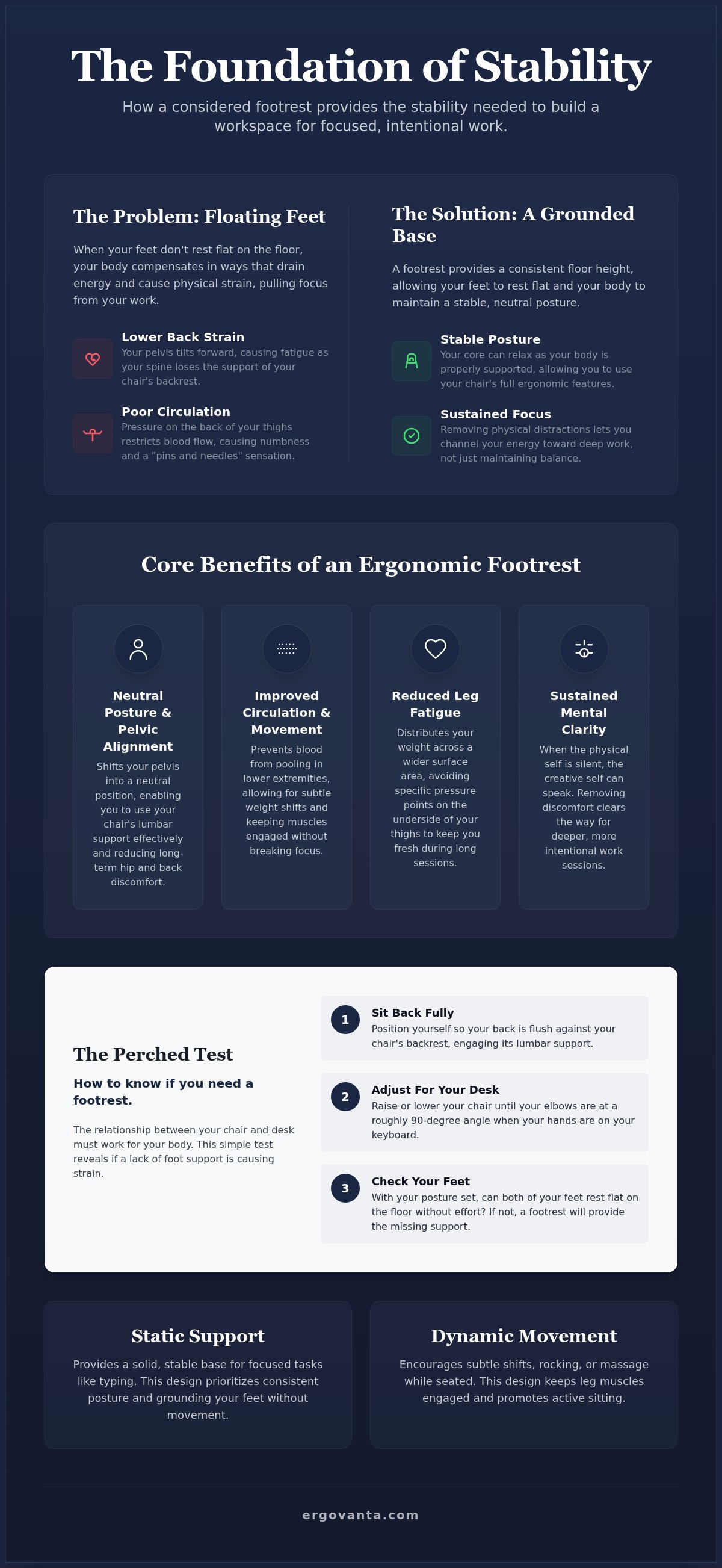
When your feet don't reach the ground, gravity pulls on your lower back. This constant tension often results in the "perched" posture, a common habit where you sit on the front edge of your chair to reach the floor. While it might feel like an active way to work, it quickly leads to lower back fatigue because your spine lacks the support of the chair's backrest. Floating feet also create a mechanical issue at the seat edge. The front of your chair presses into the soft tissue behind your knees and the back of your thighs. This pressure restricts circulation, often causing that heavy, numb sensation in the legs after long sessions. A considered foot rest earns its place by removing these physical distractions. It provides a stable base that lets you sit back into your chair, utilizing the lumbar support you already have.
Purposeful Function Over Status
There is a difference between office decor and tools made for the work. If you look into what is a footrest historically, you'll find they were often treated as simple furniture. Today, we view them through the lens of "ergon," the Ancient Greek root for purposeful function. A foot rest isn't about status or mimicking a corporate cubicle. It is about personal ownership of your environment. By grounding your feet, you allow your core to relax and your breathing to steady. This isn't a medical intervention; it's an intentional choice to equip a workspace that supports the person doing the work. You aren't just adding another object to the room. You are building a space you choose to come back to because it actually feels like yours. When your physical space is grounded, your mental focus follows.
Core Benefits of an Ergonomic Foot Rest
The workspace shapes the work. Once you have grounded your feet, the ripple effects move through your entire body. Realizing the full range of ergonomic foot rest benefits is about more than just avoiding pain; it is about creating a baseline of comfort that allows you to disappear into your tasks. When your body isn't fighting for balance, your mind can stay on the work. Physical distractions are the quiet enemies of productivity. By removing the strain of unsupported legs, you clear the way for deeper, more intentional focus.
Neutral Posture and the Pelvic Tilt
A considered foot rest encourages your back to sit flush against your chair. Without support, you often unconsciously tilt your pelvis forward or slouch to find a stable center of gravity. By raising the floor height, you shift your pelvis into a more neutral, considered position. This alignment allows you to actually use the lumbar support built into your office chair. It is not about a single moment of relief. It is about how you feel after four hours of deep focus. Small adjustments in foot height can prevent long-term discomfort in the hips and lower back, ensuring your body feels as fresh at 5:00 PM as it did at 9:00 AM.
Circulation and Movement
Static sitting is the enemy of productivity. If your legs are unsupported, gravity causes blood to pool in the lower extremities, often called venous pooling. This leads to that heavy, "pins and needles" feeling that forces you to break focus and walk around just to regain feeling. Following ergonomic standards for sitting ensures that your thighs remain parallel to the floor without pressure on the back of your legs. A foot rest allows for subtle shifts in weight, keeping your muscles engaged without requiring you to stand up every ten minutes. Consider it an essential part of your ergonomics and comfort kit.
Leg Fatigue and Mental Clarity
By distributing your weight across a wider surface area, you avoid the specific pressure points on the underside of your thighs. This reduction in leg fatigue keeps you fresh during long sessions. When the physical self is silent, the creative self can speak. If you are struggling to find the right balance in your current setup, you can always reach out to us for workspace advice. Building an intentional room means selecting the small objects that earn their place through purposeful function. Every tool should serve the work, and a stable base is where that work begins.
Static Support vs. Dynamic Movement
The workspace shapes the work. Equip it deliberately. When selecting tools for your environment, understand that not all foot rests serve the same purpose. Some are made for stillness; others are made for motion. One of the primary ergonomic foot rest benefits is the ability to choose a base that matches your specific rhythm. Static rests provide a solid, unmoving foundation for deep focus. Dynamic rests, on the other hand, prioritize active sitting to keep your body engaged during long sessions. Selecting the right base is how you maximize the ergonomic foot rest benefits for your unique environment.
The Case for Active Sitting
Movement is the antidote to a stagnant room. Dynamic foot rests, or rockers, encourage your ankles to shift naturally throughout the day. This simple motion engages the calf muscles. In ergonomic circles, the calves are often called the "second heart" because their contraction helps pump blood back up the body, improving circulation. This prevents the heavy, tired feeling that usually sets in by mid-afternoon. Research into workplace health suggests a "20-8-2" rhythm: 20 minutes of sitting, 8 minutes of standing, and 2 minutes of moving. A rocking foot rest helps you maintain that movement even while you are seated. Some people prefer foot massage boards for the added sensory feedback. The texture keeps you grounded and alert, turning a simple support into a functional advantage.
Static Bases for Heavy Tasks
Stillness has its own value. If your work requires high precision, such as high-stakes typing or detailed creative editing, you likely need a fixed base. A static rest provides a consistent, unmoving floor height that allows your upper body to remain perfectly steady. The focus here is on the relationship between the chair and the desk. Stability is not just a physical metric; it is a psychological one. Knowing your feet are planted on a solid surface can reduce the micro-tensions that build up when you feel ungrounded at a tall desk. Look for models with adjustable heights to ensure the fit is exact for your specific build. A fixed base is an anchor; it allows your core to relax because it knows exactly where the floor is at all times. Equip your space with workspace essentials that match your specific task load. Whether you need the engagement of a rocker or the reliability of a fixed base, choose the tool that earns its place by supporting the way you actually work.
How to Know if You Need a Foot Rest
The workspace shapes the work. Equip it deliberately. You might assume foot rests are only for people of shorter stature. That is a common mistake. The need for support is defined by the relationship between your chair and your desk, not just your height. If your desk is fixed at a standard height, you likely have to raise your chair to keep your elbows level with the keyboard. This often leaves your feet dangling or barely touching the floor. Recognizing this misalignment is the key to understanding why you aren't seeing the full range of ergonomic foot rest benefits in your current setup.
The 3-Minute Posture Test
Spend three minutes observing how you actually sit during a deep work session. First, sit all the way back in your chair so your lumbar support can do its job. If your feet do not rest flat and feel heavy against the floor, you are likely straining your lower back. Second, check your knees. They should be level with or slightly higher than your hips to maintain a neutral pelvic tilt. Finally, pay attention to your legs. If you find yourself constantly crossing them, tucking them under your chair, or bouncing them nervously, your body is searching for the stability it lacks. These are signs that your workspace feels "temporary" rather than grounded.
Equipping for Non-Adjustable Desks
Most standard desks are built to a height that doesn't account for individual ergonomics. They are often too high for the average person. If you don't have a standing desk converter or an adjustable surface, you are forced to adapt your body to the furniture. Raising your chair to reach the desk creates a gap between your feet and the floor. A considered foot rest bridges this gap. It makes a standard desk feel like it was made for you, turning a generic piece of furniture into a functional part of your intentional space. It is one of those small objects that earn their place by solving a mechanical problem without cluttering the room.
The "perched" test is another simple diagnostic tool. If you find yourself sliding forward to the edge of your seat just to keep your feet on the ground, you are sacrificing your back for your feet. This posture puts immense pressure on your spine and creates heavy pressure on the underside of your thighs. Check your legs for that tired, numb feeling after a long session. If the edge of your chair feels like it is digging into your skin, your circulation is being restricted. A foot rest redistributes that weight, allowing the chair to support you while your feet remain firmly planted.
Integrating Ergonomics into an Intentional Space
The workspace shapes the work. Equip it deliberately. A room that gets used is one where every object has earned its place through purposeful function. We have covered how a stable base transforms your posture; now, you must integrate that stability into a wider system. Ergonomics is not a list of medical metrics to satisfy a corporate checklist. It is about "ergon," the purposeful function that allows you to do the work without the environment getting in the way. When you realize the full range of ergonomic foot rest benefits, you see them as one part of a considered whole. Build a system that serves your specific rhythm.
Beyond the Foot Rest
A foot rest works best when the rest of your tools are aligned. If your feet are grounded but your screen is too low, you will still hunch forward. This breaks the neutral alignment we worked so hard to establish. Consider adding monitor stands to bring your display to eye level. This prevents neck strain and keeps your back flush against your chair. Even lighting plays a role in your physical stance. Poorly lit spaces cause you to lean toward the light, losing contact with your foot rest and backrest. Build a system where every tool supports the next. Equip your space deliberately; do not just buy gear, build a system.
For the People Who Do the Work
Ergovanta exists to provide the advantage you need to stay in the flow. The name itself reflects this: ERGO for purposeful function and VANTA for advantage. We believe your workspace should feel like a sanctuary of productivity, not a generic cubicle. It should feel like yours because you built it with intention. Comfort is the prerequisite for deep work. If you are constantly shifting in your seat, the room isn't working for you. Equip your space with tools made for the work. You can browse our best sellers to see the foundations other builders are using to reclaim their focus.
Building a workspace you choose to come back to requires looking at the room as a whole. Do not just buy gear to fill a desk. Build a system that respects your body and your time. When your feet are stable, your screen is at the right height, and your room is well-lit, you create the conditions for success. The room becomes a place of influence because it supports the person doing the work. Every object should serve a purpose, and every purpose should serve the work you do. Focus on the small objects that earn their place, and the results will follow.
Build a Workspace Designed for the Work
The workspace shapes the work. Equip it deliberately. By now, it's clear that a foot rest is not just an accessory; it's the foundation of a grounded, intentional environment. Grounding your feet allows your core to relax and your mind to stay on the task. Whether you opt for a static base for high-precision typing or a dynamic massage board for active sitting, the ergonomic foot rest benefits translate directly into reduced strain and improved focus.
Every object in your room should earn its place through purposeful function. We believe in helping the people who do the work by offering free shipping on essential workspace tools and providing peer-to-peer expert support. If you're ready to move past a temporary setup, choose tools that are made for the work and designed for the rooms that actually get used.
Creating a space that feels like yours is a choice. Start from the floor up and build a sanctuary of productivity you'd choose to come back to every single day.
Frequently Asked Questions
Do I really need a foot rest if I have an ergonomic chair?
You need a foot rest if your feet don't rest flat on the floor after adjusting your chair for proper arm alignment. According to the ISO 9241-5:2024 standard, support is required whenever chair height prevents a grounded posture. Even the most advanced chair cannot bridge the gap between a high desk and the floor. A foot rest ensures you can utilize your chair's features without sacrificing lower body stability.
Can I use a foot rest while standing at a desk?
Using a foot rest while standing supports a habit called active standing. By elevating one foot on a stable surface, you encourage subtle shifts in weight and posture. This reduces the stiffness and fatigue often associated with standing still for long periods. It is an intentional way to keep your body engaged while you work, preventing the static load that leads to lower back strain during standing sessions.
What is the ideal height for an ergonomic foot rest?
The ideal height is the one that allows your thighs to remain parallel to the floor while your feet are firmly planted. Your knees should be level with or slightly higher than your hips. This height varies based on your build and the specific desk-to-chair ratio of your room. The goal is to maximize ergonomic foot rest benefits by removing pressure from the back of your legs and grounding your posture.
Is a rocking foot rest better than a static one?
Better depends on the task at hand. Rocking models encourage the 20-8-2 rhythm by keeping your ankles and calves moving, which is excellent for circulation. Static rests provide a solid, unmoving anchor that is often preferred for high-precision typing or deep, focused work. Choose the tool that matches your specific rhythm. A massage board can also provide sensory feedback that keeps you alert and grounded throughout the day.
How does a foot rest help with lower back pain?
A foot rest helps by shifting your pelvis into a neutral position. When your feet are unsupported, you tend to perch on the edge of your seat, which pulls on the lumbar spine. By grounding your feet, you can sit all the way back into your chair. This allows the built-in lumbar support to do its work. It's about building a space that supports your body rather than forcing it to compensate.
Should I use a foot rest with or without shoes?
This is a matter of personal preference and the type of surface you choose. Working without shoes allows you to feel the texture of foot massage boards, providing sensory feedback that many find helpful for focus. If you prefer a firm, consistent base, shoes might feel more stable. The key is ensuring your feet feel heavy and supported. Equip your space in a way that makes you choose to come back to it.
Can a foot rest help with poor circulation in the legs?
Yes, it prevents the front edge of your chair from pressing into the soft tissue behind your knees. This pressure often causes venous pooling, leading to that heavy or numb feeling. One of the major ergonomic foot rest benefits is keeping the blood moving. Rocking models are particularly effective as they engage the calf muscles, which act as a pump to return blood from the lower extremities to the heart.
How do I know if my foot rest is at the right angle?
Your foot rest is at the right angle when your ankles are in a neutral, comfortable position. This usually means an angle between 90 and 110 degrees. Avoid angles that force your toes to point up or down excessively. The surface should feel like a natural extension of the floor. If you find yourself constantly adjusting your feet, the angle likely needs a slight change to better suit your chair height.
Disclaimer
Ergovanta publishes these guides to help people set up better workspaces. Product recommendations reflect what we sell. Specifications, prices and availability are accurate at the time of writing and may change. Nothing here is medical, ergonomic or professional advice; if you have a specific health concern about your workstation, speak to a qualified professional.
From the catalog