September 8, 2026
How Many Lumens for a Desk Lamp? Optimal Brightness Guide
The workspace shapes the work. Equip it deliberately. Most people treat lighting as a background detail, but the wrong bulb can ruin a deep work session faster than a loud neighbor. You're likely asking, how many lumens does a desk lamp need to support your focus without causing a headache? The answer isn't a single number; it's a calculation of how you use your space. A lamp is a tool that earns its place by protecting your eyes and defining the boundaries of your concentration.
It's frustrating to finish a late night with dry eyes and a dull ache from screen glare. You want a setup that feels personal and functional, not one that feels like a sterile corporate cubicle. We've all struggled with inconsistent lighting that breaks our flow and ruins our focus. This guide helps you find the 'sweet spot' for brightness, typically between 500 and 800 lumens, to reach the recommended 500 lux on your work surface. Learn to decode packaging, reduce eye strain, and equip your desk with the intentionality your work requires.
Key Takeaways
- Shift your focus from wattage to lumens. LED lighting uses lumens to measure actual brightness, helping you equip your space with precision.
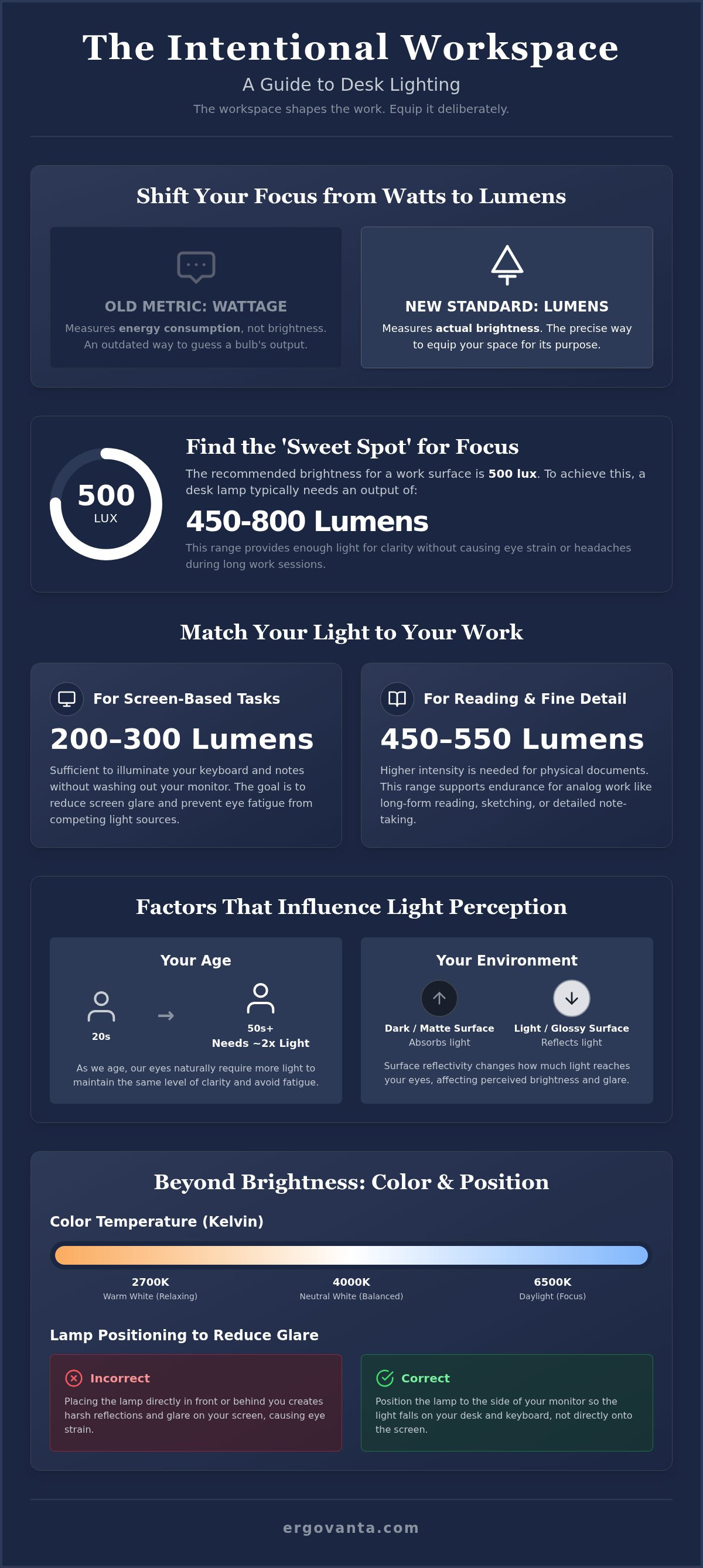
- Learn how many lumens does a desk lamp need to reach the 500 lux standard. A range of 450 to 800 lumens is typically the baseline for focused work.
- Account for your specific environment. Factors like desk surface reflection and your age change how much light you actually perceive.
- Pair brightness with the right color temperature. Using the correct Kelvin levels ensures your workspace feels intentional and supports your natural rhythm.
- Optimize your lamp’s position to reduce glare. Proper placement turns a simple light into a tool that protects your eyes during deep work.
Understanding Lumens as the Foundation of Your Workspace
The workspace shapes the work. Equip it deliberately. When building a functional desk setup, light is often the last consideration, yet it remains the most impactful. Understanding Lumens is the foundation of this process. A lumen is a measurement of the total visible light emitted by a bulb or fixture.
In the era of incandescent bulbs, we relied on wattage to guess brightness. This was always a flawed metric because wattage measures power consumption, not light output. Modern LED technology has changed the rules. You now choose equipment based on the light it produces rather than the energy it draws. When you begin to equip your space, the first question is usually: how many lumens does a desk lamp need to support your specific daily tasks?
To better understand how to select the right lighting for your desk, watch this helpful buying guide:
Why Lumens Matter for Eye Health and Focus
Inadequate lighting forces your eyes into a constant state of adjustment. You might not notice the subtle squinting at first, but the resulting physical fatigue is real. Proper brightness provides the necessary contrast that allows your brain to stay locked on the work without distraction. Choosing a lamp with a considered lumen count acts as a psychological trigger for your brain. When that specific light source is activated, it signals that it's time for deep work. It effectively carves out a sanctuary of productivity within a larger room.
The Difference Between Ambient and Task Lighting
Your ceiling fixture provides ambient light. Its purpose is to make the room navigable, not to support detailed reading or writing. Relying solely on overhead lighting creates harsh shadows and leaves your desk surface in a dim grey zone. A dedicated desk lamp provides task lighting, which is light made for the work. It allows you to build a workspace that feels personal and functional.
While general room lighting is important, your desk requires a concentrated output to reduce the strain of screen glare. Determining how many lumens does a desk lamp need is the starting point for selecting a tool that truly earns its place on your desk. Most people find that 450 to 500 lumens is the baseline for a lamp that supports focus during long sessions. Balancing these two layers ensures your space remains intentional and comfortable for the long haul.
Calculating the Lumens Required for Your Specific Work
The workspace shapes the work. Equip it deliberately. A baseline of 450 lumens is usually the starting point for a functional desk lamp. This provides enough light to see clearly without overwhelming the room. But finding the 'sweet spot' for your desk depends on what you do and, frankly, how long your eyes have been in service. As we age, our eyes naturally require more light to maintain the same level of clarity. A professional in their 50s might need twice as much light as someone in their 20s to perform the same task without fatigue.
Finding the right balance is about the 'Goldilocks' principle: light that is helpful but not abrasive. When you shop for equipment, ignore the wattage equivalent marketing on the front of the box. That is an outdated power metric. Instead, flip the packaging to the Lighting Facts label. Look specifically for the brightness row to see the lumen count. This is how you ensure the tool you're buying actually fits the job.
Lighting for Screen-Based Tasks
Computer monitors are light sources in their own right. When your work is primarily digital, how many lumens does a desk lamp need? Usually, less than you think. A range of 200 to 300 lumens is sufficient to illuminate your notes or keyboard without washing out your screen. Indirect light is essential here to prevent glare. Many people choose monitor light bars for this reason; they provide a pool of light exactly where you need it without bouncing off the glass of your display.
Lighting for Reading and Fine Detail
Physical paper is a different beast. It doesn't glow, so it requires higher intensity to maintain focus. For long-form reading, sketching, or note-taking, aim for 450 to 550 lumens. This higher output supports your endurance during analog hours, making the fine lines of a drawing or the small text of a book easier to process. If you're building a space meant for both digital and analog work, an adjustable lamp is a piece of equipment that earns its place. If you're unsure how to balance your specific room's ambient light with a new lamp, feel free to reach out to our team for guidance.
Factors That Influence How You Perceive Light at the Desk
The workspace shapes the work. Equip it deliberately. While the raw output of a bulb is a vital statistic, it is only half of the story. When you calculate how many lumens does a desk lamp need, you are actually solving for how much light your eyes receive. This perception is filtered through your environment. Everything from the color of your walls to the material of your desk surface dictates whether your 500 lumen lamp feels like a focused spotlight or a dim glow. A single number cannot account for the unique physics of your specific room.
Desk Materials and Light Absorption
Your furniture choices play a massive role in light behavior. Darker materials, such as a solid walnut desk, act as light sponges. They absorb a significant portion of the visible spectrum, meaning you might need closer to 800 lumens to achieve the same perceived brightness as a lighter surface. Conversely, white laminate or glass desks are highly reflective. Using high lumen bulbs on these surfaces often results in painful hot spots or glare that forces you to squint. Building an intentional workspace means choosing a lamp that complements your furniture rather than fighting it.
The Impact of Desk Size and Lamp Height
Distance is the silent killer of brightness. The further your lamp head is from the surface, the more the light scatters. Based on standard task lighting metrics, a lamp positioned 16 inches above the desk provides the necessary lux for focus, but moving that same lamp to 24 inches reduces the intensity significantly. This is why adjustable goosenecks or articulating arms are more than just design choices; they are functional requirements. They allow you to bring the light closer for intense focus or push it away for broader coverage across a larger area.
Consider the total lighting ecosystem of your room. If you work on a large L-shaped desk, a single source rarely provides even coverage. You might need to equip your space with two lamps or pair a desk lamp with strategic floor lighting to eliminate shadows in the corners. Secondary sources, such as natural light from a window or wall lights, also change the requirement. In a room with high ambient light, you may only need 300 lumens to fill the gaps. In a darker, more secluded room, you will likely need the full 500 to 800 lumen range to maintain a space you choose to come back to.
Beyond Brightness: Color Temperature and Positioning
The workspace shapes the work. Equip it deliberately. While you now understand how many lumens does a desk lamp need to illuminate your surface, brightness is only one variable in the equation. A space you choose to come back to requires light that feels intentional. If the brightness is correct but the color is harsh, your focus will still suffer. You need to balance the raw intensity of your bulb with the correct color temperature and strategic placement to build a truly functional environment.
The Science of Color Temperature
Color temperature is measured in Kelvin (K). It dictates the atmosphere of the room and how it interacts with your internal clock. For peak productivity during the morning and early afternoon, aim for a cool blue light in the 4000K to 5000K range. This mimicry of daylight supports alertness and keeps your brain engaged. As you transition into the evening, shift your equipment to a warm amber light around 2700K. This supports your natural circadian rhythms, signaling to your body that the intensity of the day is winding down. Equipping your desk with an adjustable-temperature LED lamp allows you to modify your environment as the sun moves, ensuring your space remains a sanctuary of focus at any hour.
Strategic Lamp Placement
Positioning is as critical as the bulb itself. A common mistake is placing the lamp on the same side as your dominant hand. This creates hand shadows that dance across your paper or keyboard as you work, causing a subtle but constant distraction. Follow the rule of opposites: if you are right-handed, place your lamp on the left side of your desk. This simple adjustment ensures an unobstructed pool of light across your primary work area.
Angle the lamp head so the bulb is not in your direct line-of-sight. You want the light on the task, not in your eyes. Beyond the practical, use your lighting to highlight the small objects that earn their place on your desk. Whether it is a favorite figurine or a considered piece of tech-device-accessories, intentional lighting makes these items part of your workspace ritual. When you determine how many lumens does a desk lamp need, remember that where those lumens land is what defines your comfort.
Equipping Your Space with the Right Lighting Tools
The workspace shapes the work. Equip it deliberately. After calculating how many lumens does a desk lamp need, the focus shifts to the selection of the tool itself. You aren't just buying a light source; you're choosing a catalyst for your daily output. A considered workspace requires a balance of at least 450 lumens for task-specific clarity, adjustable color temperature to match the time of day, and a design that earns its place through utility. Lighting is often the final step in building a personal workstation that feels functional rather than clinical.
Choosing Your Next Desk Lamp
Minimalist design isn't just about aesthetics; it's about removing the visual noise that breaks your concentration. When selecting your next piece of equipment, look for a lamp that offers integrated LED technology. These fixtures provide steady, flicker-free light while maintaining high energy efficiency over thousands of hours. Unlike traditional incandescent bulbs, modern LEDs allow for the precise control of both intensity and color required for a professional environment. A lamp with a slim profile and an articulating arm provides the flexibility to move your pool of light as your tasks change throughout the day. Explore our collection of considered desk lamps to find a fixture that fits both the aesthetic and functional needs of your room.
Creating a Holistic Ergonomic Environment
Lighting is a vital component of a larger ecosystem, but it doesn't work in isolation. It must pair with other tools like monitor stands to eliminate screen reflection and ergonomic seating to support your physical endurance. At Ergovanta, we focus on lighting that supports the people who do the work by adhering to the philosophy of 'purposeful function.' This means every object you choose should provide a clear advantage to your workflow.
When you equip your desk with intentionality, you create a room that actually gets used. A well-lit desk isn't just a place where work happens; it's a sanctuary where you can settle into a deep flow without the distraction of eye strain or physical fatigue. Building a workspace you choose to come back to is about the small objects that prove their worth every single hour. Equip your workspace with our best-selling essentials to ensure every part of your setup is made for the work.
Build a Workspace Defined by Purpose
Lighting isn't just about visibility; it's about setting the stage for deep work. By understanding how many lumens does a desk lamp need, you move away from guesswork and toward a setup that supports your specific physiological and task-based needs. Whether you're working on a light-absorbing walnut desk or a reflective glass surface, the right brightness ensures you aren't fighting your environment. Every lumen should serve a purpose.
We believe in tools that earn their place. Our lighting solutions are made for the people who do the work, focusing on functional, minimalist aesthetics and the concept of purposeful function. Every object in your workspace should provide a clear advantage, helping you maintain focus during long sessions without the distraction of eye strain or poor positioning. Take ownership of your environment and build a space that feels intentional and uniquely yours.
Peer-to-peer expert guidance is always available to help you equip a room you'll actually want to use. Start building today.
Frequently Asked Questions
Can a desk lamp be too bright?
Yes. Excessive brightness leads to uncomfortable glare, especially on digital screens. If the output is too high for the room, you'll likely experience eye fatigue and headaches. The goal is to find the point where you see clearly without squinting at reflections. A lamp that produces more than 1,000 lumens in a small, dark room often creates an abrasive environment that ruins your focus rather than supporting it.
Is 800 lumens too much for a desk lamp?
It depends on your task. For detailed analog work like drafting or sketching, 800 lumens provides the necessary intensity. However, for standard computer use, it might be excessive. When asking how many lumens does a desk lamp need, consider if your fixture has a dimmer. Adjustable equipment allows you to use 800 lumens when required and scale back for screen-based sessions to prevent screen wash-out.
How many lumens do I need for a home office?
Your total office lighting should reach about 500 lux on the desk surface. This usually requires a combination of ambient room lighting and a dedicated task lamp. A desk lamp providing 450 to 500 lumens is the standard baseline for most people who do the work. This ensures your workspace feels functional and personal while preventing the dull, inconsistent lighting that often ruins a deep work session late at night.
What is the best color temperature for a desk lamp?
The best temperature depends on the time of day. Aim for a cool 4000K to 5000K during the morning to support alertness and focus. As you transition into evening work, switch to a warm 2700K. This amber light supports your natural rhythm and makes your space feel like a sanctuary rather than a sterile office. Intentional lighting is about adapting the environment to your specific needs as the day progresses.
Do LED desk lamps save money on energy bills?
Yes, LEDs are significantly more efficient than traditional bulbs. They use about 75 percent less energy than incandescent lighting to produce the same amount of lumens. Because they generate very little heat, they also last much longer; often up to 50,000 hours. This makes them a piece of equipment that earns its place through both longevity and reduced operational costs over several years of dedicated use in your workspace.
Should I use a warm or cool light for studying?
Cool light is generally better for intense study sessions. The blue-toned light helps with concentration and keeps you awake during long reading hours. Warm light is better suited for creative brainstorming or winding down. By choosing a lamp with adjustable settings, you can equip your desk for both modes. This ensures your environment always matches the intensity of the work you're doing, whether it's memorization or sketching.
How do I calculate the lux needed for my desk?
Lux measures the light hitting a specific surface. To calculate it, you need to know the lumens of your bulb and the area of your desk. One lux equals one lumen per square meter. For a standard workspace, the target is 500 lux. If your lamp is 40cm (about 16 inches) above the desk, a 500 lumen bulb will typically provide the intensity required to support focus and reduce eye strain.
What is the difference between a task lamp and a desk lamp?
The terms are often used interchangeably, but there is a functional distinction. A desk lamp is a broad category for any light source that sits on a desk. A task lamp is a tool specifically designed to illuminate a small area for a particular activity. Task lamps usually feature adjustable arms or heads, allowing you to direct the pool of light exactly where it's needed for the work without creating shadows.
Disclaimer
Ergovanta publishes these guides to help people set up better workspaces. Product recommendations reflect what we sell. Specifications, prices and availability are accurate at the time of writing and may change. Nothing here is medical, ergonomic or professional advice; if you have a specific health concern about your workstation, speak to a qualified professional.
From the catalog