August 8, 2026
How Much to Furnish an Office Per Desk: 2026 Cost Guide

Article by
George
George is the founder of Ergovanta. He spent years on Wall Street, first as an investment banker and then as a private equity investor. The work took him into the home and corporate offices of other bankers, private equity investors, venture capitalists, hedge fund managers, and Fortune 500 executives across a wide range of industries. The longer he spent in those workspaces, the clearer the pattern got: the rooms people actually wanted to return to were never the biggest or the best funded. They were the ones built on purpose. Ergovanta turns that into pieces anyone can put in their own room, whatever the work is. He works out of New York City, mostly on lighting and the small objects that decide whether a desk gets used.
The workspace shapes the work. Equip it deliberately. When you ask how much does it cost to furnish an office per desk, you are really asking how much it costs to build an environment that supports your focus instead of fighting it. In 2026, the answer depends on your willingness to look past corporate branding and focus on objects that actually earn their place. Most people spend serious hours at a desk that feels like everyone else's, often overpaying for labels that add no real function to their daily routine.
You shouldn't have to navigate hidden shipping fees or assembly headaches just to get a functional setup. We agree that a workspace should be a sanctuary of productivity, not a source of frustration. This guide provides a clear, honest breakdown of the costs required to build a space that is made for the work. We will explore the 2026 price roadmap, identify where to invest in ergonomics for the long term, and show you how to avoid the "invisible budget" traps that often inflate project costs by up to 20 percent. It is time to build a room that actually gets used.
Key Takeaways
- Replace square footage metrics with a per-desk approach to ensure every dollar spent supports a functional daily routine.
- Discover how much does it cost to furnish an office per desk in 2026 by exploring three tiers of equipment ranging from essential builds to fully considered setups.
- Identify the core investments, such as chairs and lighting, that prioritize how you feel during long hours of work rather than corporate status labels.
- Account for the invisible budget: include intentional tools like monitor arms and cable management that solve real friction in your space.
- Equip for longevity by adding objects only as they prove their value; this prevents the all-at-once trap that leads to cluttered, unused rooms.
Budgeting for the Individual Workspace: Why the Per-Desk Metric Matters
The workspace shapes the work. Equip it deliberately. For years, office planning relied on square footage metrics to determine spend. This approach works for real estate agents, but it fails the person who actually sits in the chair. Square footage counts the hallways and the corners that collect dust; it doesn't tell you anything about the quality of the light or the stability of the surface where you solve problems. Shifting your focus to a per-desk metric is more than a budgeting trick. It's a way to prioritize the room that gets used.
When you ask how much does it cost to furnish an office per desk, you are creating a scalable roadmap for growth. Whether you are building a solo home office or equipping a small team, the individual unit remains the same. You are buying a tool for focus, not just a piece of property. Historically, a desk or bureau was often a piece of status furniture designed to signal rank. Today, that corporate posturing is irrelevant. Real productivity requires intentionality. Knowing how much does it cost to furnish an office per desk helps you avoid the "all-at-once" trap where you buy everything today and regret the clutter tomorrow. A desk that doesn't fit your workflow is just an expensive table. By budgeting per desk, you move away from "status" furniture and toward equipment that earns its place in your daily routine.
The Shift Toward Intentional Building
A workspace setup is a tool, not just a line item on an asset sheet. Most people spend eight hours a day at their desks. That is more time than many spend in their cars or their beds. Standard office bundles often trap buyers into mediocre setups; they don't actually fit the work. Instead of buying what is "standard," focus on building the space you occupy. At Ergovanta, we believe in intentional function. This means choosing components based on how they facilitate your specific tasks rather than what an office supply catalog suggests. Every piece should be considered for its contribution to your day.
Defining Your Workspace Goals
Before you set a number, identify the work that will happen. A video editor has different requirements than a writer. A student needs different tools than an office manager. Identify the physical demands of your job first.
- Analyze the intensity of your daily routine.
- Understand that every object must earn its place on the desktop.
- Set a budget that reflects the actual hours spent in the seat.
Breaking Down the Core Components: Desk, Chair, and Lighting Costs
Understanding how much does it cost to furnish an office per desk begins with a hard look at the three pillars of a workstation: where you sit, what you work on, and how you see. These are not just furniture choices; they are the physical interfaces between you and your output. If any of these pillars are weak, your focus will suffer. When you equip your space, you are investing in the tools that support your ability to stay present in the work.
The Foundation: Desks and Seating
Choosing between fixed-height surfaces and standing desks is really a decision about movement. Static positions lead to physical fatigue that drains mental energy. In 2026, entry-level standing models start around $150, while mid-range versions that offer more stability and smoother transitions typically fall between $600 and $1,200. Even the rigorous standards used by federal offices acknowledge that height-adjustable options are now fundamental to a productive environment.
Your chair is where comfort meets the ability to stay focused. A budget task chair might cost $130 to $300, but these often lack the long-term support needed for eight-hour shifts. Investing in a considered mid-range chair, usually between $300 and $800, is the "sweet spot" for most builds. It supports how you actually sit, rather than just looking good in a marketing photo. Avoid buying for status; buy for the support your body requires during deep work.
The Critical Role of Task Lighting
Overhead lighting is rarely enough for focused work. It creates shadows and glare that force your eyes to work harder than they should. Intentional lighting is about placing the light exactly where the work happens. High-quality desk lamps reduce eye strain and help define your focus zone. While many budgets overlook this, a considered lighting setup is a core requirement for a room that gets used. You should allocate a small but vital portion of your budget here to ensure your space remains functional throughout the day and into the evening.
When you calculate how much does it cost to furnish an office per desk, these three items form the bulk of your initial spend. For a setup that prioritizes longevity and function, your foundational budget will likely range from $800 to $2,500 per person. If you are planning a larger project and need a clear roadmap for your team, reach out to us to discuss how to equip your specific space.
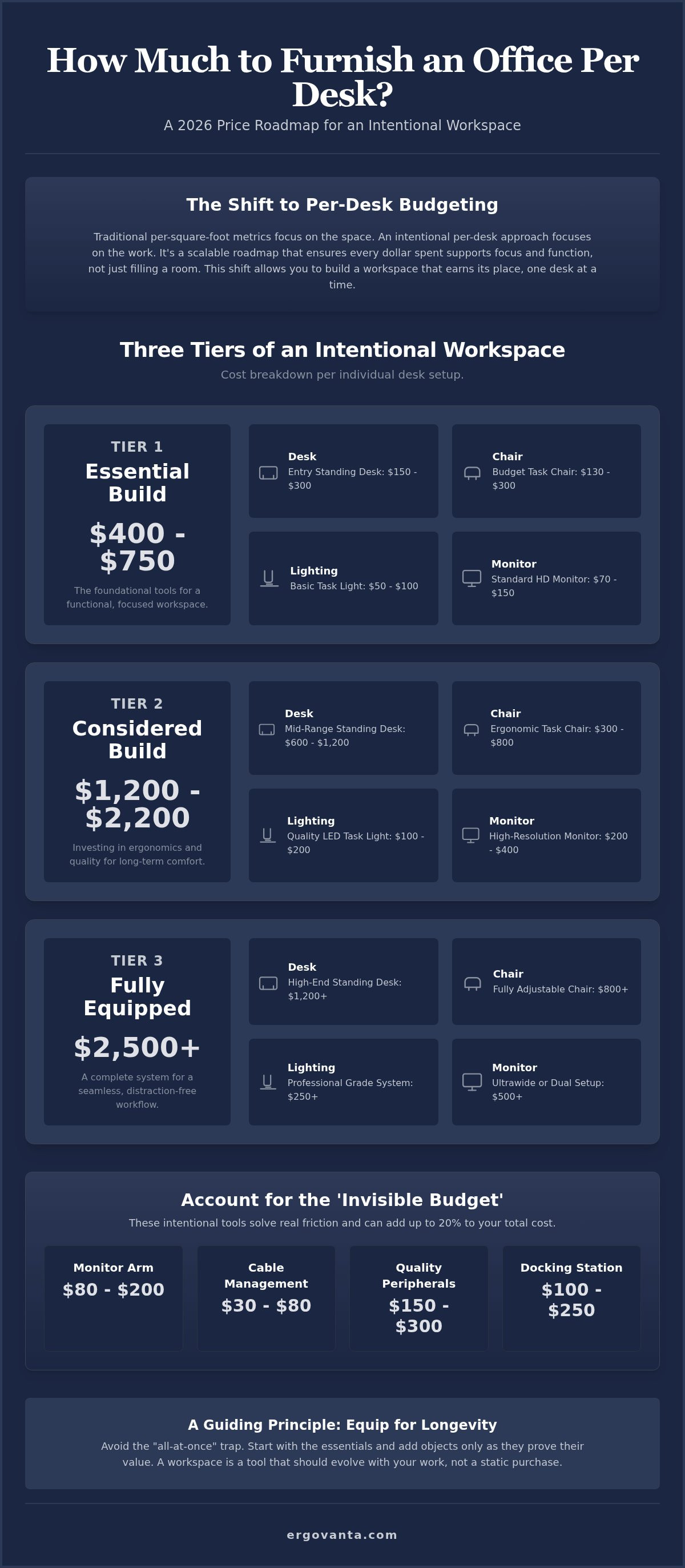
Three Tiers of Intentionality: From Essential to Fully Equipped
The workspace shapes the work. Equip it deliberately. When calculating how much does it cost to furnish an office per desk, you must decide how much utility you require from your surroundings. In 2026, a workstation is more than a place to sit; it is a system of tools that either supports your focus or creates friction. We categorize these setups into three tiers based on the intensity of your daily routine. These tiers aren't about signaling rank or buying into corporate status. They are about matching the equipment to the hours you spend in the seat.
The Essential Build: Just the Basics
For a budget of $800 to $1,200, you can secure a solid, functional start. This tier focuses on the two most critical interfaces: a reliable chair and a sturdy surface. At this price point, you prioritize function over aesthetics. You don't need a designer label to get a chair that supports your back; you need a chair that doesn't distract you with discomfort. A basic desk lamp and a fixed-height surface provide the foundation for a room that gets used without overspending on features that don't serve your immediate tasks. It is a no-nonsense approach for those who need a dedicated space that works.
The Considered Build: Adding Ergonomics
The middle tier, ranging from $1,500 to $2,500, is where most people find the highest value. This setup is for those who spend serious hours at a desk and need a space that adapts to their body. How much does it cost to furnish an office per desk at this level? The investment goes toward reclaimable desk real estate and movement.
- Integrated monitor arms allow you to position your screen at eye level, clearing the desktop for physical work.
- Upgrading to a standing desk encourages movement throughout the day, preventing the physical stagnation that kills focus.
- Selecting materials like solid wood ensures your surface will last for decades rather than years.
The Complete Build starts at $3,000 and includes full ergonomic integration. This tier is for high-performance setups where every object has earned its place. It might include triple monitor stands, specialized task lighting, and advanced cable management. While the Essential build gets you started, the Considered and Complete builds are made for the work. They provide a workspace you would choose to come back to every morning.
The Invisible Budget: Accounting for Ergonomics and Desktop Tools
The workspace shapes the work. Equip it deliberately. When you calculate how much does it cost to furnish an office per desk, the visible furniture is only part of the equation. Most budgets fail because they ignore the small objects that actually make a desk usable. These are the tools that bridge the gap between a room that looks like an office and a room that actually gets used. We recommend reserving at least 15 percent of your total spend for this "invisible budget." It covers the interfaces you touch and the systems that keep your space from becoming a cluttered distraction.
Ergonomic Accessories that Matter
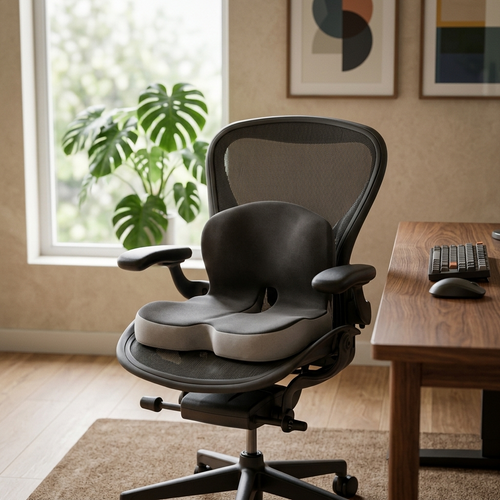
Ergonomics is often discussed in clinical, medical-device terms, but for the person doing the work, it is simply about how you feel after four hours at the screen. Static posture is the enemy of focus. Tools like monitor arms and laptop stands are not just for aesthetics; they are essential for neck comfort. By bringing your display to eye level, you eliminate the subtle, constant strain of looking down. Similarly, using lumbar pillows and foot rests provides the necessary support to keep your body engaged without fatigue. These small investments in your physical comfort prevent the long-term physical drain that turns a productive afternoon into a struggle.
Organizing the Workspace
Mental clutter follows physical clutter. A desk covered in tangled cords is a distraction you don't need. Cable management solutions, such as trays and clips, clear the visual noise and reclaim your desktop real estate. These objects earn their place by removing friction from your daily routine. Desktop tools that facilitate work, such as headphone stands, phone mounts, and wireless chargers, ensure your most-used items are accessible but out of the way. Building a space that stays organized without constant effort is the difference between a temporary setup and a workspace made for the work. Accounting for these details is vital when determining how much does it cost to furnish an office per desk in 2026.
By investing in tech integration and organizational tools early, you avoid the "death by a thousand cuts" that happens when you have to buy these items one by one later. These tools are the catalysts for focus. They ensure that when you sit down to work, the environment is already prepared to support you. Don't treat them as afterthoughts; treat them as the functional layer that makes your desk setup personal and effective.
Building Your Workspace: How to Equip for Longevity and Purpose
The workspace shapes the work. Equip it deliberately. When determining how much does it cost to furnish an office per desk, your primary focus should be on the work you actually perform. Most people fall into the trap of buying for a persona they think they should project rather than the tasks they complete every day. A workspace that feels like yours is built through intentionality and personal ownership. It is not about filling a room with furniture; it is about equipping a station with tools that stay functional long after the novelty of a new office wears off.
Avoid the "all-at-once" trap. There is a strong temptation to order an entire catalog of furniture the moment you move into a new space. Instead, start with the essentials: a reliable surface and a chair that supports your posture. Add objects only as they prove their value to your daily routine. This incremental approach ensures that every item on your desk has earned its place. It also helps you manage your cash flow, allowing you to invest in higher-quality components that offer a better total cost of ownership over time.
The Long-Term Value of Quality
"Cheap" furniture often costs more in replacements over a three-year period. While a budget desk might save you a few hundred dollars today, commercial-grade equipment is designed to last 10 to 20 years. Choosing timeless designs over trendy office fads prevents your space from feeling dated by next season. Think about your workspace as a room you would choose to come back to. Select materials that age well, such as wood or metal, which maintain their integrity through years of heavy use. This is the difference between an expense and an investment in your focus.
Taking the First Step
Assess your current space and identify the biggest friction points. Is it the glare from the window, the lack of lumbar support, or a desktop cluttered with charging cables? Set your per-desk budget based on the tiers we discussed, but leave room for the invisible budget of ergonomics. Understanding how much does it cost to furnish an office per desk requires accounting for the 10 to 20 percent in hidden costs for shipping and assembly that often surprise buyers in 2026. If you are ready to build a space made for the work, reach out to us for a considered workspace consultation.
Use this final checklist to ensure your budget sticks:
- Prioritize the chair and lighting first; these affect how you feel.
- Budget 15 percent for desktop tools like monitor arms and cable trays.
- Account for shipping and logistics averages for national US delivery.
- Choose materials based on durability and purpose, not just aesthetics.
Equip Your Space for the Work Ahead
The workspace shapes the work. Equip it deliberately. By shifting your perspective from square footage to the individual workstation, you ensure every dollar spent supports the person in the seat. Whether you are building an essential setup or a fully considered environment, knowing how much does it cost to furnish an office per desk is the foundation of a room that actually gets used. Most budgets fail when they ignore the invisible tools; those small objects like monitor arms and cable trays earn their place by removing daily friction.
Investing in quality materials ensures your tools stay functional for years, providing a true advantage in your daily routine. At Ergovanta, we focus on ERGO (purposeful function) and VANTA (advantage). Our products are catalysts for success, designed specifically for the people who do the work. It is time to move past standard office bundles and build a space that feels like yours.
Your space should be a personal sanctuary of productivity that reflects your dedication. Start with the work you do and build the environment around it. You deserve a workspace you'd choose to come back to every day.
Frequently Asked Questions
How much should I budget for an ergonomic office chair in 2026?
Budget between $300 and $800 for a mid-range chair that offers genuine support for your daily routine. While entry-level options exist for under $300, they often lack the durability required for eight-hour shifts. A considered investment in seating ensures you stay focused without the distraction of physical fatigue. If you want a setup that lasts, avoid budget models that require replacement every two years.
What is the average cost of a standing desk for a home office?
A reliable electric standing desk typically costs between $600 and $1,200 for a mid-range model in 2026. Entry-level versions are available for as low as $150, but these often sacrifice stability and motor longevity. Choosing a sturdy surface is vital for building a workspace you'd choose to come back to. Specialized models with custom wood finishes can easily exceed $2,000 depending on the materials.
Are ergonomic accessories worth the extra cost?
Yes, because these tools solve real friction points in your space. Small objects like monitor arms, laptop stands, and footrests earn their place by preventing neck strain and supporting your body during deep work. They bridge the gap between a room that looks like an office and a room that actually gets used. These accessories are the intentional layer that makes any workspace setup feel personal and functional.
Can I furnish a professional office for under $1,000 per desk?
You can build a functional setup for under $1,000 if you prioritize essentials and avoid status-driven corporate furniture. This budget tier typically covers a basic task chair, a fixed-height or entry-level standing desk, and minimal lighting. It is a solid start for anyone asking how much does it cost to furnish an office per desk while keeping the focus on utility rather than aesthetics or brand labels.
What are the hidden costs of furnishing an office?
Shipping, logistics, and assembly typically add 10 to 20 percent to your total project cost. You should also account for the "invisible budget" of cable management, power strips, and tech integration tools. Reserving a portion of your funds for these details prevents unexpected surprises when you finalize your per-desk roadmap. Most people overlook these costs until they reach the checkout screen, which can derail a strict budget.
How do I choose between a fixed-height and a standing desk?
Base your decision on how much movement your work requires throughout the day. Fixed-height desks are sturdy and cost-effective for shorter tasks; however, standing desks are better for long-term focus and physical comfort. If you spend serious hours at your desk, the ability to change positions is a tool for better output. A desk that moves with you is an investment in your ability to stay present.
Does lighting really affect my productivity at a desk?
Intentional lighting is essential for reducing eye strain and defining your zone of focus. Overhead lights are rarely enough for concentrated tasks; they often create glare that leads to mental fatigue. Investing in a quality desk lamp or monitor light bar is a small but critical part of determining how much does it cost to furnish an office per desk. Proper lighting ensures your room stays functional long after the sun goes down.
Disclaimer
Ergovanta publishes these guides to help people set up better workspaces. Product recommendations reflect what we sell. Specifications, prices and availability are accurate at the time of writing and may change. Nothing here is medical, ergonomic or professional advice; if you have a specific health concern about your workstation, speak to a qualified professional.
From the catalog