July 13, 2026
Minimalist Office Decor: Building a Workspace That Earns Its Place

The workspace shapes the work. Equip it deliberately. If you spend serious hours at a desk, the room around it matters more than you think. Many people mistake minimalist office decor for a sterile, empty desk; however, true minimalism is about intentionality. It is the practice of only keeping the objects that earn their place through utility and purpose.
You've likely experienced the frustration of a setup that looks good on camera but feels bad after three hours of deep work. Visual clutter causes mental friction, and buying items that lack utility only adds to the noise. Your space should be a tool, not a distraction. The goal is a workspace that supports the person doing the work without unnecessary friction.
This guide will show you how to build a workspace using minimalist principles that prioritize function and personal ownership. We will explore how to choose considered accessories, from lighting to monitor arms, that help you stay focused and comfortable. It's time to equip a room that finally feels like yours.
Key Takeaways
- Redefine minimalist office decor as a strategy for focus, ensuring every object in your space serves a specific purpose for the work.
- Learn how to use considered lighting and monitor bars to reduce visual friction and create clear boundaries for deep work sessions.
- Equip your desk with ergonomic tools like monitor arms that support your physical comfort without adding unnecessary bulk to your environment.
- Add organic energy to your room using faux plants and intentional accents that provide visual rest without the maintenance of traditional decor.
- Build a workspace that feels like yours by choosing small objects that earn their place through utility and personal ownership.
The Intentional Workspace: Defining Minimalist Office Decor
The workspace shapes the work. Equip it deliberately. If you spend serious hours at a desk, the environment around it functions as a tool. Minimalism in this context is not a color palette or a commitment to white walls; it is a strategy for reducing friction. By removing the non-essential, you clear the path for focus. When your surroundings are quiet, your mind can be loud.
Every object must earn its place. This rule ensures that your desk isn't a graveyard for items that look good in a photo but fail in practice. A successful minimalist office decor strategy prioritizes pieces that provide a functional or emotional advantage. Moving beyond the "white box" means introducing texture. Natural wood, cold metal, and soft felt define a space without cluttering the visual field. These materials provide sensory cues that tell your brain it's time to start.
To see how these principles look in a real-world environment, watch this setup tour:
Why Intentionality Beats Aesthetics
Avoid the trap of buying desk trinkets that end up in a drawer after two weeks. Build for the eight-hour workday. The rooms that get used are the ones where every item has a job. If a lamp doesn't light your task or a stand doesn't save your neck, it doesn't belong. Focus on utility first. A workspace that functions well will naturally develop its own honest look.
Ownership of Your Space
Your workspace is a personal environment for doing the work. It shouldn't look like a corporate catalog or a trend-chasing blog. Choosing objects that reflect personal discipline rather than fleeting styles creates a sense of ownership. When you equip your space with considered decor, you're building a setting that supports your best efforts. It's about creating a place you'd actually choose to come back to every morning.
Functional Foundations: Equipping Your Desk for Work
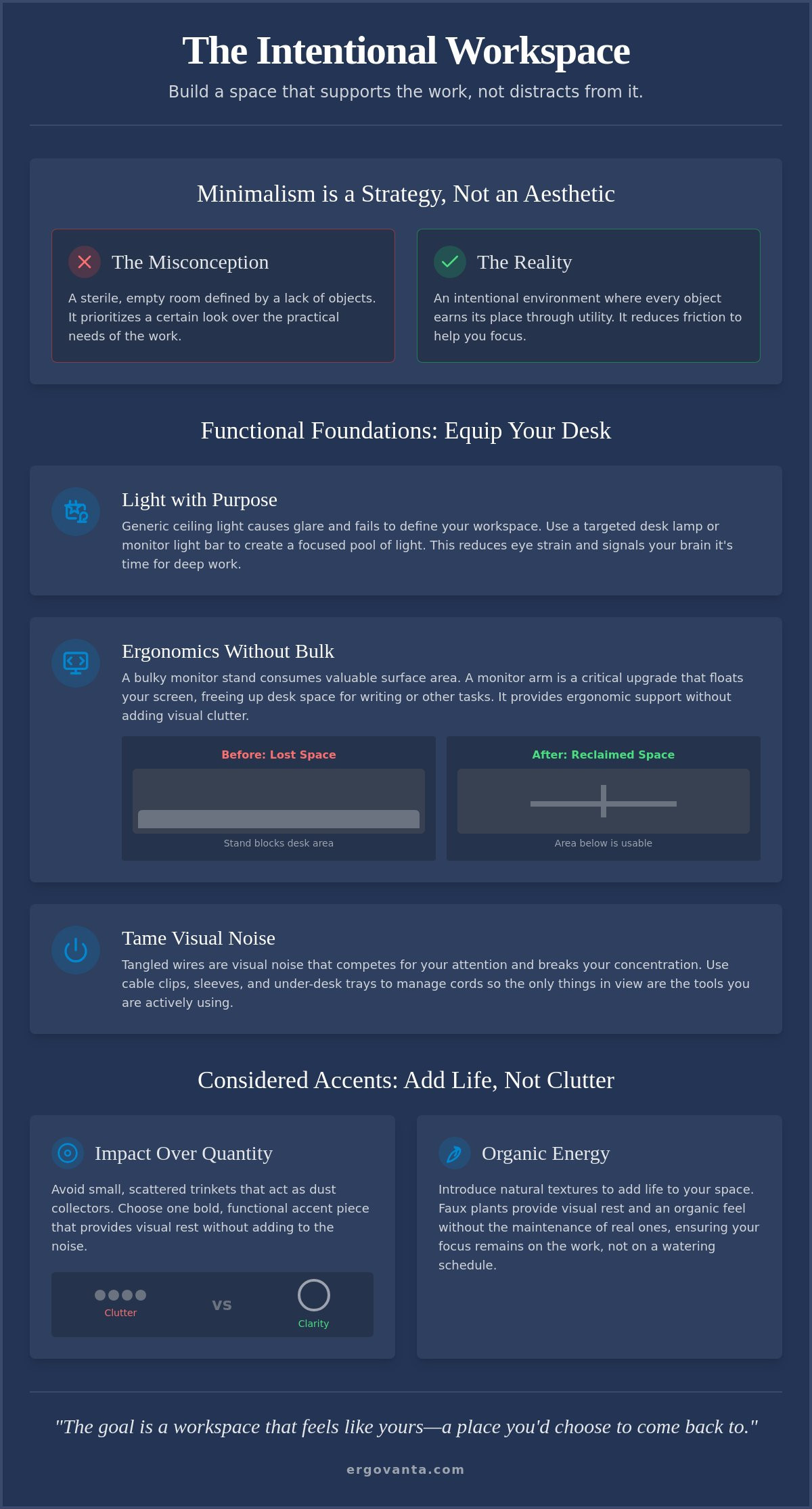
A desk is a tool for production. If the surface is crowded with cheap plastic gadgets and tangled wires, your focus will suffer. True minimalist office decor integrates function into the design rather than treating it as an afterthought. Understanding the science behind a minimalist workspace reveals that visual clutter competes for your attention. By choosing tools that serve multiple purposes, you reduce the mental friction required to start your day.
Lighting for Purposeful Function
Lighting is a tool for focus, not just a fixture. Layering your light is the most effective way to define your work zones. While ceiling lights provide general visibility, a targeted desk lamp creates a pool of light that signals your brain it's time for deep work. Monitor light bars are particularly effective because they provide glare-free illumination without taking up any desk real estate. Explore our considered lighting collection to find tools that help define your workspace.
Ergonomic Tools That Earn Their Place
Ergonomics and minimalism belong together. A monitor arm is a vital minimalist upgrade because it replaces a bulky plastic stand with a slim, adjustable arm that floats your screen. This creates usable space underneath for your keyboard or notebook. Laptop stands follow the same logic, improving your posture while keeping the device footprint small. Equip your desk with ergonomic essentials made for the work to keep your body supported without the visual bulk.
Cable management is the invisible foundation of a clean desk. Wires are visual noise that can break your concentration. Use clips and trays to tuck them away so the only things in your line of sight are the tools you're actually using. Finally, a desk mat acts as a physical boundary for your work zone. It protects your surfaces and provides a consistent texture for your mouse. If you need help choosing the right foundations for your setup, you can reach out to us for guidance.
Considered Accents: Adding Life Without the Clutter
Accents in minimalist office decor should never be dust collectors. If an object doesn't provide visual rest or a functional advantage, it is just noise. Choosing one bold accent piece over five small trinkets keeps the visual field clean. This approach ensures your workspace remains a tool for focus rather than a gallery of distractions. Every addition to your desk must be intentional.
Low-Friction Greenery
Organic shapes soften the hard lines of tech and desks. While real plants are a popular choice, they often become a source of friction for anyone who spends serious hours at a desk. Faux plants are the logical choice. They offer the psychological benefits of nature without the watering schedule or the risk of dead leaves. Selecting the right scale is vital; a single, well-placed floor plant or a small desk accent can define a corner without crowding it. Browse low-maintenance greenery for your office to add life to the room without adding to your to-do list.
Small Objects That Matter
Every item on your desk should earn its place. Vases can serve as functional art, holding essential tools or standing alone as a structural element. Similarly, tech accessories like headphone stands and wireless chargers should be chosen for how they blend into the environment. When these items are designed well, they act as decor while serving a clear purpose. You can find the small objects that earn their place in our collection of considered items.
Maintaining a minimalist office decor setup requires a daily ritual. A five-minute reset at the end of every session prevents the slow creep of papers and coffee mugs. Clear the surface, reset your tools, and wipe down the desk. This discipline ensures that when you return, you are entering a room made for the work. Intentionality is a practice, not a one-time purchase. Build a space you would choose to come back to.
Equip Your Space for the Work Ahead
Building a workspace is a practice of constant selection. You've seen that minimalist office decor is not a commitment to an empty desk; it is a strategy for intentionality. It is about removing the friction that prevents deep focus. By prioritizing lighting that defines your zones and ergonomic tools that support your physical comfort, you create an environment that functions as a tool for production. Every item in your room should have a job to do.
We believe in the philosophy of Ergo: purposeful function in action. This means choosing considered designs that earn their place through utility rather than corporate trends. Whether it is a monitor arm that clears your desk or a faux plant that adds organic shape, these objects provide a Vanta, or advantage, to your daily routine. When your surroundings are quiet and organized, your mind has the space it needs to think.
Stop settling for a setup that looks good on camera but feels bad after three hours of use. Build the workspace you would choose to come back to and shop Ergovanta. We create tools for the people who do the work. Your next intentional session starts here.
Frequently Asked Questions
How do I start a minimalist office from scratch?
Start by removing every object from your room until you are left with a blank slate. Equip your desk only with the tools required for your specific daily tasks. It is easier to build from zero than to edit down a cluttered room. Focus on the foundations first, such as lighting and ergonomics, before considering any accents. This intentional approach ensures that every piece of minimalist office decor in your new space has earned its place through utility.
What are the essential items for a minimalist desk?
The essentials are the tools that reduce physical and mental friction during your session. You need a reliable task lamp or monitor light bar to reduce eye strain and define your focus zone. A monitor arm or laptop stand is vital for maintaining posture and reclaiming desk real estate. Finally, include a cable management system to hide visual noise. These small objects earn their place by supporting the work you do without adding unnecessary bulk.
Can a minimalist office still feel personal?
A minimalist workspace feels personal when it reflects your own discipline rather than a corporate trend. Use texture and material, like a felt desk mat or a solid wood lamp, to add warmth to the room. Choose one bold accent, such as a single vase or a faux plant, instead of several small trinkets that collect dust. Ownership comes from selecting items that you actually use and value. It should be a space you would choose to come back to.
How does minimalist decor improve productivity?
Minimalist office decor improves productivity by lowering cognitive load and reducing visual distractions. Every non-essential object on your desk acts as a micro-distraction that competes for your attention. By removing the noise, you create a clearer path for deep work. A decluttered environment is documented to reduce stress and help you maintain focus for longer periods. When your space is made for the work, you spend less energy managing your surroundings and more energy on the task at hand.
From the catalog