August 11, 2026
Wall Lights: Building Functional Infrastructure for Your Space

Article by
George
George is the founder of Ergovanta. He spent years on Wall Street, first as an investment banker and then as a private equity investor. The work took him into the home and corporate offices of other bankers, private equity investors, venture capitalists, hedge fund managers, and Fortune 500 executives across a wide range of industries. The longer he spent in those workspaces, the clearer the pattern got: the rooms people actually wanted to return to were never the biggest or the best funded. They were the ones built on purpose. Ergovanta turns that into pieces anyone can put in their own room, whatever the work is. He works out of New York City, mostly on lighting and the small objects that decide whether a desk gets used.
The workspace shapes the work. Equip it deliberately. Most people treat illumination as a decorative flourish, but the right light is actually functional infrastructure. If you find yourself squinting at a screen or pushing aside a bulky lamp base just to find your notebook, your setup is working against you. Incorporating wall lights into your room isn't just about aesthetics; it's about reclaiming the surface area you need to do the work. By moving your light source to the wall, you clear the physical and mental clutter that stalls a productive session.
It's exhausting to fight against a space that wasn't built for your specific habits. You need an environment that supports your focus rather than draining it through eye strain and crowded desks. This article will teach you how to select and position wall lights that serve your work and the rooms you actually use. We'll explore the choice between hardwired and plug-in power sources, explain vertical lighting types, and help you build a workspace that feels intentional and functional.
Key Takeaways
- Reclaim your desk surface by treating lighting as vertical infrastructure that clears the way for actual work.
- Distinguish between the ambient glow of sconces and the focused utility of directional wall lights made for specific tasks.
- Evaluate the trade-offs between the permanent, cord-free look of hardwired fixtures and the immediate, renter-friendly flexibility of plug-in models.
- Learn the specific placement rules to avoid glare and ensure your lighting supports your eyes during long hours at the desk.
- Build a workspace with intentional objects that earn their place through daily utility and personal ownership.
Why Wall Lights are Essential Infrastructure for Your Space
The workspace shapes the work. Equip it deliberately. Most people view lighting as a finishing touch or a decorative choice, but it's actually foundational infrastructure. Wall lights are fixtures mounted to vertical surfaces designed to provide either ambient glow or task-specific illumination. By moving the light source off the desk and onto the wall, you reclaim the horizontal surface area needed for your keyboard, notebooks, and coffee. This isn't just about tidying up; it's about building a space where the physical environment doesn't get in the way of your output.
Vertical lighting also solves the "cave effect" that plagues many home offices. When light is only directed downward from a ceiling or a desk lamp, the corners of the room remain dark, making the space feel cramped and heavy. Mounting lights on the wall allows illumination to bounce off the vertical surfaces, opening up the room and making it feel functional. These considered choices aren't just for show; they reduce the eye fatigue that sets in during long hours at a desk by providing a consistent, balanced environment.
The Workspace Shapes the Work
Equipping your space deliberately means thinking about how you move within it. Vertical lighting creates layers of light that a single desk lamp cannot achieve on its own. When you install wall lights, you're essentially zoning your room. A light positioned over a side chair or flanking a monitor defines what that area is for, whether it's deep focus or a brief break. This layering is essential in multi-use rooms where the same four walls serve as an office, a gym, or a place to wind down. It allows the room to change its purpose without you having to move a single piece of furniture.
Moving Beyond the Desk Lamp
Relying solely on a desk lamp creates high-contrast zones and harsh shadows. Your eyes constantly adjust as they move from the bright pool of light on your desk to the darkness of the rest of the room. This constant recalibration is what leads to that end-of-day headache. A balanced ergonomic setup uses wall lights to fill the gaps. Historically, the Sconce (light fixture) was the primary tool for distributing light across a room without sacrificing floor space. Today, the logic remains the same. Clearing the clutter of heavy lamp bases and tangled cords from your desk doesn't just look better; it improves your mental focus. When the small objects on your desk earn their place, the work has room to breathe.
Choosing Between Sconces and Directional Task Lighting
Decide what the room needs to do. Lighting is a tool; it should earn its place based on the activity it supports. Choosing between a sconce and a directional task light depends entirely on whether you are building an atmosphere or providing focus for a specific task. Not all wall lights are built for the same job. Understanding core lighting design principles helps you layer these options so your space remains functional throughout the day.
The Purpose of Sconces
Sconces are built for diffusion. They typically throw light against the wall or ceiling to create a soft, ambient layer that fills the room without being overbearing. These are ideal for hallways, entryways, or as secondary light sources in a studio where you don't want harsh shadows. When selecting a sconce, focus on minimalist designs that blend into the background. You want the light to be felt, but you don't want the fixture to be a distraction. Explore the range of wall lights that prioritize clean lines and simple utility to ensure they fit your existing setup without adding visual noise.
Directional Lighting for Focus
Directional task lights are made for the work. These fixtures often feature adjustable arms or swiveling heads, allowing you to equip your desk or reading nook with light exactly where it's required. If you spend hours on detailed crafts, technical drawing, or simply reading, a directional spotlight is non-negotiable. Beyond the desk, these are also useful for highlighting intentional decor pieces or bookshelves. By controlling the beam, you reduce glare on your screens and focus your attention where it belongs.
The material of your fixture dictates how the light behaves. Consider how these common choices impact your space:
- Metal: Opaque shades that concentrate light into a sharp, purposeful beam. These are best for task-heavy zones.
- Glass: Translucent materials that allow light to bleed through, providing softer ambient illumination for the whole room.
If you're building a space for deep focus, stick to metal. If you're equipping a room for general use, glass is the intentional choice. If you have questions about which material fits your room's specific needs, ask us for a recommendation.
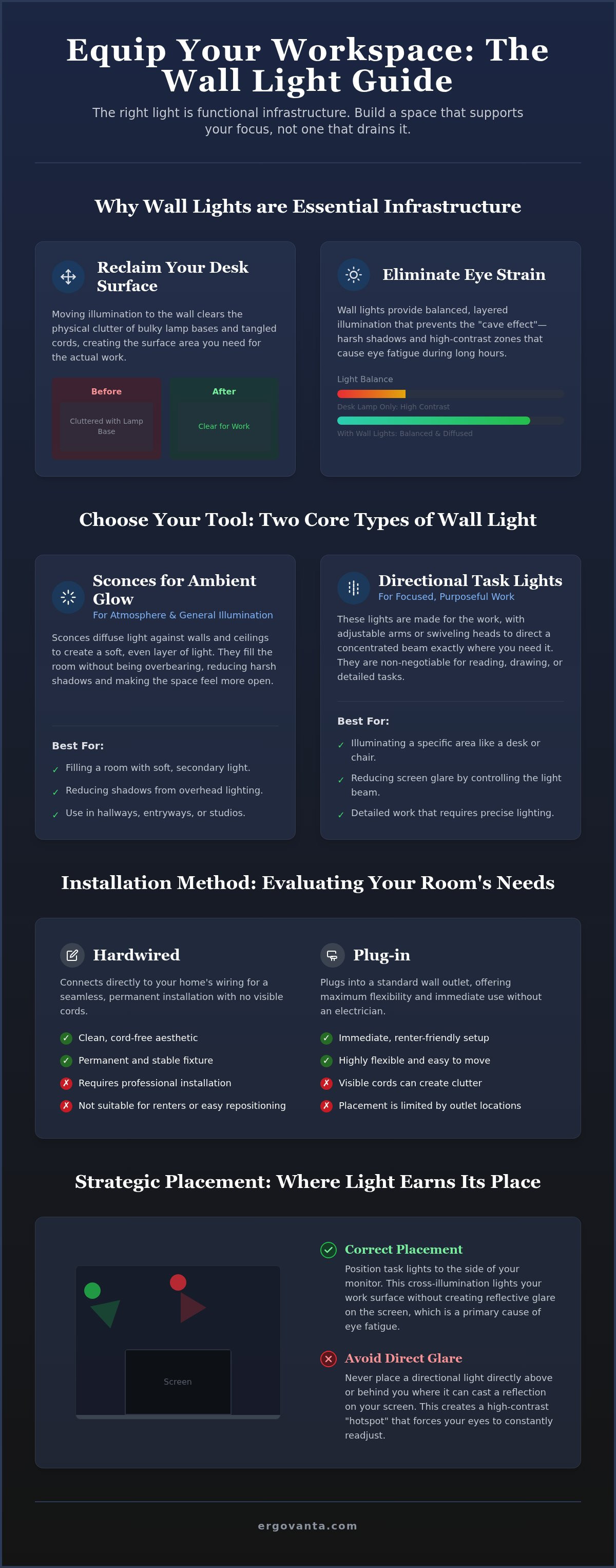
Hardwired vs. Plug-in: Evaluating Installation for Your Room
The way you power your space is as much a part of the design as the light itself. When selecting wall lights, the choice between hardwired and plug-in models usually comes down to your living situation and how permanent you want your setup to be. It's a decision between the seamless look of built-in infrastructure and the immediate, flexible utility of a mobile fixture. Both have their place; the key is choosing the one that earns its spot in your specific environment.
Don't be distracted by solar options you might see in generic hardware aisles. Solar wall lights are built for outdoor utility and rarely provide the consistent, high-quality light required for a workspace. For the room where you actually do the work, stick to AC power sources that you can rely on regardless of the weather or the time of day.
The Case for Hardwired Fixtures
Hardwired lights are the choice for permanent spaces. Because they connect directly to your home's electrical system, they offer a clean, cord-free look that makes the lighting feel like an integral part of the room's architecture. This setup increases the perceived value of the space by treating lighting as essential infrastructure rather than a temporary add-on. It's a considered approach that removes visual clutter from your walls.
This path requires more planning. You'll need to hire a professional electrician to ensure the installation meets safety codes and that the switches are positioned where you actually need them. If you're building a dedicated home office that you plan to use for years, the investment in professional installation pays off in a streamlined, organized environment that supports long-term focus. You can find a range of models suitable for permanent installation in our wall lights collection.
The Flexibility of Plug-in Lights
Plug-in lights are made for the work as it happens now. They are the ideal solution for renters who want to equip their space without losing a security deposit or for those who like to rearrange their desk every few months. These fixtures mount to the wall with simple screws or brackets and plug into any standard outlet. You get the benefit of vertical lighting without the commitment of cutting into the drywall.
Ownership of your space doesn't require a mortgage. You can still maintain a considered, intentional aesthetic with plug-in models by using cord covers or cable management clips. This keeps the lines clean and ensures the cord doesn't become another piece of desk clutter. Plug-in options allow your workspace to evolve alongside your habits, giving you the freedom to move your light source whenever your workflow changes.
Strategic Placement: Where Light Earns Its Place
A light in the wrong location is just a glowing distraction. To build a workspace that actually functions, you must consider how the beam interacts with your tools and your eyes. Placement is where the intentionality of your design meets the reality of your work habits. If a fixture causes glare on your screen or casts a shadow over your notebook, it hasn't earned its place on your wall. Positioning wall lights correctly ensures they provide utility without becoming an obstacle.
The general rule for comfort is to place lights near eye level when you are in your primary working position. This prevents the bulb from shining directly into your peripheral vision, which is a common source of fatigue. In transition areas like hallways, spacing is equally vital. You want a steady path of light rather than a series of bright spots followed by dark gaps. Aim for a consistent rhythm that guides you through the room without requiring your eyes to constantly adjust to changing light levels.
Lighting the Modern Workspace
Reflections are the enemy of focus. When equipping your desk area, avoid placing lights directly behind your monitor. This creates a high-contrast halo that strains your eyes as they struggle to balance the bright screen against the backlit wall. Instead, position your wall lights to the side of your primary seating area. This provides ample task light for reading and writing while keeping the screen clear of veiling reflections.
Consider your digital presence as well. Many professionals forget that video calls require specific lighting to avoid looking like a silhouette in a dark room. Using a wall light to gently illuminate the area behind you or to provide soft side-lighting can make your workspace feel more professional during remote meetings. You can find fixtures designed for these specific ergonomic needs in our lighting collection. By choosing the right spot, you ensure your equipment supports the work instead of complicating it.
Placement Rules for Living Areas
In the rooms you use for winding down, the rules change slightly to favor atmosphere and comfort. For bedside lighting, the fixture should be low enough to allow for comfortable reading but high enough that you don't hit your head when sitting up. A considered placement allows you to stay focused on your book without disturbing a partner. For general living areas, the standard height for mounting a sconce is usually 60 to 66 inches from the floor, though you should adjust this based on your ceiling height and the scale of your furniture.
- Corridors: Space multiple fixtures at least 6 feet apart to maintain an even flow of light.
- Seating Areas: Align the bottom of the shade with your shoulder height when seated for the best task illumination.
- Small Rooms: Use single lights in corners to push the boundaries of the space outward.
Equipping Your Space: The Ergovanta Approach to Lighting
The workspace shapes the work. Equip it deliberately. At Ergovanta, we operate on a simple thesis: every object in your room must earn its place through purposeful function. We don't view wall lights as decorative accessories or room jewelry. Instead, we see them as essential tools for the people who do the work. When you move your lighting to the vertical plane, you aren't just clearing a desk; you're making a conscious decision about how your environment supports your focus. Every fixture in our catalog is considered for its impact on your daily routine, ensuring that your space works as hard as you do.
Our name reflects this commitment to utility. Derived from the Ancient Greek "ergon," meaning purposeful function, and "vanta," representing the advantage a well-built environment provides, Ergovanta is built for intentionality. We want to help you build a space you actually want to come back to every morning. This requires moving away from generic corporate identity and toward a setup that feels personal and functional.
Intentional Selection over Mass Consumption
We prioritize minimalist and modernist styles because they strip away the distractions that stall a productive session. A considered workspace doesn't need clutter; it needs clarity. Our selection focuses on materials like metal and glass that stand the test of time and serve specific lighting needs. Metal shades provide the opaque structure required to direct light exactly where your task demands, while glass allows for a soft, diffused glow that fills the room without causing strain. To see how other professionals are equipping their rooms, you can browse our best sellers for fixtures that have proven their utility in real-world setups.
Take Ownership of Your Environment
Your space is a reflection of how you choose to spend your hours. Whether you are a creator, a freelancer, or a hybrid worker, your environment should support your specific version of productivity. Taking ownership means choosing tools that fit your habits rather than trying to fit yourself into a standardized office mold. Building a functional infrastructure with wall lights is a step toward creating a sanctuary of focus that belongs to you.
Workspaces are not all the same, and they should not feel like everyone else's. If you are unsure which power source or fixture style fits your current workflow, contact us for guidance on building your space. We are here to help you equip an environment that is intentional, personal, and made for the work.
Build a Space Made for the Work
The workspace shapes the work. Equip it deliberately. By treating wall lights as essential infrastructure rather than mere decor, you reclaim the surface area needed for deep focus. Whether you choose the clean lines of a hardwired fixture or the immediate flexibility of a plug-in model, you take ownership of your environment. You now understand how to layer ambient sconces with directional task lighting to eliminate eye strain and screen glare.
Our curated selection is made for the people who do the work. We focus on no-nonsense functional design for high-use rooms, providing the tools you need to build a space you choose to come back to. If you're ready to move beyond cluttered desks and poor lighting, we offer peer-to-peer expert advice to help you get it right.
Take the time to consider your room's specific needs. Every intentional choice brings you closer to a workspace that feels personal and functional.
Frequently Asked Questions
What is the difference between a wall sconce and a wall light?
A wall sconce is a specific type of fixture that typically provides diffused, ambient light by throwing it against the wall or ceiling. Wall lights serve as the broader category, encompassing everything from decorative sconces to directional task lamps with adjustable arms. Choose a sconce when you want to build a soft atmosphere and a directional light when you need to equip a workspace for focus.
How high should I mount my wall lights in a home office?
Position your lights at eye level based on your primary working posture. For a seated desk, this often means mounting the fixture lower than the standard 60 to 66 inches used in hallways. The goal is to avoid direct glare in your peripheral vision while ensuring the beam hits your work surface. Test the height with a temporary adhesive before committing to a permanent installation.
Can I install a wall light without an electrician?
You can install plug-in wall lights without professional help. These models mount to the wall with simple hardware and connect to a standard outlet. They are the intentional choice for renters or those who want to build their workspace quickly. Hardwired fixtures, however, require an electrician to ensure your home remains safe and meets local building codes.
Are LED wall lights better for a workspace than traditional bulbs?
LED options are superior for a workspace because they produce minimal heat and offer precise color temperatures. Traditional bulbs can make a small office feel uncomfortably warm during long hours. Modern LEDs allow you to equip your room with cool, daylight-balanced tones that reduce eye strain and support clarity. They are a considered choice for any environment made for the work.
How many wall lights do I need for a standard-sized room?
Use two fixtures for a standard-sized room to create balanced, symmetrical illumination. If you are zoning a multi-use space, a single directional light may be enough to define a reading nook or desk area. Avoid over-equipping the room; the goal is to provide enough light to work without creating a cluttered, over-lit environment that feels clinical.
Do wall lights provide enough light for a whole room?
Wall lights are typically designed to provide supplemental task or ambient layers rather than serving as the sole light source. In a large room, you should pair them with ceiling fixtures or floor lamps to build a complete lighting plan. However, in small studios or narrow corridors, a few well-placed sconces can provide enough illumination to make the space functional.
Can I use outdoor wall lights inside my house?
You can use outdoor-rated fixtures inside, but they are often built with a rugged, industrial aesthetic that may not suit a considered workspace. Outdoor models are designed to withstand moisture and debris, making them bulkier than interior wall lights. Stick to indoor fixtures to ensure the materials and scale are appropriate for a room where you spend serious hours at a desk.
What is the best way to hide cords for a plug-in wall light?
Use cord covers or paintable cable channels to maintain an organized, intentional look. These small objects earn their place by hiding visual clutter and keeping the lines of your room clean. You can also use clear adhesive clips to guide the cord along the edge of your desk or baseboards. A considered cable management strategy ensures your plug-in light looks like a permanent part of your infrastructure.
Disclaimer
Ergovanta publishes these guides to help people set up better workspaces. Product recommendations reflect what we sell. Specifications, prices and availability are accurate at the time of writing and may change. Nothing here is medical, ergonomic or professional advice; if you have a specific health concern about your workstation, speak to a qualified professional.
From the catalog